

Shen Ruoxi — International Product Sales Executive
 Home / Author / Shen Ruoxi — International Product Sales Executive / How a High-Performance Velvet Bath Mat Combines Comfort, Safety, and Efficient Textile Manufacturing
 2026.11.15
 Shen Ruoxi — International Product Sales Executive
In modern homes, a bath mat is expected to do much more than cover the floor beside a shower or bathtub. It must absorb water quickly, provide a secure step, feel comfortable under bare feet, remain attractive after repeated washing, and fit naturally into different rooms. For hospitality buyers, retailers, interior designers, and private-label distributors, it must also offer dependable quality, consistent production, flexible sizing, and a supply partner capable of meeting commercial requirements.
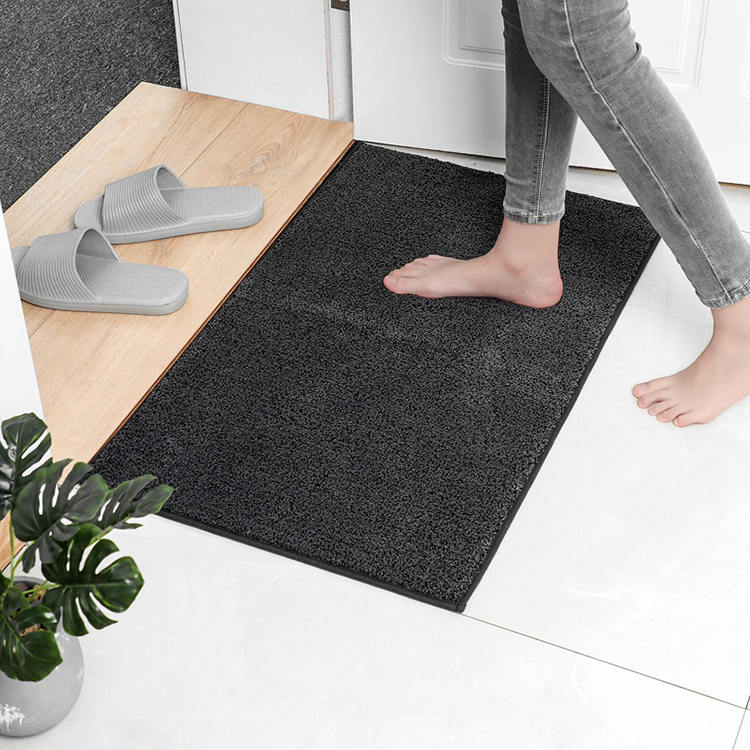
The Polaris Velvet Bath Mat has been developed to address these needs through a combination of dense polyester microfiber, a plush 20 mm pile, a 1650 gsm construction, and a strong thermoplastic rubber backing. Available in 40 × 60 cm, 50 × 80 cm, and 60 × 90 cm formats, as well as customized dimensions, it is designed for bathrooms, kitchens, children’s rooms, entrances, and other indoor spaces.
This article examines the product’s construction, practical benefits, competitive advantages, care performance, customization possibilities, and the manufacturing capabilities behind it. It also explains why an integrated textile supplier can offer greater consistency and efficiency than a supplier that relies entirely on fragmented third-party production.
Content
Bathrooms have become important design spaces rather than purely functional areas. Homeowners increasingly select flooring accessories according to color, texture, safety, maintenance requirements, and overall interior style. A bath mat therefore needs to support a complete user experience: stepping out of the shower should feel soft and stable, water should be removed from the feet quickly, and the mat should remain easy to clean.
Traditional lightweight mats may satisfy one requirement but fail in another. A thin product may dry quickly but provide limited cushioning. A highly absorbent mat may become heavy and difficult to launder. A decorative mat may look attractive but slide across smooth ceramic or stone flooring. Products with weak backing can curl, shed, or lose their shape after repeated use.
The Polaris Velvet Bath Mat takes a more balanced approach. Its polyester microfiber surface provides softness and water absorption, while the dense 1650 gsm weight contributes to a substantial hand feel. The 20 mm pile creates a cushioned contact surface, and the TPR backing helps reduce movement on the floor. These features are designed to function together rather than as isolated specifications.
This balanced construction is useful for both residential and commercial markets. In a home, it supports daily comfort and convenient laundering. In a guesthouse, serviced apartment, rental property, or hotel bathroom, it offers a practical combination of appearance, safety, and repeat-use durability. For retailers, its neutral rectangular format and solid-color presentation make it suitable for a broad range of customers.
The product is a rectangular indoor bath mat made primarily from polyester microfiber. Its standard dimensions are 40 × 60 cm, 50 × 80 cm, and 60 × 90 cm, with custom sizes available for specific projects or market requirements. The standard formats can serve different placement needs, from compact powder rooms to larger bathrooms requiring greater floor coverage.
| Specification | Details | Practical Significance |
|---|---|---|
| Product type | Velvet bath mat | Designed for softness, water absorption, and comfortable standing |
| Available sizes | 40 × 60 cm, 50 × 80 cm, 60 × 90 cm, or customized | Supports different room layouts and purchasing programs |
| Primary material | Polyester microfiber | Offers durability, softness, color retention, and easy care |
| Weight | 1650 gsm | Creates a dense, substantial construction and plush hand feel |
| Pile height | 20 mm | Adds cushioning and comfort beneath bare feet |
| Construction | Bonded | Supports structural stability and long-term use |
| Backing | TPR | Helps reduce shifting and skidding on smooth indoor floors |
| Shape | Rectangular | Fits common bathroom, kitchen, and entryway arrangements |
| Pattern | Solid color | Coordinates easily with a variety of interior styles |
| Care | Machine washable | Allows convenient routine cleaning |
| Recommended use | Indoor spaces, bathrooms, kitchens, and children’s rooms | Suitable for multiple household applications |
| Special features | Softness, water absorption, washability, and non-slip performance | Combines comfort, maintenance, and functional safety |
Specifications alone do not determine the quality of a bath mat, but they provide an important starting point. The value of this model lies in how these specifications work together. A substantial gsm weight without an appropriate backing could create a mat that feels heavy but moves easily. A tall pile without durable fibers could flatten quickly. A non-slip backing without a comfortable surface would address safety but not user comfort. The product is designed as a coordinated system.
The surface is made from 100% polyester microfiber. Polyester is widely used in home textiles because it offers a useful combination of strength, dimensional stability, color retention, and resistance to ordinary household wear. Microfiber construction allows the material to create a soft, fine-textured surface that feels comfortable against bare feet.
Compared with coarse or low-density synthetic fibers, microfiber can provide a smoother contact experience. This is particularly valuable in a bath mat, because the user often steps onto it immediately after bathing or showering. The surface should feel warm and pleasant rather than rough, stiff, or abrasive.
Polyester also supports practical ownership. It is less prone to absorbing and retaining moisture in the same manner as some natural fibers, allowing the mat to be cleaned and dried more conveniently when proper care instructions are followed. The material is also recognized for good fade resistance, helping solid colors remain visually attractive over time.
For wholesale buyers, the material offers another advantage: consistency. Synthetic fibers can be produced in controlled specifications, allowing manufacturers to manage yarn characteristics, density, color, and finishing processes more reliably. This helps reduce variation between production batches and supports repeat orders.
The phrase “velvet” in this product context refers to the soft, plush surface effect created by the fine microfiber construction and pile. It is not simply a decorative label. The tactile quality is a central part of the product’s purpose. A well-finished velvet-style mat should combine a smooth touch with sufficient resilience so that the fibers recover after ordinary foot traffic.
GSM means grams per square meter and is commonly used to indicate the weight or density of textile products. At 1650 gsm, this bath mat is designed to provide a more substantial feel than lightweight floor mats. It has enough material presence to feel stable and cushioned while still remaining suitable for routine washing and indoor handling.
A higher textile weight can contribute to several perceived and functional benefits. First, it gives the mat a fuller hand feel. The user is less likely to experience direct contact with a hard floor, particularly when standing at a sink or stepping out of a shower. Second, the additional material can support the development of a dense, absorbent surface. Third, the mat can appear more premium on retail shelves and in finished interior installations.
However, weight must be considered together with construction and drying performance. A very heavy mat with poor fiber arrangement may retain excessive moisture or become difficult to launder. The product’s microfiber surface, bonded construction, and machine-washable design are intended to create a practical balance between plushness and usability.
For comparison, extremely thin mats often prioritize low price and compact shipping volume. They may be suitable for temporary use, but they typically offer less cushioning and a less luxurious appearance. The 1650 gsm format positions this product toward buyers who want a more comfortable and substantial bath mat without moving to a complicated or high-maintenance material.
Pile height describes the approximate height of the textile surface above its foundation. A 20 mm pile gives the bath mat a noticeably plush profile. When a user steps onto the mat, the pile compresses slightly under pressure, creating a cushioned sensation that can make routine bathroom activities more comfortable.
The pile also contributes to visual volume. A flat or very short surface may look functional but lack the inviting appearance associated with a soft home textile. The raised velvet surface gives the mat a richer texture and can help create a warmer, more comfortable atmosphere in bathrooms and other indoor areas.
Comfort is especially relevant for households where people spend time standing at a vanity, applying makeup, grooming, washing children, or assisting older family members. A cushioned floor covering can make these activities feel less tiring than standing directly on hard flooring.
At the same time, pile height must be engineered carefully. If the fibers are too loose, they may flatten or shed. If the pile is too dense without appropriate backing, the mat may become difficult to clean. The combination of polyester microfiber, bonded construction, and a strong base is intended to support resilience while maintaining the soft surface effect.
The 20 mm height also helps distinguish the product from basic printed or thin cut-pile mats. It provides a tangible difference that consumers can feel immediately, which is useful for retail merchandising and showroom presentation.
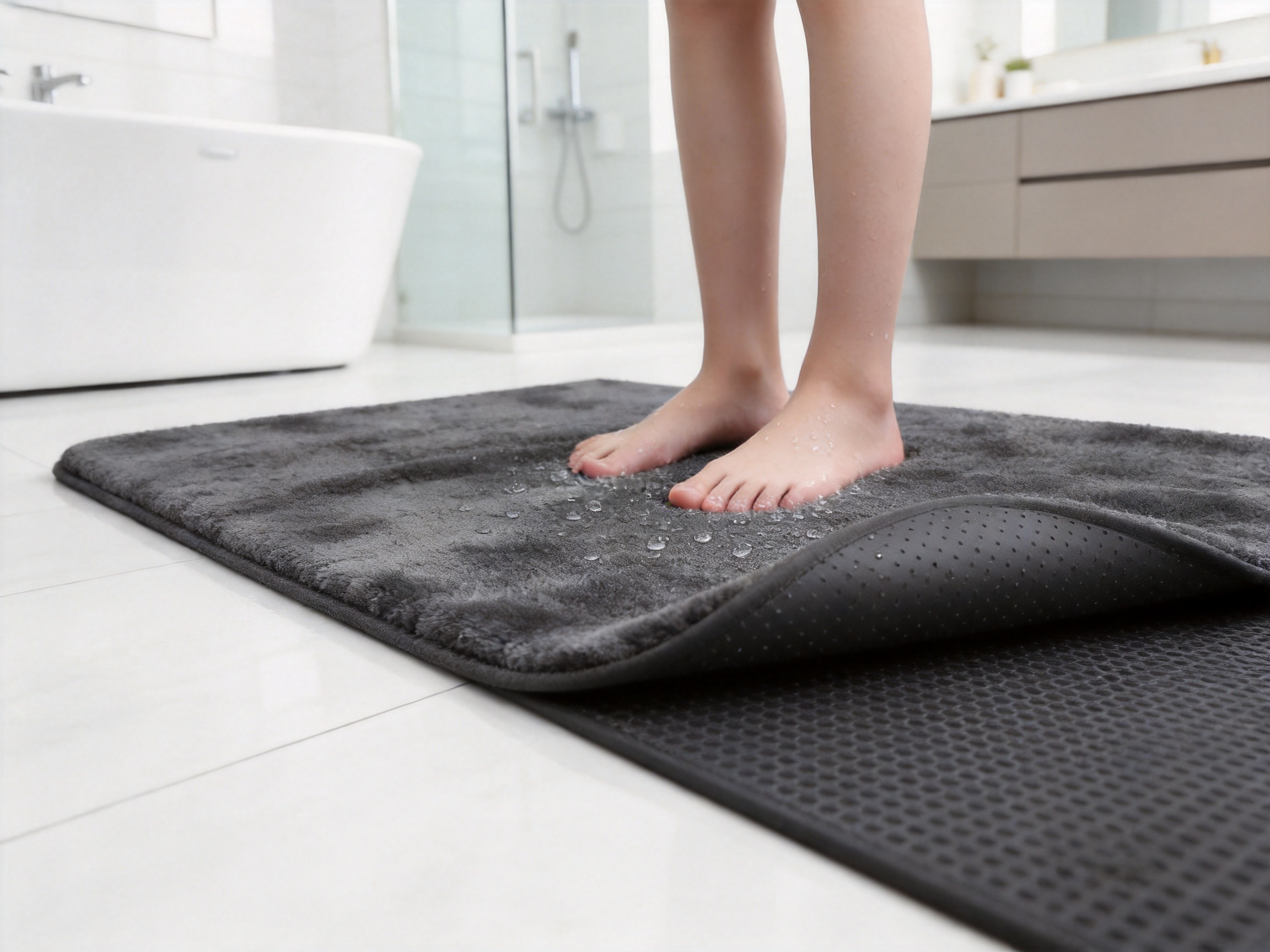
Water absorption is one of the most important functions of a bath mat. After bathing, wet feet can create a slipping risk on ceramic tile, polished stone, vinyl, or other smooth surfaces. A mat that draws moisture away from the feet helps keep the immediate standing area more comfortable and reduces the amount of water transferred to the floor.
The soft microfiber layer is designed to absorb water from wet feet rather than leaving moisture sitting visibly on the surface. The fine fibers create a large contact area, helping the mat capture water during the first step. This is particularly useful in busy households where several people may use the same bathroom during the day.
Good moisture management also affects the appearance of the mat. A surface that holds water in an uneven way may develop noticeable wet patches or remain damp for long periods. A properly constructed microfiber surface can distribute moisture through the textile structure, supporting more even drying when the mat is hung or placed in a well-ventilated area.
It is important to understand that no bath mat eliminates all moisture-related concerns. Users should still provide adequate ventilation and avoid leaving a saturated mat folded or pressed against a wet floor for extended periods. Regular washing and appropriate drying are essential for hygienic maintenance.
For commercial buyers, water absorption is a central product feature because it affects user satisfaction and floor maintenance. A bath mat that manages moisture effectively can support a cleaner appearance around sinks, bathtubs, and showers. It may also reduce the need for repeated wiping in residential and hospitality settings.
The backing material is thermoplastic rubber, commonly referred to as TPR. The backing is designed to help prevent shifting and skidding when the mat is placed on a smooth indoor floor. This is particularly important in bathrooms, where water and bare feet can increase the risk associated with unstable floor textiles.
A secure backing contributes to confidence. When a person steps onto a mat, the product should remain close to its original position rather than sliding away under pressure. This is valuable for children, older adults, and anyone who needs a stable surface after bathing.
TPR can also support flexibility. Unlike some rigid or brittle backing materials, a suitable rubber-based backing can allow the mat to remain pliable during handling, washing, and storage. This helps the product lie flat when placed correctly.
Non-slip performance depends on more than the backing material alone. The floor must be clean, dry, and suitable for use with a rubber-backed mat. The mat should not be placed over another loose floor covering, and users should follow normal safety practices. The backing helps reduce movement; it should not be interpreted as a guarantee against slipping in every condition.
Compared with mats that use no backing or a weak textile-only base, a TPR-backed design offers a meaningful functional advantage. It makes the product better suited to polished ceramic, stone, laminate, and other smooth indoor floors commonly found in residential and commercial interiors.
Polaris Velvet Bath Mat
The bath mat uses a bonded construction type. Bonding is important because a floor mat must hold its surface, foundation, and backing together during repeated foot traffic, folding, washing, drying, and handling. A weakly connected structure may separate at the edges, develop distortion, or lose its original feel over time.
A well-controlled bonding process supports dimensional integrity. The rectangular shape should remain recognizable, the surface should stay attached to its foundation, and the backing should continue to perform as intended. This is particularly important for wholesale programs where buyers expect repeat orders to maintain comparable quality.
Construction quality also affects the product’s presentation. A mat with a clean edge, even surface, and stable backing appears more premium than one with curling corners, uneven thickness, or visible separation. In retail environments, these details influence customer perception before the product is even touched.
Bonded construction must be balanced with wash care. Excessive heat, harsh chemicals, or unsuitable washing conditions can damage textile products regardless of their original construction quality. For that reason, the recommended care process uses cold water, mild detergent, no chlorine or bleach, low-speed tumble drying, or hanging to dry.
For buyers comparing products, it is useful to evaluate the relationship between surface density, backing quality, edge finishing, and bonding. Looking only at pile height or color can overlook the structural features that determine whether a bath mat remains useful after months of service.
Bath mats are exposed to water, soap residue, dust, hair, and ordinary bathroom traffic. A product that cannot be cleaned easily may quickly lose its appeal. Machine washability makes routine maintenance more convenient and supports better household hygiene.
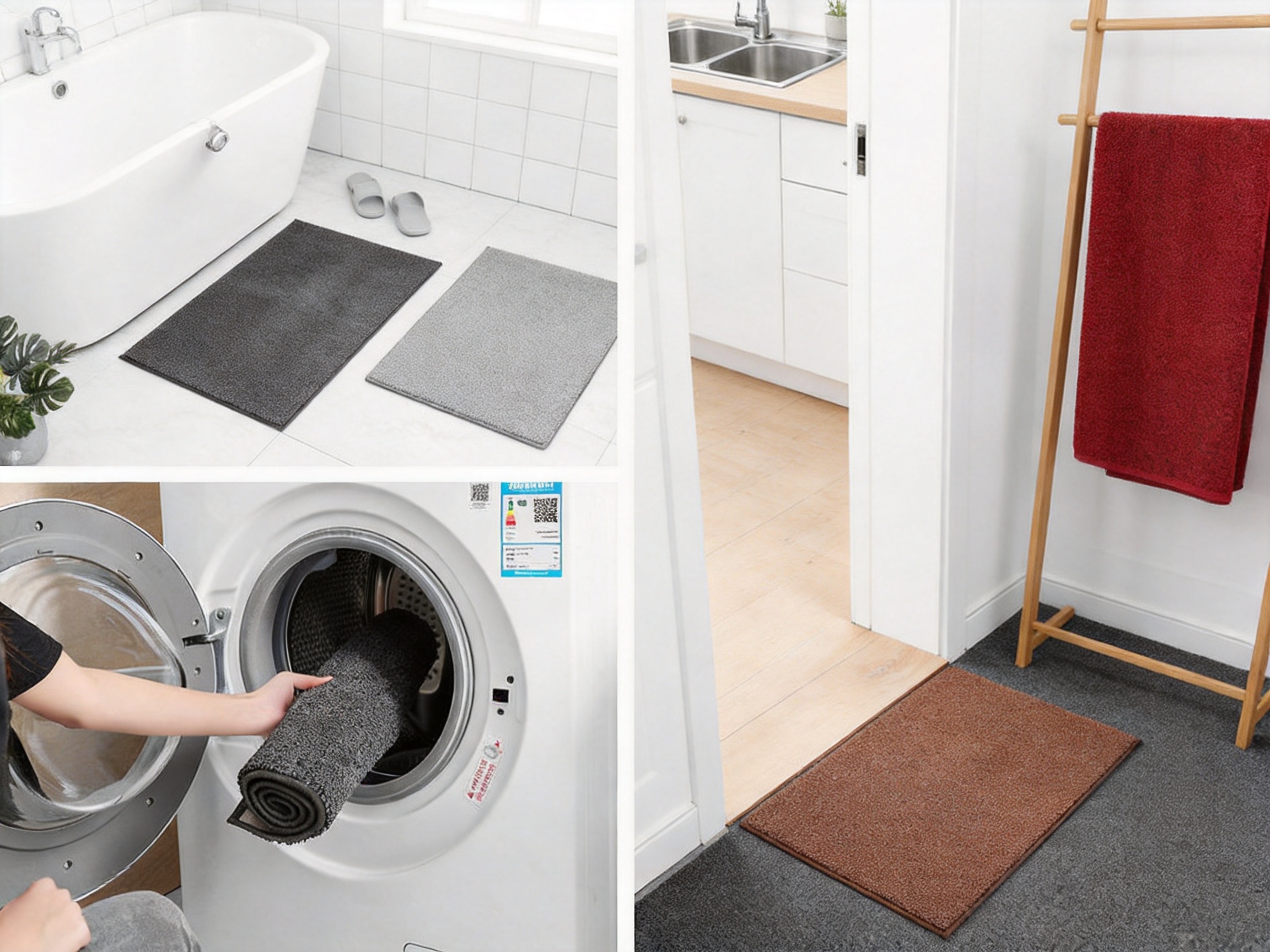
The recommended care method is to machine wash with cold water and a mild detergent. Chlorine and bleach should be avoided because aggressive chemicals may affect color, fibers, or backing performance. After washing, the mat can be tumble dried at a low speed or hung to dry.
Cold-water washing has several practical benefits. It can help reduce unnecessary energy consumption, limit stress on synthetic fibers, and support color preservation. Mild detergent is generally sufficient for normal household soil. Overuse of strong chemicals is not necessary for everyday maintenance and may shorten the product’s useful life.
Low-speed tumble drying offers convenience when time is limited, while hanging provides a gentler drying option. The mat should be fully dry before being returned to the floor. Drying the underside as well as the surface is important, especially when the bathroom has limited ventilation.
Washability is also a competitive advantage over delicate decorative mats that require specialist cleaning. Consumers increasingly look for products that can fit easily into existing household routines. A washable bath mat reduces maintenance friction and makes it more practical to keep the bathroom environment fresh.
For commercial applications, care instructions should be incorporated into housekeeping procedures. Operators can establish regular washing schedules, inspect the TPR backing, and replace mats when they show signs of excessive wear. Clear maintenance practices help protect the investment and maintain a consistent guest experience.
The product is available in solid colors rather than a fixed complex pattern. This design approach allows the mat to coordinate with many interior styles, including contemporary, minimalist, Scandinavian, traditional, and family-oriented bathroom designs.
Solid colors can also simplify purchasing decisions. Retailers can build a coordinated color assortment without managing multiple complicated patterns. Interior designers can select shades that complement wall tile, cabinetry, towels, shower curtains, and flooring. Hospitality buyers can use neutral or brand-compatible color programs across multiple rooms.
A simple surface design places greater emphasis on texture. The plush velvet effect becomes the main visual feature, allowing the product to look refined without relying on elaborate graphics. This can give the mat a more timeless appearance and reduce the likelihood that the design will look dated as interior trends change.
Color consistency is especially important for wholesale programs. Buyers should expect clear production specifications and controlled dyeing processes to reduce variation between batches. An integrated textile manufacturer can coordinate yarn, dyeing, finishing, and final product inspection more effectively than a fragmented supply chain.
Although categorized as a bath mat, the product is suitable for more than one location. Its water absorption and non-slip features make it a natural choice for bathrooms, but its soft surface and rectangular format also support use in kitchens, children’s rooms, laundry areas, vanity spaces, and other indoor settings.
In a kitchen, it can be placed near a sink or food-preparation area where users stand for extended periods. The cushioned surface can make standing more comfortable, while the washable construction helps manage occasional splashes and household dirt.
In a children’s room or family bathroom, the soft pile creates a comfortable surface for bare feet. The non-slip backing can help reduce unwanted movement, although the floor should always be kept clean and the mat should be checked regularly for proper flatness.
At an indoor entrance, the mat can provide a soft transition surface, provided the location is not exposed to excessive outdoor moisture or abrasive dirt. The product is designed for indoor use, so it should not be treated as a heavy-duty outdoor doormat.
This multi-room usability can make the product attractive for retailers. One product line can be displayed in several home-textile categories, increasing merchandising flexibility. It can also support bundle sales with towels, shower curtains, cushions, blankets, and other coordinated textile products.
The three standard sizes address common household requirements. The 40 × 60 cm option is suitable for smaller spaces, compact bathrooms, and areas in front of a toilet or vanity. The 50 × 80 cm option provides a balanced middle format for many residential bathrooms. The 60 × 90 cm option offers broader coverage near a shower, bathtub, or larger vanity area.
Custom sizing provides additional flexibility for projects with non-standard floor plans. A developer, hotel group, retailer, or private-label customer may require dimensions that correspond to a particular bathroom layout, display program, or packaging format. Custom production can help buyers create a closer fit rather than forcing every application into a standard size.
Custom dimensions should be planned together with pile, edging, backing, packaging, and minimum order requirements. A professional manufacturer can review the proposed size and advise on production feasibility, shipping efficiency, and recommended care labeling.
Size customization is a significant advantage over mass-market products that are available only in a few fixed formats. It allows distributors to serve regional preferences and helps commercial customers standardize their installations. It can also support private-label product development, where the bath mat is part of a broader collection.
When selecting a size, buyers should leave enough clearance for doors, drawers, toilet bases, and other fixtures. The mat should lie flat without creating an obstruction. In a wet area, the product should also be positioned so that its surface can dry effectively between uses.
The competitive position of this bath mat comes from the combination of features rather than from one isolated specification. Many low-cost mats offer only a thin synthetic layer. Others may have a soft surface but lack a stable backing. Some decorative products prioritize appearance while providing limited washing flexibility.
The 1650 gsm weight gives this model a fuller and more substantial feel than many lightweight alternatives. The 20 mm pile adds cushioning and tactile softness. Polyester microfiber supports a smooth surface, water absorption, color retention, and practical maintenance. TPR backing improves floor stability. Bonded construction supports overall integrity. Machine washability reduces the burden of routine care.
These features create a stronger value proposition for buyers who want a product positioned above basic entry-level mats but still suitable for everyday use. The result is a bath mat that can be marketed through comfort, safety, hygiene, durability, and design compatibility at the same time.
Another competitive advantage is product adaptability. Standard sizes support immediate purchasing, while custom dimensions support project-based requirements. Solid colors simplify coordination, and indoor multi-room use broadens the potential customer base.
For wholesale customers, manufacturing capability is equally important. A product may have attractive specifications, but inconsistent quality, uncertain lead times, or limited customization can create problems. An experienced textile supplier with control over weaving, dyeing, printing, and finished-product processing can provide a more dependable foundation for long-term business.
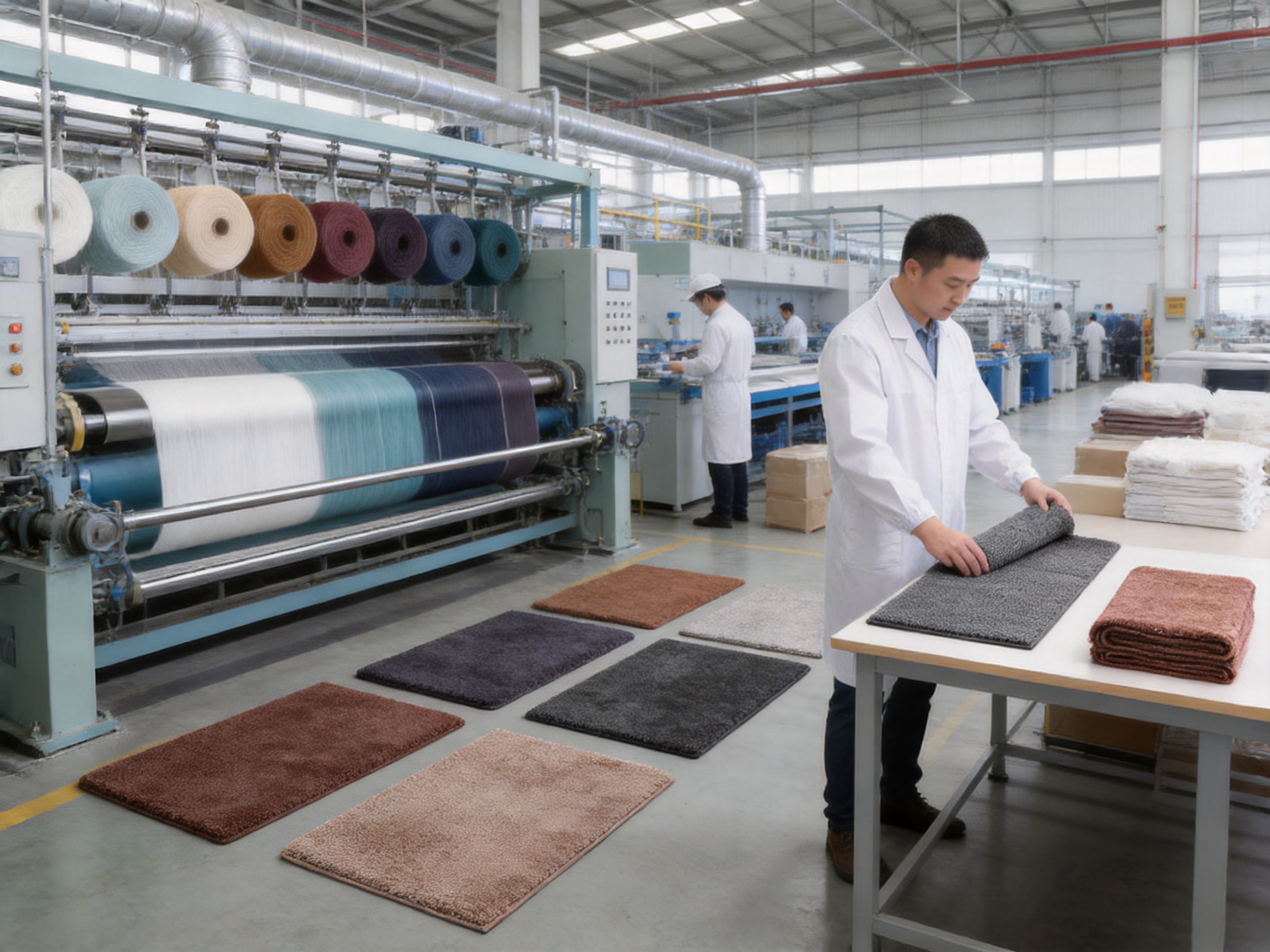
Zhejiang Benyi Textile Technology Co., Ltd. is located in Shaoxing, Zhejiang Province, a region widely recognized for its textile production resources. The company specializes in carpets, rug fabrics, and finished carpet products, with capabilities covering multiple stages of the production chain.
According to the supplied company information, the business operates its own weaving and dyeing or printing factories as well as finished carpet processing facilities. This integrated structure allows it to coordinate surface materials, color development, backing, finishing, and final assembly more directly.
Vertical integration can provide several advantages. It reduces dependence on unrelated subcontractors and allows production teams to communicate more quickly when specifications change. It also helps improve traceability because material and processing information can be connected across stages rather than being managed through disconnected suppliers.
Control over the production chain can support more consistent quality. Textile products are affected by yarn selection, weaving or forming conditions, dye concentration, finishing temperature, bonding, cutting, edging, and packaging. When these processes are coordinated within one manufacturing network, the supplier has greater opportunity to identify and correct variations.
Integrated production can also improve lead-time management. A supplier that controls key stages may be able to schedule materials and finished-product processing more efficiently than a trading company that must coordinate several independent factories. This is valuable for seasonal product launches, retail promotions, hospitality projects, and repeat wholesale programs.
The company also reports a team of more than 20 fabric engineers. A dedicated technical team can contribute to new product development, surface experimentation, color work, construction improvements, and customer-specific solutions. For buyers seeking more than a standard catalog item, engineering support can be an important part of supplier selection.
Textile markets change quickly. Consumers may seek softer textures, more sustainable fibers, new color palettes, improved wash performance, or different room applications. Manufacturers that invest in product development are better positioned to respond to these changes.
The company reports developing new carpet fabrics each quarter based on market trends. This indicates an ongoing development approach rather than reliance on a static product catalog. Regular development can create opportunities for buyers to introduce updated collections, seasonal colors, and differentiated constructions.
For a bath mat such as this one, innovation may involve adjusting microfiber fineness, pile density, surface height, backing composition, edge finishing, or color range. It may also involve developing custom formats for specific market segments. Each adjustment should be assessed for comfort, absorbency, washability, production stability, and cost.
Product development is most effective when it combines design awareness with manufacturing knowledge. A visually attractive sample is not enough if it cannot be produced consistently or withstand normal use. A textile engineering team can help translate a concept into a repeatable construction with defined specifications.
Buyers should discuss intended use, target price, sales channel, packaging, order volume, and performance expectations early in the development process. This allows the supplier to recommend materials and processes that match the commercial purpose of the product.
Environmental performance is becoming increasingly important across the home-textile industry. Buyers are examining fiber sources, dyeing methods, water consumption, production waste, packaging, and product longevity. A durable, washable product can support more responsible ownership by remaining useful over an extended period, but manufacturing practices also matter.
The company describes ecological and environmental protection as part of its textile technology focus. It reports investment in sustainable materials and production methods, including recycled polyester and water-saving dyeing techniques. These approaches can help address resource use and the environmental impact associated with textile manufacturing.
Recycled polyester can make use of existing polymer resources rather than relying exclusively on new raw materials. The suitability of recycled content depends on the requested product specification, supply availability, color requirements, and certification needs. Buyers should confirm the precise material composition and documentation for each order.
Water-saving dyeing technologies are relevant because coloration can be a resource-intensive stage in textile production. Improving dye uptake, process control, and water reuse can reduce consumption while supporting more consistent shades. Such improvements are particularly valuable for suppliers producing multiple colors and recurring collections.
The company also reports having passed OEKO-TEX and Global Recycled Standard certifications. Certification status should always be verified against the specific facility, product, material, and current certificate scope. Nevertheless, recognized certifications can provide useful evidence that defined requirements have been addressed within the applicable production system.
Sustainability should also be evaluated through product life. A bath mat that maintains its surface, color, shape, and backing after repeated care may reduce the frequency of replacement. Buyers can support better outcomes by selecting suitable specifications, communicating accurate care instructions, avoiding unnecessary over-packaging, and planning efficient shipping quantities.
Quality control begins before the finished mat reaches the packing line. Fiber and yarn characteristics influence surface softness, color, strength, and absorption. During weaving or surface formation, production teams must monitor density, tension, and consistency. Dyeing and finishing require control of shade, hand feel, and dimensional stability.
After the surface is prepared, bonding and backing application become critical. The TPR layer should be distributed consistently, with no significant gaps, contamination, or weak areas. The bond between the surface and backing should be inspected for separation. Edges should be clean and secure, and the rectangular shape should remain within agreed tolerances.
Finished-product inspection can include visual checks, dimensional measurement, surface evaluation, backing inspection, color comparison, packaging review, and sampling for wash performance. The precise inspection plan should reflect the customer’s requirements and the intended sales channel.
For wholesale customers, quality documentation can help support internal approvals and market compliance. A supplier should be able to discuss material composition, care labeling, packaging specifications, inspection standards, and any applicable testing or certification requirements.
Quality control is not merely a final inspection activity. It is a chain of decisions. If the wrong yarn is selected, later finishing cannot fully correct the problem. If color control is weak during dyeing, a finished inspection may identify variation but cannot eliminate the cost of reprocessing. Integrated manufacturing allows quality teams to address issues closer to their source.
Bath mats are relatively compact textile products, but their plush pile and rubber backing require careful handling during storage and shipping. Excessive compression can affect the surface appearance temporarily, while unsuitable packing conditions may trap moisture. Packaging should protect the product while supporting efficient logistics.
Buyers should define whether the product will be packed individually, bundled by size, or prepared for retail display. Private-label programs may require woven labels, printed care instructions, barcode stickers, color cards, or customized cartons. These details should be agreed before production begins.
Standard sizes can simplify stock planning. A retailer may carry one compact size, one medium size, and one larger size to cover different customer needs. A hospitality buyer may standardize one or two sizes across a property group. Custom dimensions can be reserved for projects where a precise fit creates sufficient value.
Lead time depends on raw material availability, color approvals, production volume, customization, packaging, and inspection requirements. Buyers should communicate projected annual demand where possible. This allows the manufacturer to plan materials and reduce unexpected delays during peak seasons.
For international shipments, customers should confirm carton dimensions, gross and net weights, labeling rules, import requirements, and documentation. These logistical details do not change the bath mat’s performance, but they influence total landed cost and the smoothness of the purchasing process.
To obtain the best performance, place the mat on a clean, smooth, and dry indoor floor. Confirm that the mat lies flat and that doors or drawers do not catch on its pile or edges. Do not place it over another loose rug or on a floor contaminated with oil, soap, or excessive moisture.
Shake or vacuum the surface periodically to remove loose dust and hair. For routine washing, use cold water and a mild detergent. Avoid chlorine and bleach. Use a low-speed tumble-dry setting or hang the mat to dry. Ensure that both the surface and backing are fully dry before returning the mat to the floor.
Inspect the backing occasionally. If it becomes cracked, detached, excessively worn, or unable to remain stable, the mat should be replaced. Even a high-quality non-slip product requires normal maintenance and should not be treated as a substitute for safe flooring practices.
In commercial environments, establish a cleaning cycle appropriate to traffic levels. High-use bathrooms may require more frequent washing than private residential bathrooms. Store clean mats in a dry, ventilated area and avoid placing heavy objects on them for long periods.
Homeowners should begin with room dimensions and the location of the shower, bathtub, toilet, and vanity. The 40 × 60 cm size may suit a compact area, while the 50 × 80 cm or 60 × 90 cm sizes may provide greater coverage. Consider the floor material, ventilation, laundry facilities, and preferred color.
Retailers can position the product as a soft, washable, non-slip bath mat with a premium-weight construction. A three-size assortment can serve different budgets and room layouts without creating excessive complexity. Solid colors make it easier to create coordinated displays and replenish popular shades.
Hotels, guesthouses, serviced apartments, and spas should evaluate absorbency, washing frequency, drying procedures, replacement cycles, and size consistency. A supplier capable of repeat production and custom labeling may be preferable for multi-property programs.
Design professionals can use the solid-color format as a quiet complement to tile, stone, wood-effect flooring, and cabinetry. Custom dimensions may help address bathrooms with unusual layouts. Early coordination with the manufacturer is recommended when exact colors, sizes, or packaging are required.
Private-label customers should discuss target positioning, color range, labels, packaging, certifications, minimum order quantities, and inspection requirements. The product’s combination of standard availability and customization can support both initial launches and future collection expansion.
Shaoxing has a deep textile ecosystem that includes raw materials, machinery, dyeing, weaving, finishing, logistics, and technical services. Operating in such a region can give a textile company access to specialized knowledge and production resources. However, geographic location alone does not guarantee quality; the supplier’s internal capabilities and management systems remain essential.
Zhejiang Benyi Textile Technology Co., Ltd. combines textile development with finished carpet and rug processing. Its stated ability to manage weaving, dyeing or printing, and finished-product manufacturing provides a foundation for more direct control. The company’s focus on carpet fabrics and finished products also aligns closely with the technical requirements of bath mats and related home-textile categories.
The company’s broader product scope includes area rugs, prayer mats, kitchen mats, door mats, carpet fabrics, blankets, and sofa cushions. This category experience may be useful to buyers seeking coordinated home-textile collections from one source. A supplier that understands several related products can help customers develop consistent colors, textures, packaging, and merchandising concepts.
Its stated commitment to customer customization is also relevant. Buyers increasingly want products adapted to regional tastes, floor plans, retail formats, and brand identities. Customization requires communication, sampling, technical review, and controlled production. A supplier with in-house engineers and multiple manufacturing stages is better positioned to manage this process.
The main material is 100% polyester microfiber. This material is selected for its soft touch, durability, color retention, and practical care performance.
The standard sizes are 40 × 60 cm, 50 × 80 cm, and 60 × 90 cm. Custom dimensions can also be discussed for specific projects and purchasing programs.
Yes. It is designed for indoor use and can also be used in kitchens, children’s rooms, vanity areas, laundry spaces, and other suitable indoor locations.
Yes. It uses a TPR backing intended to help reduce shifting and skidding on smooth indoor floors. The floor should be clean and dry, and normal safety precautions should still be followed.
The pile height is approximately 20 mm. This creates a plush, cushioned surface beneath bare feet.
GSM means grams per square meter. A 1650 gsm construction indicates a dense and substantial textile weight, contributing to a fuller hand feel and a more premium surface.
Yes. It is machine washable. Cold water and mild detergent are recommended, while chlorine and bleach should be avoided. It can be tumble dried at low speed or hung to dry.
Solid colors are generally easy to coordinate with tile, flooring, towels, cabinetry, and other bathroom accessories. Specific color availability should be confirmed for each order.
Its absorbent surface, washable construction, non-slip backing, and available size range make it suitable for consideration in hotels, guesthouses, serviced apartments, and similar indoor environments. Commercial buyers should confirm laundering procedures and volume requirements before ordering.
Yes. Custom sizes are available subject to technical review, production requirements, and order conditions. Buyers should provide drawings or exact dimensions where possible.
The supplier reports control over weaving, dyeing or printing, and finished carpet processing, supported by a team of more than 20 fabric engineers. This integrated structure can help coordinate materials, color, construction, quality, and lead time.
The company reports investment in recycled polyester, water-saving dyeing methods, and environmental initiatives. Customers should confirm the exact material composition and certification scope required for a particular order.
It may be tumble dried at low speed or hung to dry. The mat should be completely dry, including the backing, before being placed back on the floor.
Its main differentiating features include a 1650 gsm weight, 20 mm pile, soft polyester microfiber surface, TPR backing, bonded construction, water absorption, and machine washability. Together, these features provide a more substantial combination of comfort, safety, and convenience.
The Polaris Velvet Bath Mat is designed as a balanced home-textile product rather than a single-purpose decorative accessory. Its 100% polyester microfiber surface provides a soft velvet feel, while the 1650 gsm weight and 20 mm pile create a comfortable and substantial underfoot experience. Water absorption supports practical bathroom use, and the TPR backing helps reduce unwanted movement on smooth indoor floors.
Machine washability, solid colors, rectangular sizing, and indoor versatility make the product easy to position across residential, retail, hospitality, and private-label channels. The availability of three standard sizes, together with custom dimensions, adds flexibility for different rooms and commercial requirements.
The product’s advantages are strengthened by the supplier’s manufacturing structure. Zhejiang Benyi Textile Technology Co., Ltd. reports control over weaving, dyeing or printing, and finished-product processing, supported by fabric engineers and ongoing product development. Its attention to ecological production, recycled polyester, water-saving dyeing, and certification initiatives also reflects the changing expectations of the textile market.
For buyers comparing bath mats, the most important consideration is not one isolated feature but the relationship between material, density, pile, backing, construction, care, and manufacturing consistency. This product brings those elements together in a format that is comfortable, washable, adaptable, and suitable for broad indoor use.
1. Product specification sheet for the Polaris Velvet Bath Mat, including dimensions, material, gsm weight, pile height, backing, care instructions, and applications.
2. Textile industry guidance on grams per square meter, pile construction, microfiber performance, and floor-covering durability.
3. General home-textile care recommendations for polyester microfiber products and rubber-backed floor mats.
4. Company-provided information concerning Zhejiang Benyi Textile Technology Co., Ltd., its textile production facilities, engineering team, product development, and finished-product capabilities.
5. General principles of responsible textile production, including recycled polyester, water-saving dyeing, product longevity, and certification management.

ADD: No.75 Zhenyuan Road, Yuecheng District, Shaoxing City, Zhejiang Province, China 312000

Tel : +86-189 6750 9795

FAX : +86-0575-8803 2773

Email : fisher@benetextile.com

Copyright © Zhejiang Benyi Textile Technology Co., Ltd. All Rights Reserved. Carpets and Rugs Manufacturer

 English
 Français
 Deutsch
 عربى