

Qiao Yunting — Senior Carpet Sales Manager
 Home / Author / Qiao Yunting — Senior Carpet Sales Manager / Cake Velvet Solid Dyed Fabric: A High-Performance Textile for Carpets, Rugs, and Bath Mats
 2026.10.10
 Qiao Yunting — Senior Carpet Sales Manager
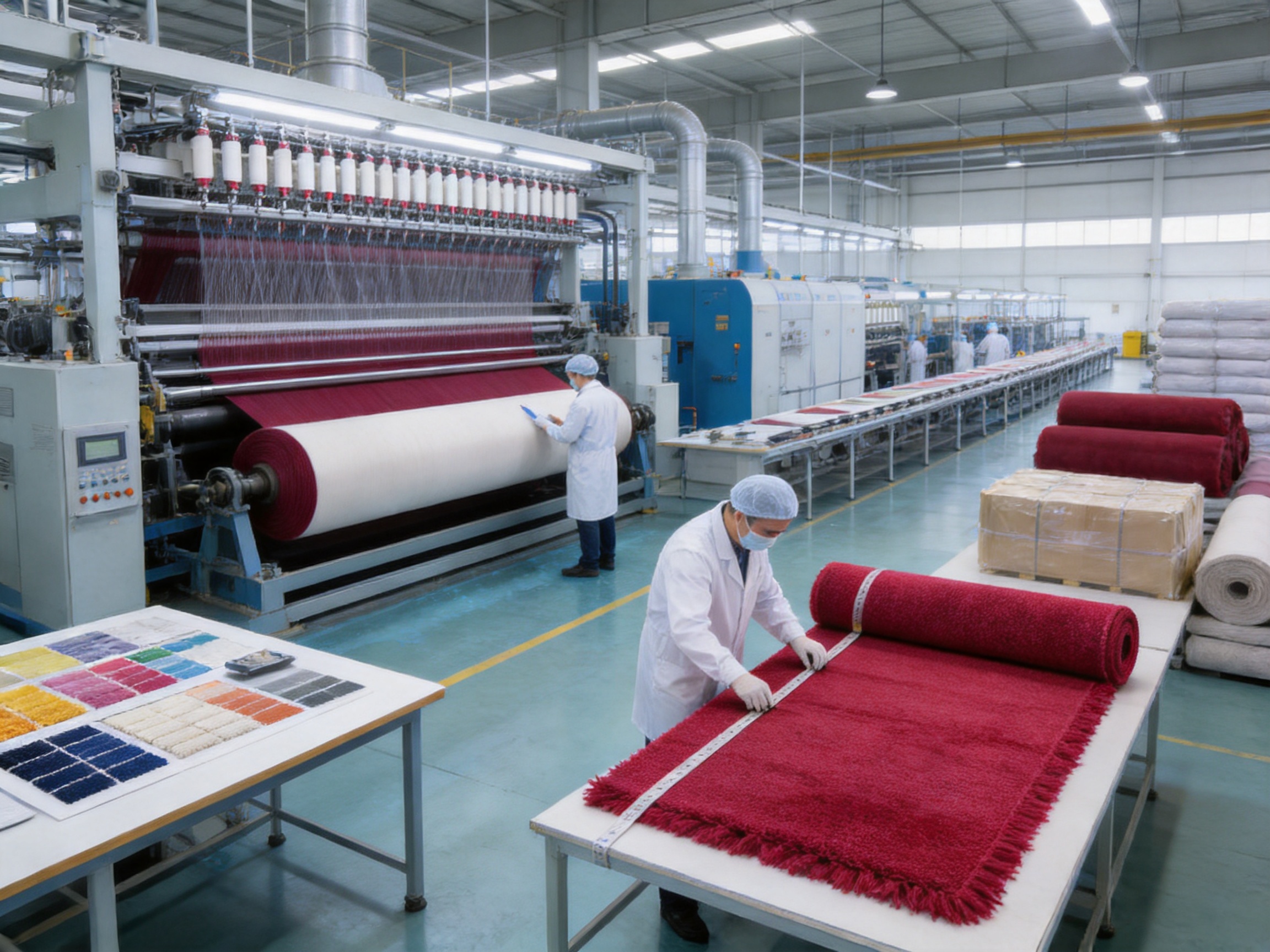
Cake Velvet Solid Dyed Fabric is a high-pile textile developed for manufacturers of carpets, area rugs, bath mats, and other soft-surface home furnishing products. Combining a substantial 800gsm weight with a 25–30mm pile height, the fabric is designed to provide a plush hand feel, visual fullness, and dependable performance in finished products. Made from 100% polyester microfiber and produced through a knitted construction, it offers a practical balance between softness, durability, color flexibility, and production efficiency.
For buyers searching for carpet fabric rolls, this product provides a versatile foundation for both standard and customized designs. It can be supplied in widths of 170cm, 190cm, and 210cm, while customized widths are also available. The maximum width can reach 3.2 meters, creating additional opportunities for manufacturers that need to reduce seams, improve cutting efficiency, or produce larger rugs and textile panels.
The fabric is available as a make-to-order product with a minimum order quantity of 500 kilograms per color. This supply model allows color and specification requirements to be discussed before production, helping wholesale buyers align fabric output with their product programs. The material is packaged in rolls and normally delivered within 15–20 days, subject to order details, production scheduling, and confirmation of specifications.
Produced by Zhejiang Benyi Textile Technology Co., Ltd., a textile technology company based in Shaoxing, Zhejiang Province, China, the fabric benefits from an integrated development and manufacturing structure. The company operates across weaving, dyeing or printing, and finished carpet processing, giving customers access to a coordinated supply chain rather than an isolated fabric-production stage.
Content
Cake Velvet Solid Dyed Fabric is a plush carpet textile characterized by its dense appearance, soft surface, and solid-color finish. Its primary material is 100% polyester microfiber, a synthetic fiber widely used in household textiles because of its strength, color adaptability, resistance to everyday wear, and suitability for large-scale production.
The term “velvet” in this context refers to the fabric’s soft, rich, and raised surface appearance. The 25–30mm pile height gives the material a visibly deep texture that can make a finished rug look fuller and more luxurious than a low-pile textile. At the same time, the knitted construction creates a flexible textile base that can be processed into a variety of carpet and mat applications.
Unlike printed fabrics that rely on a surface pattern, this product is solid dyed. A solid-dyed surface offers a clean and uniform appearance that can complement modern, minimalist, contemporary, hospitality, and residential interiors. It can also be dyed in a broad range of colors, allowing wholesalers, retailers, and private-label manufacturers to build coordinated collections.
The product model number is 100013. It is primarily intended for business-to-business supply, especially for buyers that need fabric rolls in commercial quantities. Typical uses include area rugs, carpets, bath mats, and related soft home-furnishing products. The fabric may also be considered for selected decorative or upholstery-adjacent applications where a deep, soft textile surface is appropriate, subject to testing and product-specific construction requirements.
The following specifications summarize the main characteristics of the fabric. Buyers should confirm final production parameters, color standards, packaging requirements, and testing needs before placing a bulk order.
| Specification | Details |
|---|---|
| Product name | Cake Velvet Fabric |
| Item model number | 100013 |
| Material | 100% polyester microfiber |
| Weight | 800gsm |
| Standard widths | 170cm, 190cm, and 210cm |
| Maximum stated width | Up to 3.2 meters |
| Pile height | 25–30mm |
| Supply type | Make-to-order |
| Manufacturing technique | Knitted |
| Recommended usage | Carpets, area rugs, and bath mats |
| Color treatment | Solid dyed; custom colors available |
| Minimum order quantity | 500kg per color |
| Surface characteristics | Soft and smooth |
| Packaging | Rolls |
| Typical delivery time | 15–20 days |
One of the fabric’s most important advantages is its 25–30mm pile height. Pile height directly influences the look, touch, and perceived comfort of a carpet or mat. A taller pile generally creates a deeper surface that feels softer underfoot and provides a more substantial visual effect.
For area rugs in bedrooms, living rooms, reading corners, and family spaces, a deep pile can contribute to a warm and comfortable interior atmosphere. For bath mats, the soft surface can create a pleasant transition between wet areas and the rest of the room. The pile may also help a finished product appear more generous and premium on retail shelves or in product photography.
The pile height is also useful for manufacturers seeking to create products with a strong tactile identity. A flat or short-pile fabric may be practical for certain applications, but a 25–30mm construction gives designers more opportunity to emphasize softness, texture, and visual depth.
Because comfort is influenced by more than pile height alone, the final performance of a finished product will also depend on its backing, edge treatment, density, underlay, dimensions, and intended environment. Buyers should therefore evaluate the fabric as part of a complete rug or mat construction rather than as an isolated specification.
At 800gsm, Cake Velvet Solid Dyed Fabric has a substantial material weight suitable for products designed to feel full and substantial. A higher fabric weight can contribute to a richer appearance, stronger material presence, and more satisfying handling during use.
For rug manufacturers, an 800gsm fabric can help finished products achieve a dense and comfortable visual profile. It may also support positioning in mid-range and premium product categories, where customers often associate material fullness with quality. The weight is particularly relevant when developing statement rugs, soft bath mats, and decorative floor coverings that need to make a strong visual impression.
Weight should not be interpreted as a standalone measure of quality. Durability and service performance are also influenced by yarn structure, knitting method, pile retention, backing, finishing, usage intensity, cleaning conditions, and manufacturing quality. Nevertheless, the 800gsm specification gives buyers a clear basis for comparing this fabric with lighter alternatives.
Compared with very lightweight carpet fabrics, this material may provide a more substantial hand feel and a less insubstantial appearance. For manufacturers competing in a market where consumers evaluate products through touch as well as appearance, that difference can be commercially important.
The fabric is knitted from 100% polyester microfiber. Polyester is widely used in carpet and home-textile production because it can be engineered for softness, strength, color development, and efficient processing. Microfiber construction can contribute to a smooth and pleasant surface, which is especially valuable for products that are touched or walked on frequently.
Polyester microfiber also offers practical advantages for collection development. It can be dyed into many shades, helping manufacturers create seasonal color ranges, coordinated room collections, and private-label products. The supplied product information also identifies fade resistance as a benefit of the microfiber construction. Actual colorfastness will depend on dye selection, processing conditions, exposure, cleaning, and end use, so buyers should request test results for their intended application.
The synthetic composition can make the fabric suitable for manufacturers that want consistency across repeated production runs. Fiber availability and established polyester processing technologies support scalable production, while the make-to-order model allows the fabric to be prepared according to agreed requirements rather than being limited to a small selection of ready-stock colors.
Polyester is also compatible with ongoing textile sustainability initiatives when recycled inputs are selected and properly documented. Zhejiang Benyi Textile Technology Co., Ltd. reports investment in sustainable materials and production methods, including recycled polyester and water-saving dyeing techniques. Buyers that require recycled content should confirm the percentage, certification scope, chain-of-custody documentation, and applicability to the specific order.
The fabric is produced using knitting technology. Knitted textiles are formed through interconnected loops, creating a construction that can provide flexibility and dimensional adaptability. In a carpet fabric, this can be useful when the material must be handled in rolls, cut into different shapes, or combined with a backing and other components.
Knitting can also support the development of a soft surface without sacrificing the fabric’s ability to function as a production material. The construction is intended to enhance structural integrity while retaining a comfortable hand feel. This combination is important for manufacturers that need a textile capable of moving efficiently through cutting, sewing, bonding, backing, edge finishing, and packaging processes.
In comparison with fabrics designed only for decorative display, a knitted carpet material must withstand more demanding conversion processes. It may be rolled, unrolled, trimmed, joined, backed, and subjected to tension during manufacturing. A stable and carefully controlled knitted structure can help reduce handling difficulties and maintain a consistent product appearance.
As with all textile constructions, buyers should evaluate roll consistency, weight tolerance, width tolerance, pile uniformity, color variation, and dimensional stability through sample approval and pre-production inspection. These controls help ensure that the fabric performs reliably in the customer’s own manufacturing environment.
Solid colors remain important across residential, hospitality, office, and retail interiors. A solid-dyed carpet fabric can be used as a calm foundation for a room or as a bold accent, depending on the selected shade. Its uniform appearance makes it compatible with minimalist spaces, tone-on-tone collections, and products that emphasize texture rather than printed decoration.
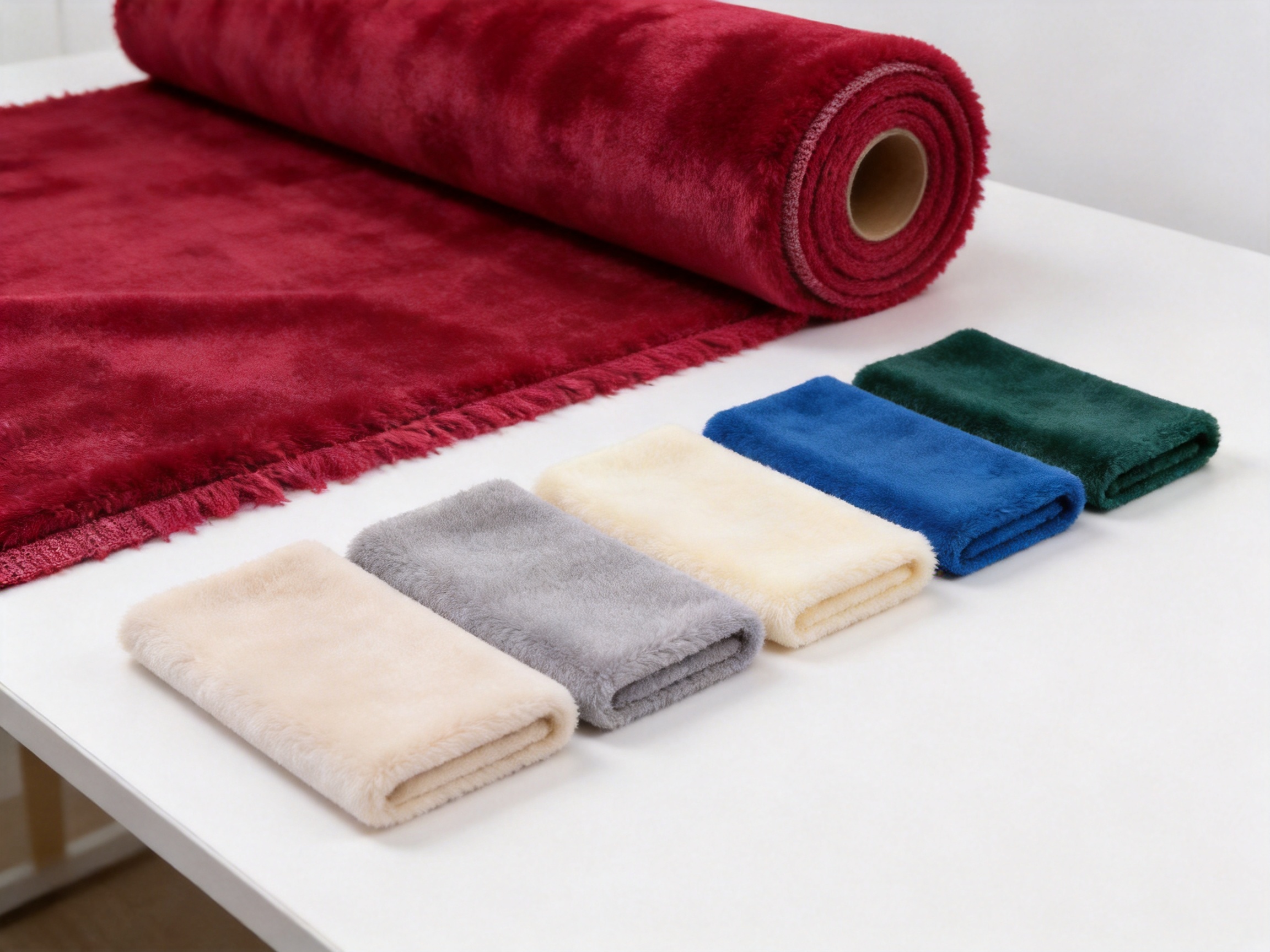
The fabric can reportedly be dyed to customer-selected colors. This creates opportunities for brand-specific collections, retailer-exclusive ranges, hospitality projects, and coordinated products that use the same color family across rugs, bath mats, cushions, and other accessories.
Color customization can also help manufacturers respond to regional preferences. Neutral beige, gray, cream, taupe, and brown shades may suit understated interiors, while blue, green, terracotta, yellow, or deeper jewel tones can support more expressive collections. The final color should always be approved against a physical lab dip, sample, or agreed color standard because screen images cannot accurately represent textile color.
Solid dyeing has an additional design benefit: it allows the pile texture to remain the visual focus. A deep velvet-like surface can produce subtle light and shade variations as the fibers move, giving the finished product visual richness without requiring a complex printed pattern.
The standard width options are 170cm, 190cm, and 210cm, with customized widths available. The stated maximum width is up to 3.2 meters. Width flexibility is a significant advantage for carpet and rug manufacturers because it affects cutting plans, seam requirements, labor, and material waste.
A wider roll can be especially valuable for large area rugs, broad carpet panels, hospitality projects, and products that would otherwise require multiple joined sections. Reducing the number of seams may simplify production and create a cleaner finished appearance. It can also support more efficient nesting of cutting patterns, although the actual savings will depend on product dimensions and layout.
The 170cm, 190cm, and 210cm options may suit common rug sizes and smaller mat formats. Buyers can select a width that aligns with their existing equipment and product range. For unusual dimensions, customized width discussions may provide a better fit than purchasing a standard roll and trimming away a substantial portion of the material.
Width customization should be confirmed together with tolerance, edge quality, roll length, winding direction, and minimum production quantity. These details influence how effectively the fabric can be converted in a particular factory.
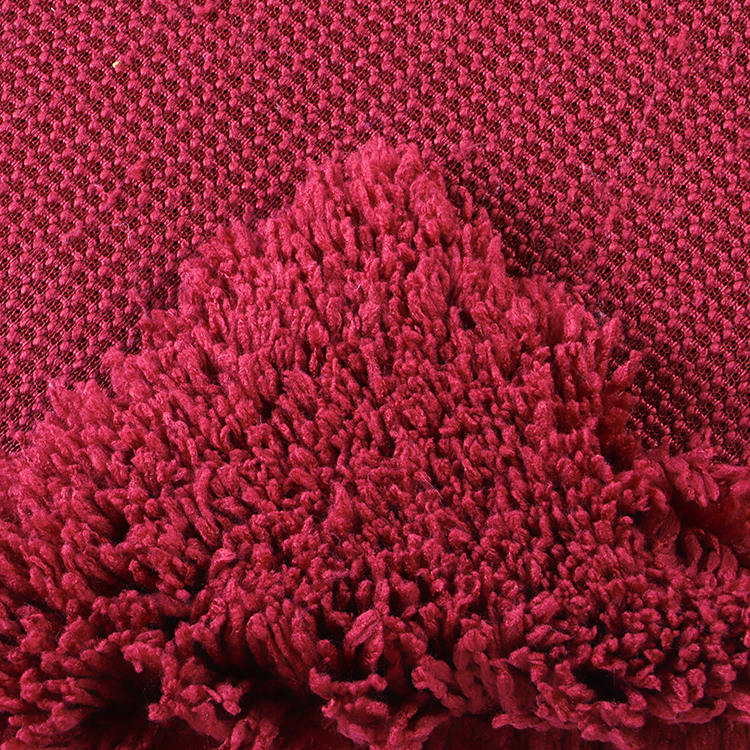
Cake Velvet Solid Dyed Fabric
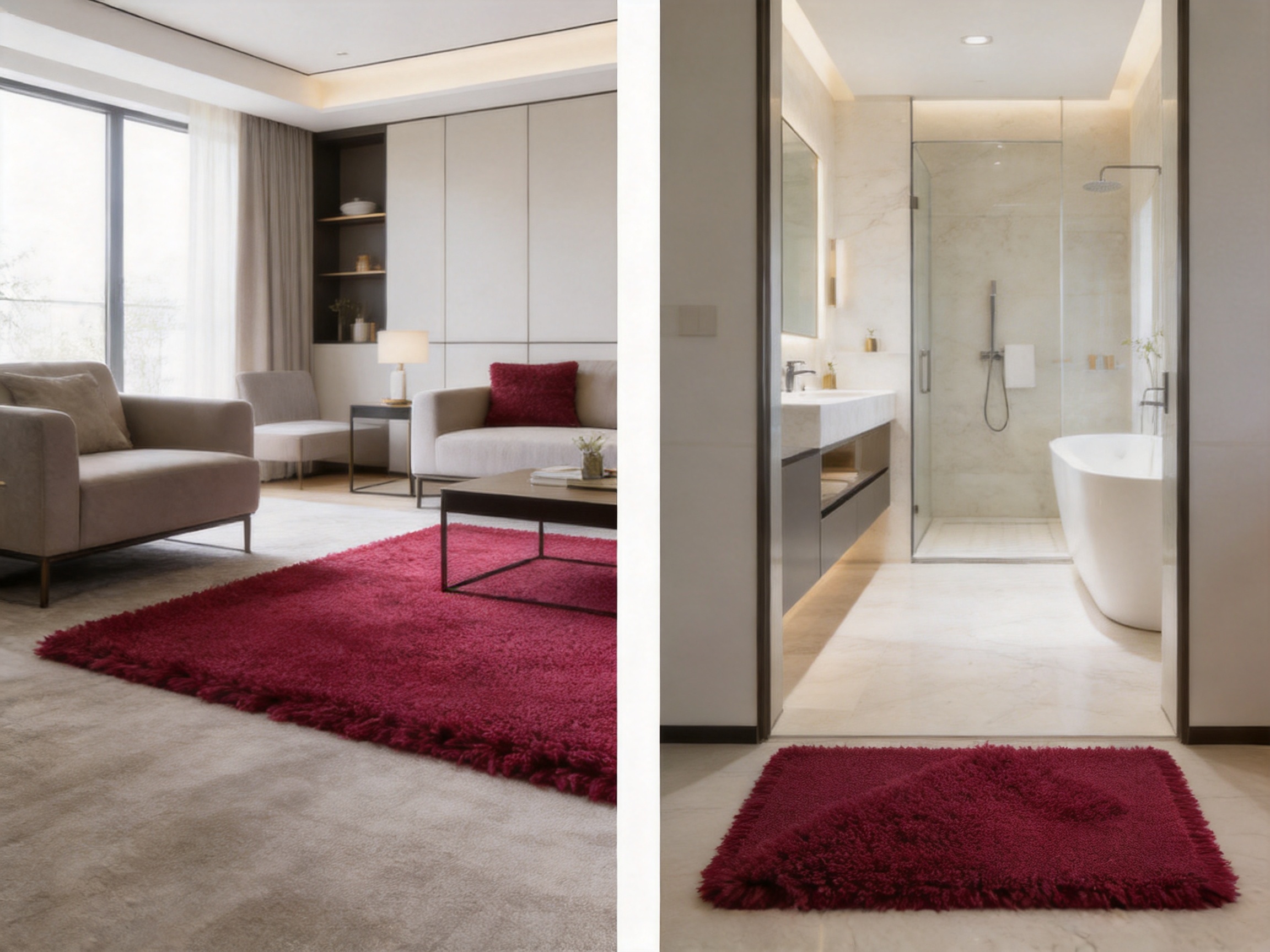
The fabric is well suited to area rug production. Its high pile, soft surface, 800gsm weight, and solid-color availability support rug designs intended to provide comfort and visual warmth. It can be used for bedroom rugs, living room rugs, nursery products, lounge areas, and decorative accent pieces.
Manufacturers can combine the velvet surface with different backing systems to achieve distinct product characteristics. A flexible backing may support lightweight, rollable rugs, while a more structured backing may be selected for stability. Anti-slip treatment, edge binding, overlocking, and custom shaping can also be added according to the target market.
The 25–30mm pile height makes the fabric suitable for soft bath mat designs. A deep surface can provide a comfortable underfoot experience and add a spa-like character to bathrooms. Solid colors make it possible to coordinate bath mat collections with towels, shower curtains, bathroom accessories, and broader home-textile programs.
For bath mat applications, manufacturers should assess absorbency requirements, drying behavior, backing compatibility, laundering conditions, colorfastness, and slip resistance. Polyester is not automatically equivalent to a highly absorbent fiber, so the complete bath mat construction should be tested for the performance expectations of the intended market.
The fabric can serve as a component in carpet products where a soft, decorative, and substantial surface is required. Depending on the final construction, it may be used for loose-laid rugs, carpet panels, decorative floor coverings, or selected custom carpet formats.
Large-format carpet projects may benefit from the availability of widths up to 3.2 meters. Wider material can help reduce seams and may simplify the manufacturing of broad surfaces. Project buyers should confirm whether the final construction meets applicable requirements for wear, flammability, cleaning, dimensional stability, and indoor air quality.
Although the primary stated uses are carpet, rug, and bath mat production, the fabric’s soft surface may also be considered for selected decorative textile products. Possible development areas include floor cushions, accent panels, display products, and other items where plush texture is a priority.
Any use outside the recommended applications should be validated through prototype testing. Upholstery, seating, high-contact products, and products exposed to unusual abrasion may require different technical standards than floor coverings.
Wholesale buyers generally need more than an attractive fabric sample. They require dependable specifications, scalable production, manageable lead times, customization options, and a supplier capable of communicating clearly throughout the order process. Cake Velvet Solid Dyed Fabric addresses these needs through a combination of standardization and flexibility.
First, the product offers a clearly defined base specification: 100% polyester microfiber, 800gsm weight, 25–30mm pile height, knitted construction, and roll packaging. These details help product developers assess whether the material is compatible with their existing designs and equipment.
Second, the fabric is available in multiple widths and can be customized. This is useful for buyers whose product dimensions do not correspond precisely to common standard rolls. Width selection can affect yield and production economics, making it an important commercial consideration.
Third, the material can be dyed to different colors. Custom color capability enables buyers to create differentiated collections instead of competing only with generic stock products. It can also support retailer-specific or project-specific color programs.
Fourth, the stated delivery period of 15–20 days provides a planning reference for buyers. Since the product is make-to-order, the final schedule should be confirmed after reviewing color, quantity, width, packaging, and technical requirements. Clear pre-production communication is essential for keeping the supply plan reliable.
Finally, the minimum order quantity of 500kg per color is suitable for commercial customers that need meaningful production volumes. It may be appropriate for wholesalers, rug brands, bath mat manufacturers, importers, and retailers developing repeatable product lines.
Carpet fabrics vary widely in weight, pile height, fiber type, construction, width, dye method, and supply capability. Compared with a lightweight or short-pile generic fabric, Cake Velvet Solid Dyed Fabric offers a more pronounced plush surface and a heavier 800gsm construction.
Compared with printed materials, its solid-dyed design places greater emphasis on tactile quality, color depth, and surface texture. This can be advantageous for brands seeking a clean and contemporary aesthetic. It may be less suitable for buyers whose primary requirement is a detailed graphic pattern printed directly onto the fabric.
Compared with narrow-width materials, the available widths up to 3.2 meters may provide more flexibility for large-format products. Fewer seams can improve appearance and may reduce certain conversion steps. The financial benefit should be assessed through a cutting study based on the buyer’s actual product dimensions.
Compared with ready-stock fabrics, the make-to-order model provides more opportunity for specification and color customization. However, it also means that buyers need to plan ahead and approve details before production. This trade-off is often worthwhile for businesses developing a consistent product range rather than purchasing small quantities for immediate resale.
In practical terms, the fabric’s strongest competitive position is the combination of plush pile, substantial weight, polyester microfiber performance, width flexibility, color customization, and integrated manufacturing support. These features allow it to compete not simply as a basic carpet roll, but as a development-oriented textile platform for differentiated finished products.
Zhejiang Benyi Textile Technology Co., Ltd. is located in Shaoxing, Zhejiang Province, a region widely recognized for its textile activity and manufacturing resources. The company describes itself as a textile technology enterprise focused on carpets, rug fabrics, and finished products.
A major stated strength is control across multiple stages of production. The company has its own weaving, dyeing and printing factories, and finished carpet processing factories. This integrated structure can improve coordination between fabric development, coloration, finishing, and conversion into completed carpet products.
Vertical or semi-integrated production can also support more effective quality management. When several stages are managed within a connected supply chain, technical information can move more efficiently between departments. Issues involving color, pile, backing, roll handling, or finished-product performance may be easier to trace and address.
The company reports a team of more than 20 fabric engineers. This engineering capacity supports the development of new carpet fabrics each quarter based on market trends. It also creates a foundation for customized product development, allowing customer requirements to be discussed with technical personnel rather than handled only as a standard catalog transaction.
Such development capability is valuable in a market where buyers increasingly request specific pile heights, widths, colors, textures, backing systems, recycled inputs, and packaging formats. A supplier that understands both fabric production and finished carpet processing can often provide more practical recommendations during product development.
For bulk fabric purchasing, quality control should begin before production. Buyers should provide a complete technical brief that identifies material composition, target weight, pile height, width, color standard, roll length, packaging, end use, and any required compliance tests.
Color approval is particularly important for solid-dyed fabrics. A physical sample or laboratory dip should be approved before bulk dyeing. Buyers should also define acceptable shade variation between batches, because dyeing conditions and production lots can produce visible differences if standards are not clearly established.
Fabric weight and pile height should be measured according to agreed procedures. A reasonable tolerance should be documented so that both supplier and buyer have the same understanding of acceptable production variation. Width, edge quality, pile uniformity, surface defects, and roll winding should also be examined.
For finished bath mats and rugs, additional tests may be required. These can include colorfastness to washing and rubbing, dimensional stability, backing adhesion, slip resistance, shedding, abrasion resistance, and cleaning performance. The appropriate tests depend on the destination market and product category.
Pre-shipment inspection can verify quantity, roll identification, packaging, appearance, and conformity with approved samples. Proper labeling of colors and production lots is useful for inventory control and future repeat orders.
The fabric’s make-to-order supply type allows buyers to approach product development with a customized mindset. Instead of selecting only from pre-existing inventory, a customer can discuss color, width, quantity, and intended use before the manufacturing schedule is finalized.
Customization may begin with color. A brand can submit a color reference and request a lab dip for approval. The next stage may involve width and roll specifications. If the buyer intends to cut large rugs, the roll width can be selected to improve yield. If the material will be used for bath mats, the buyer may also discuss backing and edge-finishing compatibility.
Customization can extend to the finished product. The same base fabric may be converted into rectangular rugs, round mats, runners, bedside mats, bathroom sets, or other shapes. Different backing materials, binding tapes, labels, packaging, and retail presentations can create distinct product lines from one textile platform.
Buyers should recognize that customization is most successful when specifications are documented early. Drawings, color references, tolerance requirements, test standards, packaging artwork, and inspection criteria should be confirmed before bulk production.
Environmental considerations are increasingly important in carpet and home-textile procurement. Polyester products should be evaluated not only for their immediate performance but also for fiber source, dyeing processes, production efficiency, product lifespan, and end-of-life options.
Zhejiang Benyi Textile Technology Co., Ltd. reports an emphasis on ecological protection and consumer health. The company also states that it invests in recycled polyester and water-saving dyeing technologies. These initiatives may help reduce resource consumption, but buyers should request product-specific evidence when sustainability claims are part of a procurement requirement.
The company reports OEKO-TEX® and Global Recycled Standard certifications. Certification details should be checked for current validity, covered facilities, product scope, and the specific material supplied. A company-level certification does not necessarily mean that every product, color, or production batch carries identical certified content.
Durability is another part of sustainability. A fabric that remains attractive and functional for a longer period may reduce the frequency of replacement. The 800gsm weight and substantial pile are intended to support a durable, premium-feeling product, but actual service life will depend on construction, care, traffic, and application.
Responsible buyers should consider the complete product lifecycle, including packaging materials, shipping efficiency, cleaning requirements, repairability, and potential recycling pathways. Product claims should be supported by accurate technical documents and appropriate testing.
An efficient ordering process begins with a clear inquiry. Buyers should identify the intended application, estimated quantity, preferred color, width, pile height, target weight, delivery destination, and any required certifications or tests.
The supplier can then confirm whether the requested specification is available as a standard option or requires development. For custom colors, a sample or lab dip should be reviewed. For custom widths, buyers should confirm the minimum quantity, tolerance, edge condition, and production implications.
After sample approval, the commercial order should state the item model, material, weight, dimensions, color reference, quantity, packaging method, inspection requirements, delivery terms, and payment arrangements. The 500kg-per-color minimum order should be considered when planning a multi-color collection.
Before shipment, the buyer may request production photos, roll information, inspection results, or a pre-shipment inspection. Once the goods arrive, the buyer should check the packaging and inspect representative rolls before converting the entire shipment.
The care requirements of a finished carpet or mat depend on the full construction, not just the surface fabric. Manufacturers should provide end-product instructions that reflect the backing, binding, adhesives, and intended use.
Routine care may include regular vacuuming or gentle surface cleaning to remove dust and loose particles. Spills should generally be addressed promptly using a method appropriate for polyester textiles and the finished product’s backing. Strong chemicals, excessive heat, harsh brushing, or unsuitable machine washing may damage the pile or backing.
Bath mats require particular attention to drying and hygiene. A product should be dried thoroughly after washing and should not be stored while damp. If the finished mat includes a coated or rubberized backing, the care label should specify temperature, washing method, and drying limitations.
For commercial environments, buyers should match the fabric and finished construction to expected traffic levels. A soft high-pile product may be ideal for comfort-focused spaces but may require more maintenance in high-traffic entrances or public corridors than a low-pile commercial textile.
The fabric is made from 100% polyester microfiber. Its synthetic fiber construction is designed to provide a soft surface, color flexibility, and practical durability for carpet, rug, and bath mat production.
The stated fabric weight is 800gsm. This substantial weight contributes to a fuller appearance and a more substantial hand feel than many lightweight carpet fabrics.
The pile height is approximately 25–30mm. This deep pile is intended to provide a plush, soft, and comfortable surface.
Standard widths include 170cm, 190cm, and 210cm. Customized widths are available, and the maximum stated width can reach up to 3.2 meters.
Yes. The fabric is solid dyed and can reportedly be dyed to customer-selected colors. A physical color sample or laboratory dip should be approved before bulk production.
The minimum order quantity is 500 kilograms per color. Buyers should consider this requirement when planning multi-color collections or private-label product ranges.
The fabric is packaged in rolls. Roll length, roll weight, labeling, and protective packaging should be confirmed for each order.
The stated delivery time is 15–20 days. Because the product is make-to-order, the final schedule should be confirmed after color, quantity, width, and other production details are approved.
The recommended applications include carpets, area rugs, and bath mats. Other uses may be possible, but they should be evaluated through sampling and performance testing before commercial production.
The manufacturer reports investment in recycled polyester and water-saving dyeing methods and states that it has OEKO-TEX® and GRS certifications. Buyers requiring certified materials should request current documentation covering the specific product and order.
The 25–30mm pile gives this fabric a deeper and softer surface, while its 800gsm weight provides a more substantial appearance. Low-pile fabrics may be preferable where easy cleaning, compact storage, or heavy-traffic performance is the primary objective.
Buyers should request samples, color approvals, technical specifications, tolerances, certification documents where applicable, packaging details, production timing, and any required test reports. A pre-production sample is particularly useful for confirming the finished construction.
Cake Velvet Solid Dyed Fabric is a versatile carpet textile designed for manufacturers that need softness, visual fullness, color flexibility, and scalable roll supply. Its 100% polyester microfiber composition, 800gsm weight, 25–30mm pile height, knitted structure, and solid-dyed finish make it suitable for a broad range of area rugs, carpets, and bath mats.
The product’s competitive strengths include its plush surface, substantial material weight, customized color capability, multiple width options, maximum width of up to 3.2 meters, and make-to-order production model. These characteristics can help buyers create differentiated products while improving compatibility with their own cutting and conversion processes.
The manufacturing capabilities of Zhejiang Benyi Textile Technology Co., Ltd. provide additional support. The company’s integrated textile and finished-product operations, engineering team, regional manufacturing location, and stated focus on sustainable production create a foundation for customized development and coordinated supply.
For the best results, buyers should approach the fabric as part of a complete product-development program. Sample approval, color control, quality inspection, backing selection, care testing, and application-specific performance evaluation will help ensure that the finished rug or mat meets market expectations. When these steps are managed carefully, Cake Velvet Solid Dyed Fabric can serve as a strong material platform for comfortable, visually appealing, and commercially adaptable floor-covering products.
1. Product specification sheet for Cake Velvet Fabric, item model 100013, including material, weight, width, pile height, supply type, usage, packaging, and delivery information.
2. Manufacturer-provided product description for Cake Velvet Solid Dyed Fabric, including statements regarding polyester microfiber, solid dyeing, knitted construction, customized colors, and maximum width.
3. Zhejiang Benyi Textile Technology Co., Ltd. company information concerning textile production, carpet and rug manufacturing, integrated facilities, engineering resources, and customized services.
4. Manufacturer-provided sustainability information concerning recycled polyester, water-saving dyeing methods, OEKO-TEX® certification, and Global Recycled Standard certification.
5. General textile-industry principles concerning pile height, fabric weight, knitted construction, polyester microfiber, color approval, quality control, and carpet-product development.

ADD: No.75 Zhenyuan Road, Yuecheng District, Shaoxing City, Zhejiang Province, China 312000

Tel : +86-189 6750 9795

FAX : +86-0575-8803 2773

Email : fisher@benetextile.com

Copyright © Zhejiang Benyi Textile Technology Co., Ltd. All Rights Reserved. Carpets and Rugs Manufacturer

 English
 Français
 Deutsch
 عربى