

Qiao Yunting — Senior Carpet Sales Manager
 Home / Author / Qiao Yunting — Senior Carpet Sales Manager / How a Jacquard Velveteen Sherpa Throw Blanket Combines Luxury, Warmth, and Manufacturing Efficiency
 2026.09.20
 Qiao Yunting — Senior Carpet Sales Manager
A high-quality throw blanket must do more than provide warmth. It should feel pleasant against the skin, look refined in different interiors, remain dependable after repeated washing, and offer enough versatility to serve residential, hospitality, travel, and workplace applications. The Jacquard Shu Velveteen Sherpa Throw Blanket is designed around these expectations. Combining a decorative jacquard Shu velveteen face with a soft sherpa fleece reverse, the blanket presents a practical balance of comfort, appearance, durability, and easy care.
Produced by Zhejiang Benyi Textile Technology Co., Ltd., this double-layer blanket reflects the advantages of an integrated textile manufacturing model. The company operates weaving, dyeing and printing, and finished carpet and textile processing facilities, allowing it to manage multiple stages of production internally. Although the blanket is categorized as a blanket product, its development benefits from the company’s broader expertise in textile surfaces, color development, fabric construction, and finished-product processing.
Available in 50 by 60 inches, 60 by 80 inches, 90 by 90 inches, and 90 by 110 inches, the blanket can be specified for individual use, shared seating, beds, guest rooms, hotel applications, offices, aircraft travel, and gift programs. Its 500gsm construction combines 300gsm jacquard Shu velveteen fabric with 200gsm sherpa fleece, creating a substantial hand feel without relying on complicated maintenance requirements.
The result is a blanket that competes effectively with ordinary fleece throws, single-layer velour blankets, and basic promotional blankets. Its key strengths are its reversible softness, double-layer warmth, clear surface texture, solid-color versatility, neat welt sewing, machine-washable construction, and suitability for all seasons.
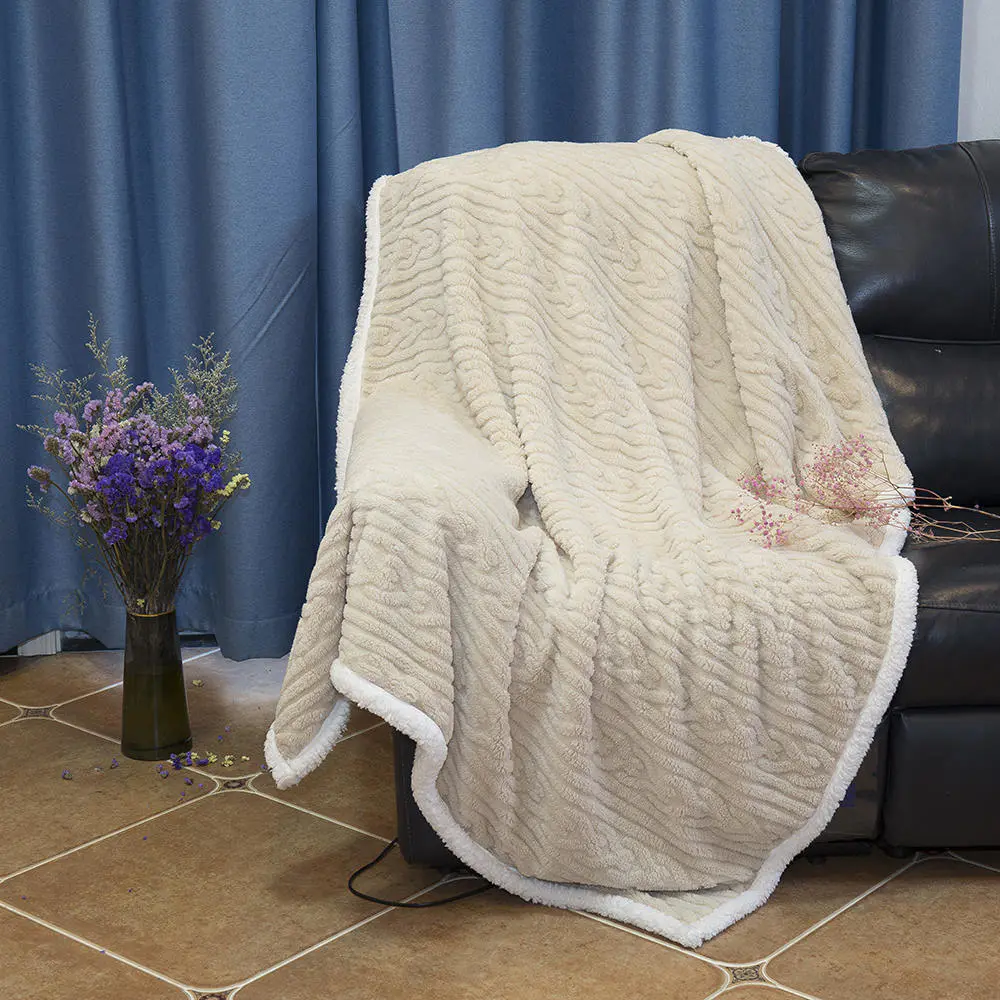
Jacquard Shu Velveteen Sherpa Throw Blanket
Content
The Jacquard Shu Velveteen Sherpa Throw Blanket is made from 100% polyester. Polyester is widely used in modern blanket production because it can be engineered for softness, resilience, color retention, and relatively simple care. In this product, the material is used in two complementary forms: a jacquard Shu velveteen outer layer and a sherpa fleece inner layer.
The velveteen side supplies visual structure and a smooth, plush touch. The jacquard construction creates a clear texture design, giving the blanket more visual character than a completely flat fleece surface. The reverse sherpa side contributes a fluffy, warm hand feel and creates a comfortable layer between the user and the surrounding environment.
The blanket has a double-layer structure with a combined weight of 500gsm. The 300gsm jacquard Shu velveteen fabric forms the decorative face, while the 200gsm sherpa fleece forms the soft reverse. This division of materials allows each side to perform a distinct function. The face is suitable for display and styling, while the sherpa side emphasizes warmth and tactile comfort.
| Product Feature | Specification |
| Product Type | Jacquard Shu Velveteen Sherpa Throw Blanket |
| Material | 100% polyester |
| Total Weight | 500gsm |
| Face Fabric | 300gsm jacquard Shu velveteen |
| Reverse Fabric | 200gsm sherpa fleece |
| Construction | Double layer |
| Edge Construction | Welt sewing |
| Weave Type | Knitted |
| Available Sizes | 50 by 60 inches; 60 by 80 inches; 90 by 90 inches; 90 by 110 inches |
| Pattern Direction | Solid colors with textured surface design |
| Care | Machine wash |
| Suitable Seasons | All seasons |
| Recommended Applications | Sofa, bed, hotel, plane, office, study, coach, and gifting |
These specifications make the product suitable for multiple sales channels. Retailers can offer it as a premium home comfort item. Hospitality buyers can use it as an additional guest-room layer. Corporate purchasers can select it for office comfort programs or seasonal gifts. Importers and distributors can choose different sizes according to regional demand and end-user preferences.
Single-layer blankets can be lightweight and convenient, but they often provide a more limited experience. A basic fleece throw may offer warmth, yet it may lack the decorative surface required for refined interior styling. A smooth velour blanket may look attractive, but it may not deliver the same level of fluffy insulation as a sherpa-backed construction. The double-layer design addresses both needs in one product.
The jacquard Shu velveteen face creates a polished exterior. Its surface has a soft, plush appearance and a defined texture pattern that can add depth to a sofa, bed, lounge chair, or hotel room. The sherpa reverse provides a more cloud-like feel. Users can select the side that best matches their immediate purpose: the textured velveteen side for presentation and the sherpa side for direct contact and extra warmth.
This reversible functionality is a significant advantage over many competing blankets. It gives the user two tactile experiences instead of one and enables the blanket to coordinate with different environments. When folded over the arm of a sofa, the velveteen side can face outward. When wrapped around the body, the sherpa side can provide a warmer and more enveloping feel.
The 500gsm total weight also contributes to perceived quality. Weight alone does not determine comfort, but a balanced, substantial construction often feels more premium than a very thin throw. The combination of 300gsm face fabric and 200gsm sherpa fleece supports a fuller hand feel while remaining suitable for folding, storage, and transport.
For manufacturers and buyers, the double-layer structure can also create a stronger product story. Instead of selling a blanket only as a basic warmth accessory, it can be presented as a reversible comfort textile with decorative value, practical performance, and broad application potential.
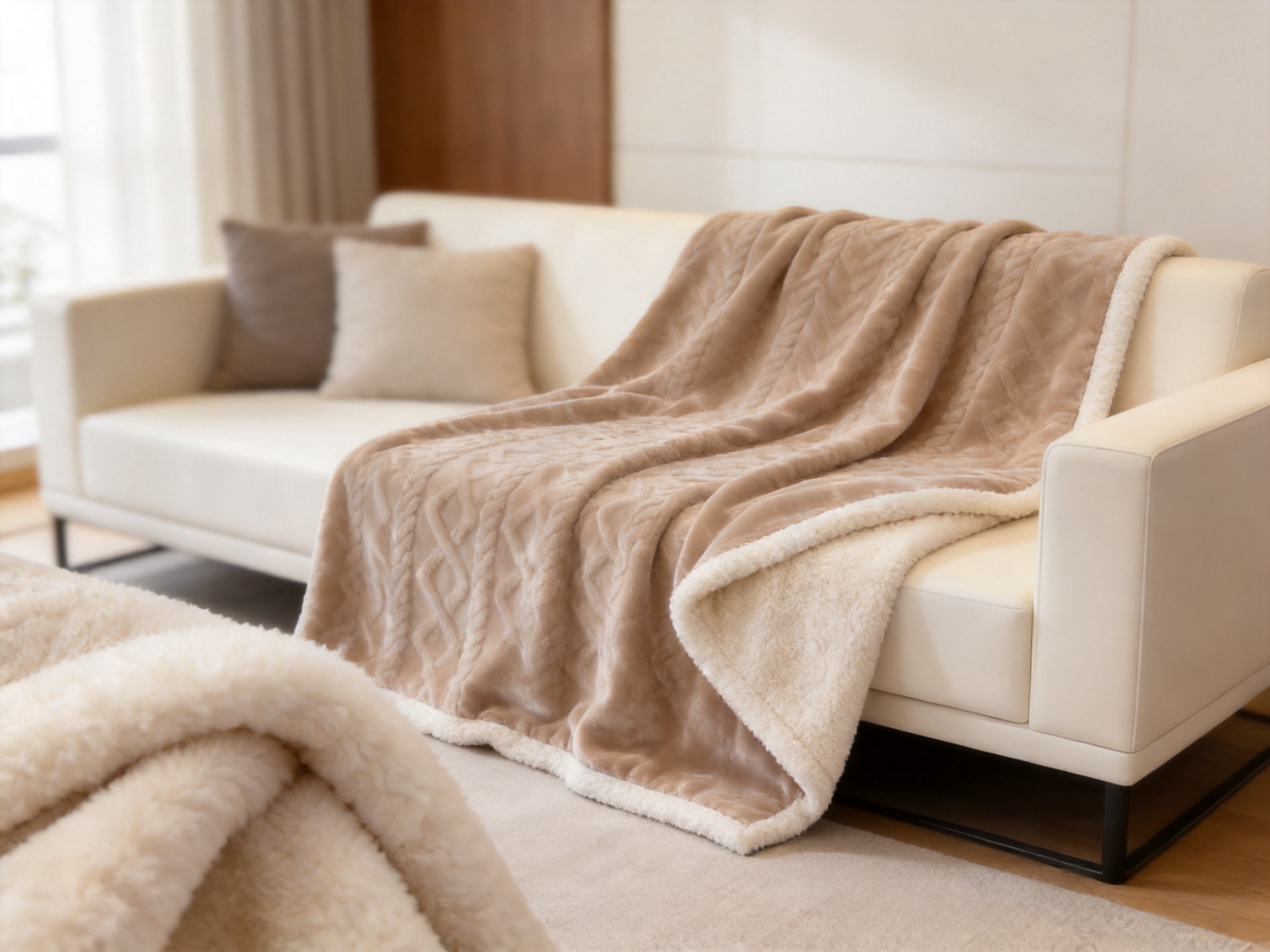
The surface of a blanket strongly influences how customers evaluate it before purchase. Color, texture, drape, and touch all contribute to the perceived value of the product. The jacquard Shu velveteen face is intended to create a richer sensory experience than a plain, undetailed blanket surface.
Velveteen fabrics are valued for their short, soft pile and smooth hand. The surface can catch light gently, producing subtle changes in appearance as the blanket moves or is folded. This effect helps the blanket look more dimensional without requiring a highly complex print or a busy decorative pattern.
The jacquard approach adds a clear texture design to the face. This can make solid colors appear more sophisticated and versatile. A solid-color blanket with surface texture can coordinate with minimalist, contemporary, classic, hotel, and commercial interiors. By contrast, a heavily printed pattern may be attractive to a narrower group of customers or may conflict with existing décor.
For wholesale buyers, solid-color availability is especially useful. It allows retailers, hospitality groups, and interior suppliers to select shades that correspond with seasonal collections, room palettes, private-label programs, or promotional requirements. The textured construction helps maintain visual interest even when the color is restrained.
The velveteen face is also useful when the blanket is displayed in a showroom or retail environment. A folded stack can show the surface texture clearly, while a draped sample can demonstrate the fabric’s softness and fluidity. This improves the product’s visual merchandising potential and can help distinguish it from low-cost, flat-surface alternatives.
Sherpa fleece is associated with a fluffy, wool-like appearance and a warm hand feel. In this blanket, the sherpa layer serves as the comfort-focused reverse. It creates a plush surface that can be placed against the body, used over bedding, or wrapped around the shoulders during colder conditions.
The sherpa layer is particularly suitable for users who prioritize softness. Its raised, fluffy structure gives the blanket a more enveloping feel than a smooth, single-layer textile. It can also increase the perceived warmth of the product by creating a comfortable layer between the user and the surrounding air.
The reverse side expands the product’s appeal across age groups. Children may appreciate the soft, fluffy sensation, while adults may value the blanket as a sofa accessory, travel layer, reading companion, or bedroom throw. The product information identifies it as suitable for all ages, making it appropriate for family-oriented retail and gift assortments.
Because both sides are designed for comfort, the blanket is not limited to display use. It is intended for regular interaction: wrapping, resting, folding, carrying, and washing. This practical orientation is important for a product that may be used in homes, offices, hotel rooms, aircraft cabins, and study spaces.
Blanket edges are exposed to repeated handling. They may be pulled when the user unfolds the product, compressed during storage, caught on furniture, or placed through washing and drying cycles. For this reason, edge construction is an important part of overall product reliability.
The Jacquard Shu Velveteen Sherpa Throw Blanket uses welt sewing. This construction produces a neat finished edge and supports a stronger connection at the seams. A well-finished edge can help reduce the risk of visible fraying, seam separation, or an untidy appearance during ordinary use.
Welt sewing also contributes to presentation. A clean border gives the blanket a more complete and premium appearance, which is valuable for retail display and hospitality applications. In a hotel room or on a showroom bed, a neat edge can make the product look more intentional and professionally finished.
Durability should always be understood in relation to correct use and care. No textile is immune to damage from sharp objects, excessive abrasion, unsuitable washing temperatures, or aggressive chemical treatment. However, careful edge construction provides a stronger foundation for repeated everyday handling than a minimally finished edge.
Easy care is one of the most important competitive factors in the blanket category. Consumers increasingly expect home textiles to be practical, and commercial buyers need products that can be cleaned efficiently. The blanket is designed for machine washing, making it easier to maintain than products that require specialized cleaning.
Machine-washable construction supports several use environments. At home, users can refresh the blanket after regular sofa or bed use. In an office, it can be cleaned as part of routine textile care. In hospitality settings, washable construction simplifies housekeeping procedures. For travel-related use, it provides a practical option for users who want a personal comfort layer that can be cleaned after a journey.
The product information also highlights anti-pilling hand feel and a dyeing technique intended to help maintain color after washing. Care results depend on washing conditions, detergent selection, mechanical action, and drying method, but the blanket’s polyester composition and production approach are suited to routine maintenance.
For best results, buyers should follow the care label supplied with the finished product. A gentle or moderate machine-wash cycle, suitable detergent, avoidance of harsh bleaching agents, and appropriate drying conditions can help preserve the softness, color, and shape of the textile. The blanket should also be stored dry and allowed to air properly after washing.
Compared with delicate decorative throws that require dry cleaning or highly restrictive care, a machine-washable blanket can offer greater long-term convenience. This is a meaningful advantage for families, hotels, offices, and retailers seeking a product with broad practical appeal.
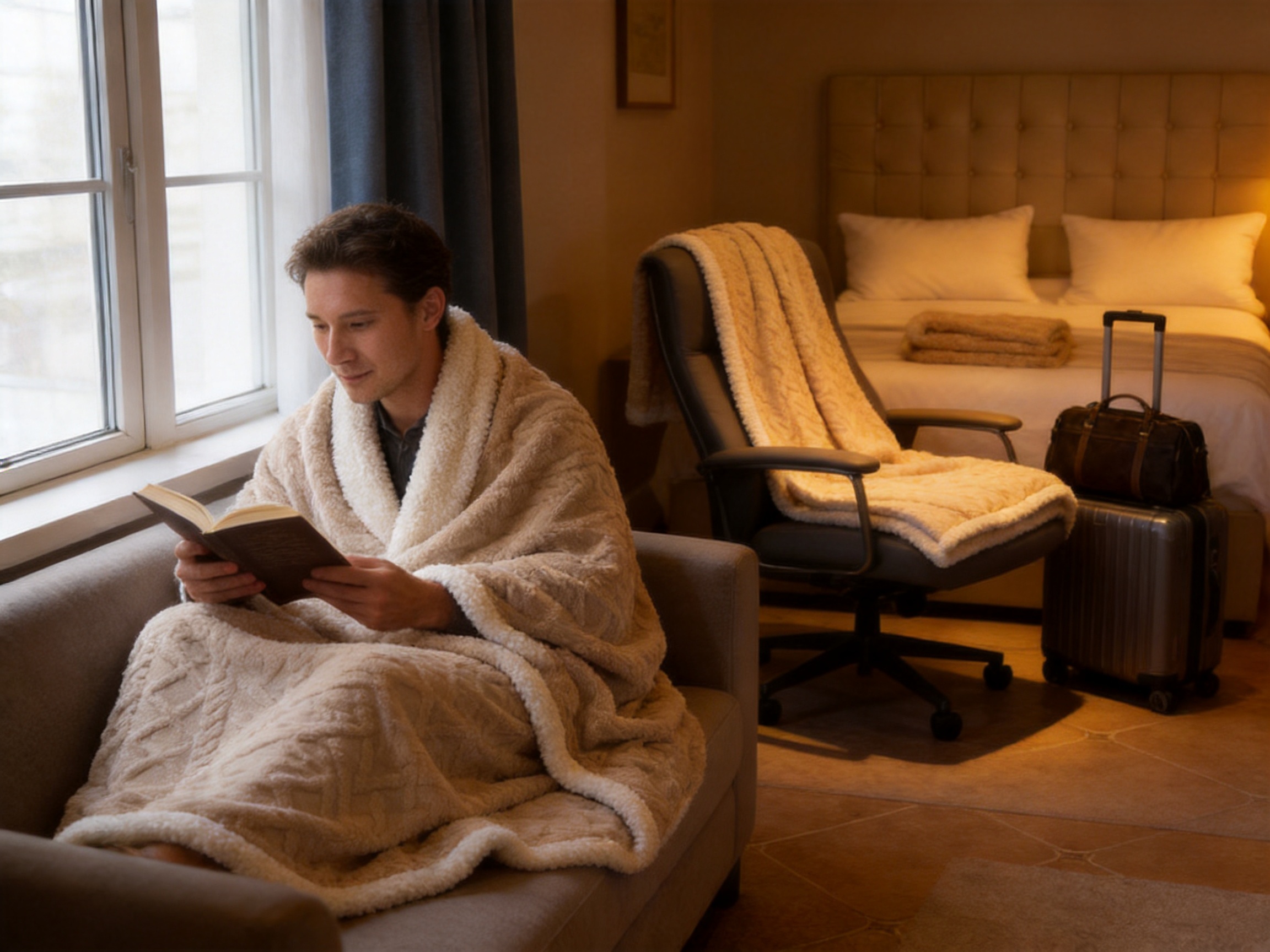
On a sofa, the blanket can function as both a comfort layer and a decorative accessory. The velveteen face provides a refined visual finish, while the sherpa reverse offers softness when the user relaxes, reads, watches television, or takes a rest. The 50 by 60 inch size is particularly suitable for personal use and compact seating.
Larger sizes can be shared across a sofa or used as an additional layer over a sectional. The solid-color format makes it easier to coordinate the blanket with cushions, upholstery, curtains, and rugs. This is useful for retailers selling complete home textile collections or for consumers who prefer coordinated interiors.
The product can be folded at the foot of a bed, placed across the upper portion for additional warmth, or used as a personal wrap while sitting in a bedroom chair. The 60 by 80 inch size offers broader coverage for individual relaxation, while the 90 by 90 inch and 90 by 110 inch sizes can provide more generous coverage for larger beds or shared use.
Its double-sided construction supports flexible styling. A hotel or homeowner can display the velveteen side for a polished appearance and turn the blanket over when maximum tactile softness is preferred. This combination of presentation and comfort makes it suitable for guest rooms, master bedrooms, children’s rooms, and reading areas.
Hotels need textiles that look attractive, feel comfortable, and can be maintained efficiently. A blanket with a defined surface texture and neat welt-sewn edge can complement a professionally arranged room. Its machine-washable construction can also support housekeeping requirements.
Depending on the room concept, the blanket may be placed on a bed, folded over a lounge chair, or offered as an additional comfort item. Solid colors are advantageous because they can be selected to match the property’s interior palette. The range of sizes provides flexibility for guest-room beds, seating areas, and suite applications.
Office temperatures can vary, especially in air-conditioned buildings. A soft throw blanket can provide personal comfort without requiring changes to the entire room environment. The product can be used in private offices, study rooms, reading areas, lounges, and rest spaces.
The blanket’s appearance is suitable for professional surroundings because its solid color and textured face are understated rather than visually overwhelming. The 50 by 60 inch size can be convenient for individual office use, while larger versions may be appropriate for shared lounge seating.
Travel environments often require compact comfort products that can be folded, carried, and cleaned. The blanket can be used on airplanes, coaches, trains, and other journeys where passengers may experience cool temperatures. Its double-layer construction offers a warmer alternative to thin travel covers.
When selecting a travel size, users should consider luggage capacity and personal coverage requirements. A smaller version may be easier to carry, while a larger version may offer more complete body coverage. Because the blanket is machine washable, it can be refreshed after travel and prepared for future use.
Soft home textiles are widely used as gifts because they are practical, broadly suitable, and associated with comfort. The blanket can be positioned for birthdays, housewarmings, anniversaries, seasonal celebrations, family occasions, and corporate gifting programs.
Its all-season positioning expands the number of potential sales periods. Although the blanket provides warmth during colder months, its reversible softness and breathable textile handling can also support use during transitional weather or in air-conditioned interiors. Retailers can therefore present it as a year-round comfort product rather than a narrowly seasonal item.
Offering several sizes helps buyers match the product to different usage scenarios. Size is one of the clearest ways to organize a blanket assortment, and the available options support both personal and shared applications.
| Size | Suggested Positioning | Typical Use |
| 50 by 60 inches | Personal throw | Office chair, sofa, travel, reading, and gifting |
| 60 by 80 inches | Generous individual blanket | Bedside use, lounge seating, and personal wrapping |
| 90 by 90 inches | Large shared throw | Queen-style coverage, sectional sofas, and guest rooms |
| 90 by 110 inches | Extra-large coverage | Larger beds, shared use, hospitality, and family settings |
Retailers can use the smaller sizes to attract customers looking for affordable personal comfort items, while larger sizes can support higher-value positioning. Hospitality buyers may select a mixed assortment depending on room dimensions and furniture arrangements. E-commerce sellers can present the sizes as a clear progression from individual throw to generous bed coverage.
Packaging should communicate the double-layer construction, material composition, available colors, care instructions, and size accurately. Product photography can show both sides of the blanket, the jacquard texture, the sherpa surface, the finished edge, and the scale of each size. Clear presentation helps customers understand why the product offers more than a standard fleece throw.
The blanket’s competitive position comes from the combination of features rather than from a single isolated specification. Many products may offer softness, but fewer combine a decorative jacquard velveteen face, sherpa reverse, 500gsm double-layer construction, welt sewing, multiple sizes, solid-color versatility, and machine-washable care in one offering.
Basic fleece blankets are often lightweight and functional, but they may have a flatter appearance and less differentiated tactile experience. The double-layer construction gives this product a fuller feel and two distinct surfaces. The jacquard texture also provides more visual interest than a plain fleece surface.
A single-sided velour throw can look attractive, but its reverse may be less plush or less warm. The sherpa backing of this product gives users a second comfort-focused surface. The reversible design provides greater flexibility for wrapping and display.
Some thick blankets achieve warmth through considerable bulk, which can make them difficult to fold, transport, and store. The 500gsm double-layer format aims to provide substantial comfort while retaining the practicality expected of a throw blanket. The result is suitable for home use, travel, and commercial environments without requiring the handling of an exceptionally heavy textile.
Decorative blankets that require specialized cleaning can create additional cost and inconvenience. Machine-washable construction gives this product a practical advantage for users who want an attractive blanket that can be maintained as part of ordinary textile care routines.
Bold patterns can limit the number of interiors with which a blanket can coordinate. Solid colors with a jacquard texture provide a more flexible alternative. The product can fit contemporary, traditional, neutral, hospitality, and office environments while still offering a distinctive surface.
The manufacturer’s broader textile capabilities are an important part of the product’s value proposition. Zhejiang Benyi Textile Technology Co., Ltd. is located in Shaoxing, Zhejiang Province, an area known for its extensive textile industry and supply-chain resources. The company focuses on textile production technologies, ecological considerations, consumer comfort, carpets, rug fabrics, and finished textile products.
One of the company’s strengths is control over multiple stages of production. Its capabilities include weaving, dyeing and printing, and finished carpet processing. For a blanket program, this type of integrated structure can support better coordination between fabric development, color execution, finishing, inspection, and delivery planning.
Vertical coordination can reduce dependence on disconnected external suppliers. When fabric development, dyeing, and finishing are handled through an organized production system, technical teams can communicate more directly about surface hand, color consistency, construction requirements, and production schedules. This is particularly valuable for wholesale customers that require repeat orders or customized specifications.
The company also reports a team of more than 20 fabric engineers. A dedicated engineering group can contribute to product development by evaluating yarns, surface structures, fabric weights, color directions, finishing methods, and market needs. New fabric concepts are developed each quarter based on market trends, while customized services are available according to customer requirements.
Although the company is known for carpet fabrics and finished carpet products, its expertise in textile surfaces is relevant to blanket development. Knowledge of weaving, coloration, pile effects, texture, edge finishing, and durability can be applied across different home textile categories. This cross-category experience can help the manufacturer understand how products perform visually and physically in real interiors.
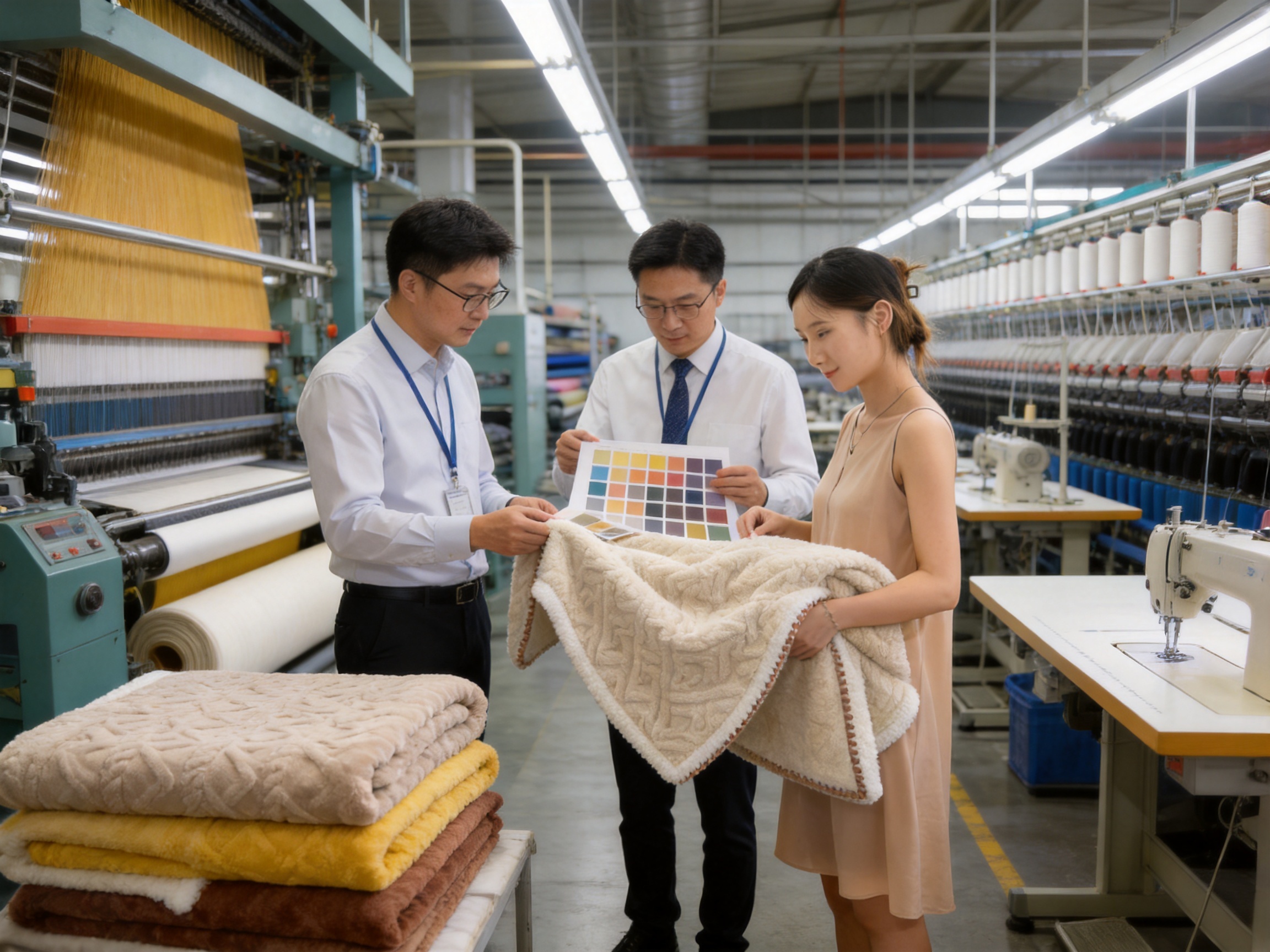
Textile product quality begins before final sewing. It depends on the selection and control of fibers, yarns, fabric structures, dyeing parameters, finishing treatments, and inspection procedures. The manufacturer’s focus on new textile technologies creates a foundation for developing products that respond to changing market preferences.
For this blanket, surface control is important because the product combines two different fabrics. The velveteen side must maintain a consistent plush appearance and clear jacquard texture. The sherpa side must retain a soft, fluffy feel. The joining process must connect both layers neatly without compromising drape or comfort.
Color control is also essential for solid-color blankets. A solid color may appear simple, but customers can notice uneven dyeing, shade variation, streaking, or fading. An organized dyeing and finishing operation can support better repeatability across production batches. This is particularly important for wholesale buyers developing coordinated collections or replenishing established colorways.
The company’s stated interest in ecological and environmental protection also aligns with current market expectations. Its company information references sustainable materials and production methods, including recycled polyester and water-saving dyeing techniques. It also reports OEKO-TEX® and GRS certifications. Buyers should verify the specific certification scope and applicability for each product, material, and production batch, but these stated priorities indicate an awareness of responsible textile manufacturing.
Environmental performance is increasingly connected to product quality. Efficient dyeing can reduce resource consumption, while durable construction can help extend product service life. Machine-washable care can also support practical ownership, provided users follow appropriate washing instructions and avoid unnecessary over-washing.
Wholesale customers evaluating this product should examine several areas before placing a large order. These include fabric hand, face and reverse appearance, shade consistency, dimensional accuracy, edge construction, seam strength, pilling behavior, wash performance, packaging, and labeling.
Sampling is recommended for buyers who need to match the blanket to a specific retail or hospitality program. A sample can be reviewed under different lighting conditions, washed according to the proposed care instructions, folded and unfolded repeatedly, and compared with the intended interior palette. Such testing helps confirm that the product meets the practical requirements of the target market.
For repeat orders, buyers may wish to establish approved color standards, size tolerances, packaging requirements, carton markings, inspection procedures, and delivery schedules. An integrated manufacturer can often coordinate these details more efficiently when the fabric and finished-product processes are managed through connected facilities.
Product documentation should clearly state the material composition, total weight, size, care instructions, manufacturing information, and any applicable certifications. Accurate documentation supports customs processing, retail compliance, customer communication, and after-sales service.
Because the blanket is intended for all ages, buyers should also consider general product safety requirements in their destination markets. These may include fiber labeling, flammability rules, chemical restrictions, packaging requirements, and testing standards. Requirements differ by country and application, so importers and distributors should confirm the regulations that apply to their specific sales channels.
Regular care should be simple, but the product’s softness and appearance are best preserved through sensible handling. Machine washing should follow the supplied instructions. Overloading the washing machine may prevent adequate rinsing and place unnecessary stress on seams and fabric surfaces.
Harsh bleach, excessive heat, and aggressive mechanical treatment may affect color, surface softness, or dimensional stability. A suitable detergent and a moderate care cycle are generally preferable. The blanket should be dried thoroughly before storage, especially when it is folded for an extended period.
When used in hotels, offices, or other commercial environments, blankets should be inspected periodically for seam wear, stains, surface damage, and loss of loft. A simple rotation system can distribute usage more evenly across an inventory. Proper storage in a clean, dry, ventilated area can help protect the fabric between uses.
The product’s polyester construction, welt-sewn edges, and double-layer structure support regular use, but service life still depends on the environment. Furniture surfaces, pets, sharp accessories, repeated friction, and improper laundering can affect performance. Communicating correct care to end users helps protect both customer satisfaction and the manufacturer’s reputation.
The product can serve as a foundation for customized wholesale programs. Potential areas for discussion may include color selection, size assortment, packaging, labeling, logo presentation, carton configuration, and order volume. A manufacturer with in-house or coordinated textile capabilities may be able to support development from material selection through finished product.
For hospitality buyers, customization can focus on colors that match the property’s interior identity. Retailers may request colors aligned with seasonal trends or existing home textile collections. Corporate purchasers may explore packaging suitable for employee gifts, customer appreciation programs, or event merchandise.
Customization should be managed with clear technical documentation. Buyers should define the desired shade, fabric weight, dimensions, edge finish, label content, packaging format, and quality expectations. Pre-production samples or approval samples are useful for confirming the final result before bulk manufacturing.
The manufacturer’s team of fabric engineers can support this process by discussing available structures, surface effects, color directions, and production feasibility. This can be especially valuable for buyers who want a product that is differentiated from standard market offerings without requiring an entirely new manufacturing platform.
In home textile retail, the blanket can be positioned as a premium reversible throw. Its strongest selling points include the jacquard texture, velveteen softness, sherpa reverse, solid-color versatility, and machine-washable care. Retail displays should show both surfaces and make the available sizes easy to understand.
For hotels and guest accommodations, the focus can shift toward presentation, comfort, washable construction, size options, and supply consistency. The blanket can complement bedrooms, suites, lounges, and reading spaces. Color coordination and replenishment capability may be particularly important to hospitality buyers.
For gifting, the product offers a broad appeal because it is useful across age groups and seasons. Packaging and color selection can be adapted to the occasion or organization. Larger sizes may create a stronger premium impression, while smaller throws can be suitable for larger distribution programs.
Travel distributors can present the blanket as a reusable comfort layer for aircraft, coaches, offices, and temporary accommodations. The machine-washable feature supports repeated use, and the smaller size options may be convenient for personal transportation.
The blanket is made from 100% polyester. It combines a 300gsm jacquard Shu velveteen face with a 200gsm sherpa fleece reverse, creating a total weight of 500gsm.
Yes. The blanket has a textured, plush velveteen side and a soft sherpa fleece side. Each surface offers a different tactile and visual experience.
Double layer means that two fabric layers are joined to create the finished blanket: a jacquard Shu velveteen face and a sherpa fleece reverse. The construction supports warmth, softness, and a fuller hand feel.
The available sizes are 50 by 60 inches, 60 by 80 inches, 90 by 90 inches, and 90 by 110 inches. These options cover personal throws, larger individual blankets, shared sofa use, and generous bed coverage.
Yes. The product is designed for machine washing. Users should follow the care instructions supplied with the finished blanket and avoid unsuitable washing or drying conditions.
It is identified as an all-season blanket. The double-layer structure provides warmth in cooler conditions, while the soft, versatile design makes it suitable for air-conditioned rooms, transitional weather, travel, and indoor comfort throughout the year.
Recommended applications include sofas, beds, hotels, airplanes, offices, study areas, coaches, and other indoor or travel settings. It can also be used as a gift or as an additional comfort layer in guest accommodations.
Welt sewing is a finished edge construction used to create a neat border and strengthen the connection at the seams. In this blanket, it contributes to a cleaner appearance and supports durability during regular handling.
The product is described as being available in solid colors, with a clear jacquard texture design on the velveteen surface. This offers visual interest while remaining easy to coordinate with different interiors.
It combines a soft plush touch with a defined surface texture. This can make the blanket look more refined than a completely flat fleece throw and can improve its suitability for decorative home, hospitality, and retail applications.
The sherpa reverse provides a fluffy, soft surface intended to enhance warmth and comfort. It gives the blanket a second tactile identity and allows users to select the side they prefer against the body.
Customization may be discussed for areas such as colors, sizes, packaging, labeling, and private-label requirements. Buyers should provide clear specifications and approve samples before bulk production.
The manufacturer has experience in weaving, dyeing and printing, and finished textile processing. It also has a team of more than 20 fabric engineers and develops new fabric concepts based on market trends and customer requirements.
Buyers should review samples, fabric hand, surface consistency, shade accuracy, dimensions, seam quality, wash performance, packaging, labeling, certification documentation where applicable, and destination-market compliance requirements.
The Jacquard Shu Velveteen Sherpa Throw Blanket is designed to meet the modern demand for home textiles that are attractive, soft, warm, durable, versatile, and easy to maintain. Its 500gsm double-layer construction combines a 300gsm jacquard Shu velveteen face with a 200gsm sherpa fleece reverse, offering two distinct surfaces in one practical product.
Its advantages over ordinary blankets are found in the balance of features. The textured velveteen side gives the blanket a more refined appearance than a basic fleece throw. The sherpa reverse provides a fluffy and comfortable surface. Welt sewing supports a neat, durable finish. Solid colors make the product easier to coordinate with residential, hospitality, office, and travel environments. Multiple sizes allow buyers to serve different use cases, while machine-washable care supports everyday convenience.
The company behind the product adds value through integrated textile capabilities, including weaving, dyeing and printing, finished-product processing, fabric engineering, and customized development. Its focus on textile technology, production coordination, sustainability, and quality control provides a strong foundation for wholesale supply and private-label programs.
For distributors, retailers, hotels, offices, and gift buyers, this blanket offers a flexible product platform with broad market appeal. It can be sold as a premium throw, supplied as a hospitality comfort item, included in a corporate gift program, or carried as a reusable travel blanket. Through the combination of material selection, double-sided construction, careful sewing, practical care, and coordinated manufacturing, it presents a compelling option in the competitive blanket market.
1. Product specification sheet for the Jacquard Shu Velveteen Sherpa Throw Blanket, including material, weight, sizes, construction, care, and recommended uses.
2. Manufacturer-provided company information for Zhejiang Benyi Textile Technology Co., Ltd., including textile production capabilities, engineering resources, customization services, and sustainability initiatives.
3. General textile manufacturing principles relating to polyester fibers, knitted fabric construction, jacquard surface development, fleece finishing, edge sewing, and machine-washable home textiles.
4. General quality-control considerations for wholesale blankets, including dimensional accuracy, color consistency, seam performance, surface durability, labeling, packaging, and care testing.
5. General guidance for responsible textile sourcing, including review of material claims, certification scope, dyeing practices, production traceability, and destination-market compliance.

ADD: No.75 Zhenyuan Road, Yuecheng District, Shaoxing City, Zhejiang Province, China 312000

Tel : +86-189 6750 9795

FAX : +86-0575-8803 2773

Email : fisher@benetextile.com

Copyright © Zhejiang Benyi Textile Technology Co., Ltd. All Rights Reserved. Carpets and Rugs Manufacturer

 English
 Français
 Deutsch
 عربى