

Shen Ruoxi — International Product Sales Executive
 Home / Author / Shen Ruoxi — International Product Sales Executive / Three-Dimensional Bubble Fabric: A Durable, Customizable Solution for Carpets, Rugs, and Bath Mats
  2026.08.07
 Shen Ruoxi — International Product Sales Executive
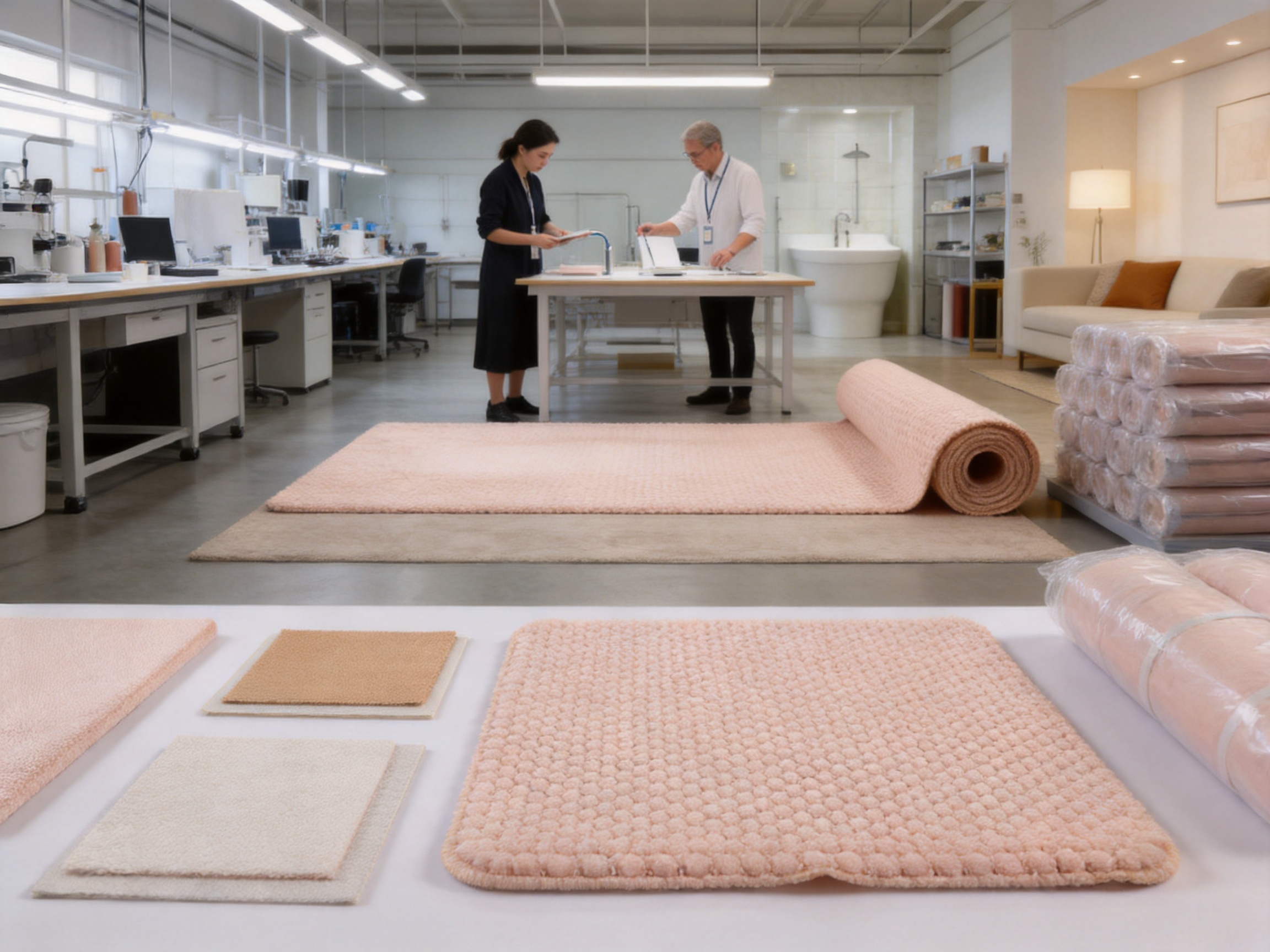
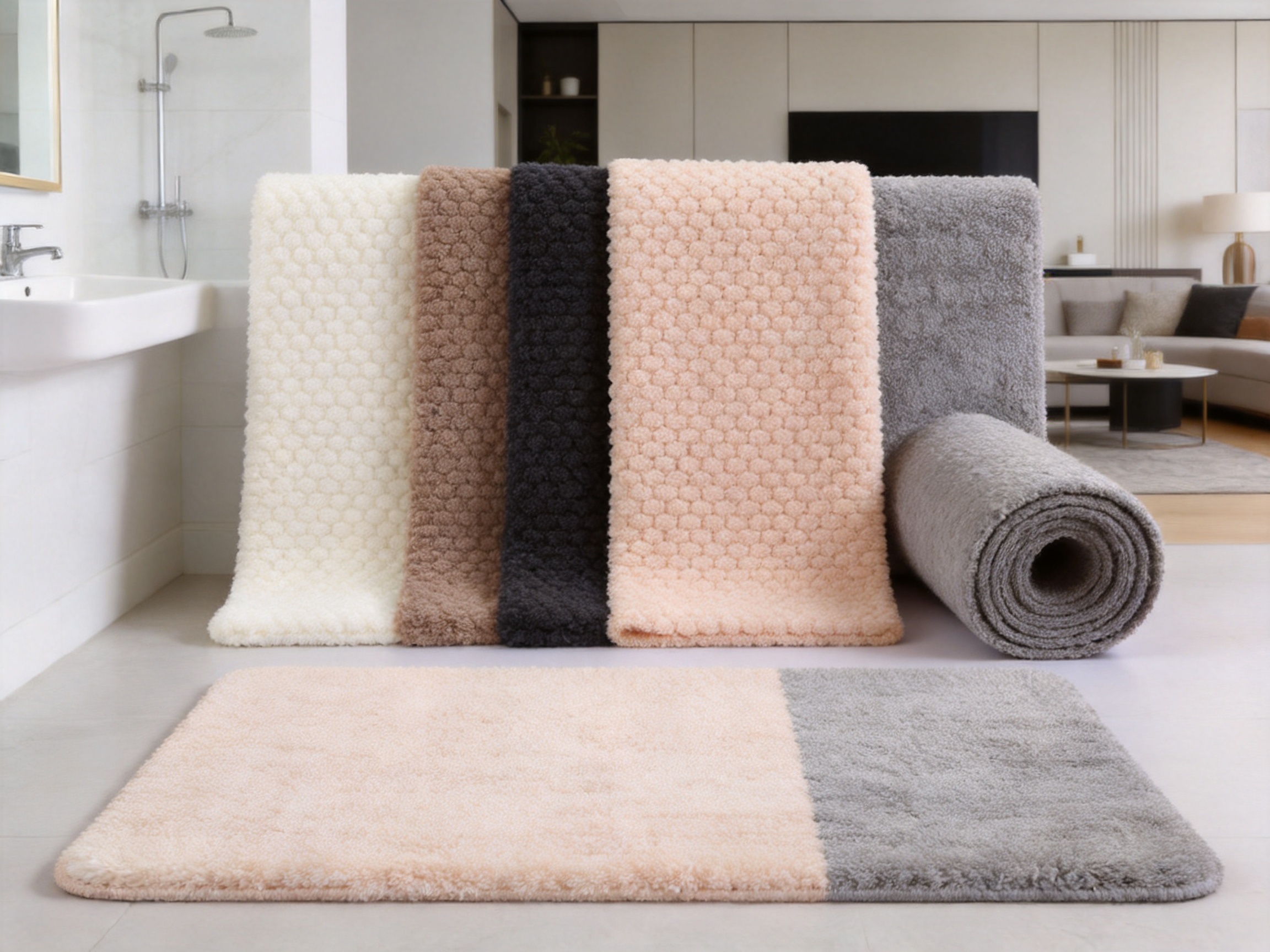
Three-dimensional Bubble Fabric is a knitted carpet textile designed for manufacturers, wholesalers, retailers, and home textile brands seeking a distinctive surface, dependable performance, and flexible production options. Made from 100% polyester microfiber, this fabric combines a robust construction with a soft, luxurious hand feel. Its raised 4 mm pile and concave-convex particle design create a clearly visible three-dimensional effect while providing a pleasant underfoot sensation.
Unlike conventional flat carpet fabrics, this material is engineered to offer depth, texture, and visual movement. The bubble-like surface can help finished carpets, area rugs, bath mats, and related home textile products stand apart in a competitive marketplace. At the same time, its polyester composition supports durability, color retention, efficient processing, and broad application potential.
The fabric is supplied in standard widths of 170 cm, 190 cm, and 210 cm, with customized widths available for special projects. The maximum width can reach 3.2 meters according to production requirements. It is available as a make-to-order product, allowing customers to select colors and discuss specifications according to their intended application. With a minimum order quantity of 500 kilograms per color and an estimated delivery time of 15 to 20 days, it is suitable for both planned collections and commercial production programs.
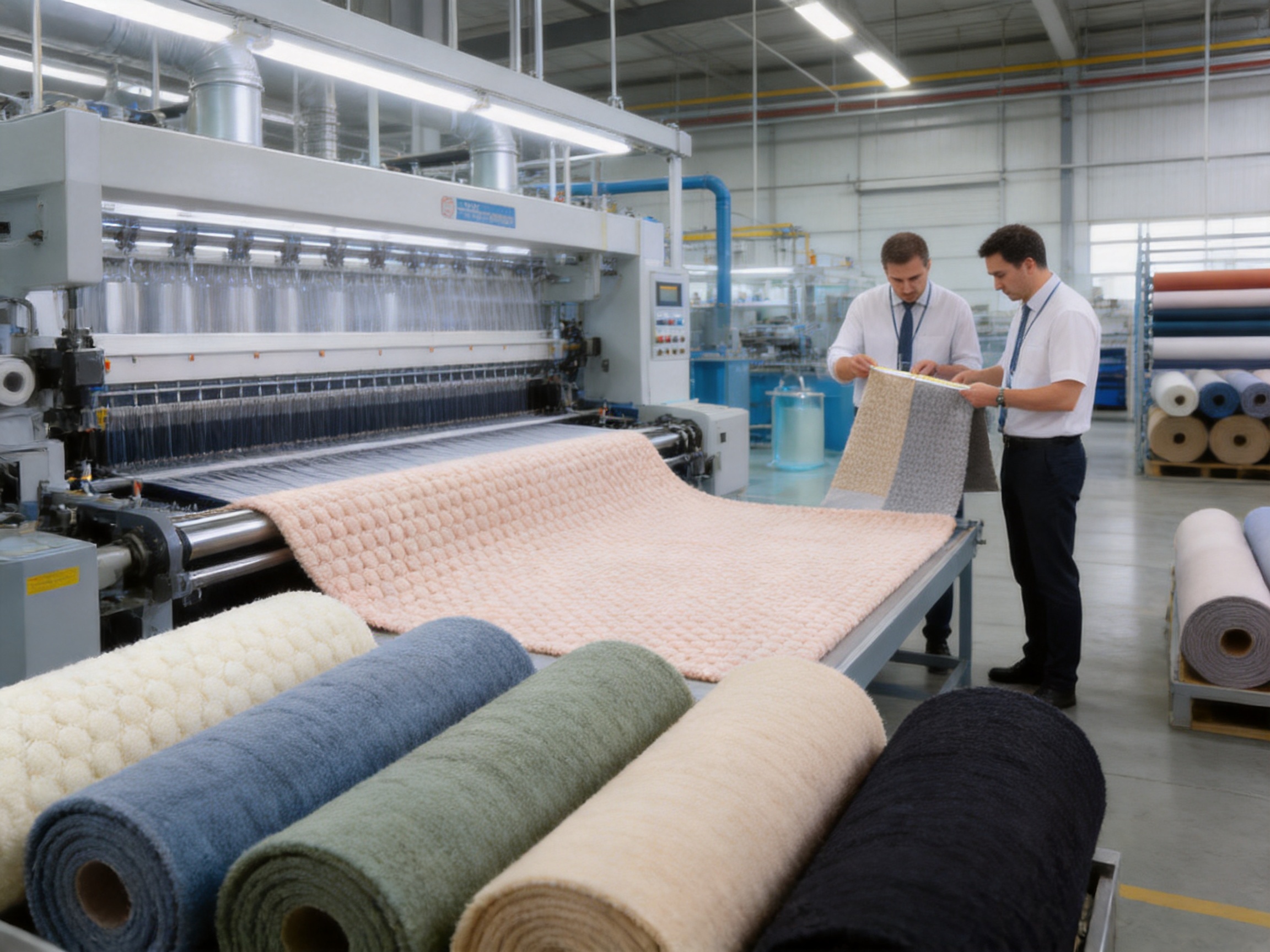
Produced by Zhejiang Benyi Textile Technology Co., Ltd., the fabric reflects an integrated approach to textile development. The company combines fabric engineering, weaving, dyeing or printing, and finished carpet processing capabilities. This integrated structure gives customers access to coordinated development, controlled production, and more efficient communication throughout the supply chain.
Content
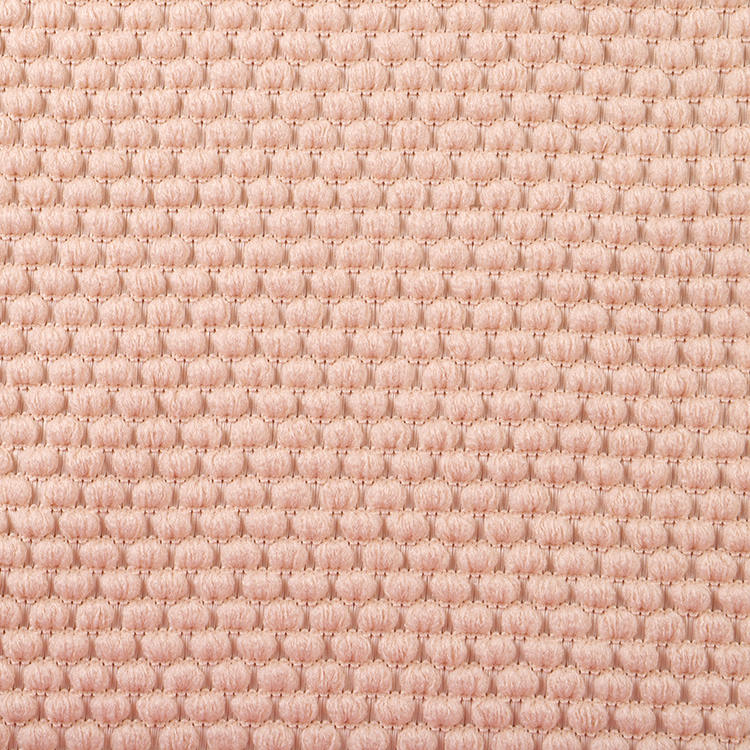
The most recognizable characteristic of this textile is its dimensional surface. A 4 mm pile height gives the fabric a raised profile, while the concave-convex particle structure creates a tactile pattern that can resemble bubbles or rounded relief. This surface is not only decorative. It also changes how the fabric feels underfoot and how it interacts with light.
When used in an area rug or bath mat, the raised pattern produces a richer visual effect than a plain, low-profile knitted surface. Light and shadow move across the texture, helping solid dyed colors appear more dynamic. The result is a textile that can be used in minimalist, contemporary, hospitality, lifestyle, and family-oriented collections.
The three-dimensional structure also gives designers more opportunities to create products with a recognizable identity. Many standard carpet fabrics rely primarily on color to differentiate one product from another. Bubble Fabric adds surface architecture to the design process. A brand can select a single color while still presenting a product with depth and visual character.
For bath mats, the textured construction can contribute to a comfortable stepping experience. For rugs and carpets, it can create a more substantial appearance and a stronger sense of softness. For product developers, this means the same fabric concept can be adapted across several categories without requiring a completely different material platform.
| Specification | Details |
|---|---|
| Product name | Bubble Fabric |
| Item model number | 100124 |
| Material | 100% polyester microfiber |
| Weight | 380 gsm |
| Standard widths | 170 cm, 190 cm, and 210 cm |
| Maximum stated width | Up to 3.2 meters, subject to production requirements |
| Pile height | 4 mm |
| Supply type | Make-to-order |
| Technics | Knitted |
| Recommended usage | Carpets, area rugs, and bath mats |
| Color | Solid dyed, with customized colors available |
| Minimum order quantity | 500 kilograms per color |
| Package | Rolls |
| Estimated delivery time | 15 to 20 days |
| Primary features | Three-dimensional surface and robust construction |
Material selection is central to the performance of a carpet fabric. This Bubble Fabric uses 100% polyester microfiber, a fiber choice valued for its balance of resilience, appearance, processing efficiency, and cost control. The microfiber construction contributes to a refined surface and a comfortable hand feel, while the polyester base provides a practical foundation for commercial home textile production.
Polyester is widely used in carpets and rugs because it can withstand regular household use when properly constructed and finished. It is suitable for products that may experience repeated foot traffic, routine cleaning, transportation, storage, and seasonal changes in demand. Its relatively stable performance makes it useful for manufacturers that need a dependable material for repeat production.
The fabric is also designed to support color consistency. Solid dyed colors allow brands to build coordinated product families, including matching or complementary rugs, bath mats, and other soft furnishing products. Because the color is an important part of a finished textile’s commercial appeal, the ability to specify colors according to a collection can help businesses maintain a coherent visual identity.
The microfiber surface offers a soft touch without sacrificing the firm, structured quality expected from a 380 gsm carpet fabric. This balance is particularly useful when a product needs to feel comfortable while still retaining enough body for cutting, sewing, edging, backing, or other finishing operations.
The product information identifies the fabric as durable and fade resistant. These characteristics are important in home textile applications because carpets, rugs, and mats are often exposed to sunlight, repeated handling, friction, dust, and cleaning. No textile is completely immune to wear or color change, and final performance depends on construction, backing, care, and environment. However, a polyester microfiber base offers a strong starting point for developing products intended for regular use.
Compared with more delicate fibers, polyester can provide a practical advantage for manufacturers serving value-conscious and mid-market segments. It can help reduce the need to use expensive specialty fibers while still delivering a soft and visually attractive result. This combination allows brands to position the finished product as both comfortable and commercially accessible.
For buyers comparing fabrics, it is important to assess not only fiber content but also weight, pile height, knitting structure, dyeing quality, backing compatibility, and finished-product testing. The 380 gsm weight and 4 mm pile provide useful reference points during product development. Buyers may also request samples and conduct their own abrasion, colorfastness, dimensional stability, and care evaluations before placing a large order.
Surface design has become an increasingly important part of home textile development. Consumers often evaluate a rug or bath mat through several senses at once: visual appearance, softness, thickness, texture, and perceived quality. Bubble Fabric addresses these expectations with a raised, tactile surface that is easy to recognize.
The 4 mm pile height provides enough relief to create a noticeable dimensional effect without making the fabric excessively deep. This can be advantageous for products that require an attractive texture while still needing practical handling and processing. The surface can be used as a central design feature or combined with edging, backing, printed elements, labels, and other finishing details.
The concave-convex particle design is another distinguishing feature. Instead of presenting a completely uniform face, the structure creates repeated raised and recessed areas. This may provide a gentle massage-like sensation under the feet, as described in the product information. Such a feature can be especially relevant to bath mats, bedroom rugs, and comfort-oriented household products.
From a merchandising perspective, a dimensional surface can improve shelf and showroom presentation. Texture catches light differently from flat fabric, allowing a product to remain visually interesting even when offered in a single solid color. This may help retailers develop collections that feel more premium without relying on complex printing or elaborate yarn combinations.
Three-dimensional Bubble Fabric
Although the fabric is listed for carpets, rugs, and bath mats, its structure provides flexibility for several related applications. Buyers should match the fabric to the intended use and complete appropriate performance testing, but the material’s appearance and construction make it a useful platform for diverse product concepts.
Area rugs are one of the most natural applications for Three-dimensional Bubble Fabric. The raised face can give a room a warmer, more layered appearance, while solid dyed colors make it easier to coordinate the rug with furniture, curtains, bedding, and decorative accessories. The fabric can be converted into different shapes and sizes according to a brand’s collection strategy.
Manufacturers may use the material for small accent rugs, bedside rugs, children’s room products, living room designs, and larger decorative pieces. Depending on the final construction, the fabric can be combined with suitable backing materials to improve stability and support. Edging options may include overlocking, binding, tape, or other finishing methods selected according to the product’s target market.
The tactile pile and concave-convex design are particularly relevant to bath mat development. A bath mat should provide a comfortable surface after bathing while presenting a clean and attractive appearance. Bubble Fabric can help brands create products that feel soft and textured underfoot rather than flat and basic.
For bath mat production, the selection of backing, absorbency requirements, drying behavior, washing instructions, and slip-resistance performance should be considered separately. The fabric itself provides the surface design, but the completed bath mat must be engineered as a finished product. Buyers should therefore evaluate the compatibility of the textile with the selected backing and finishing process.
As a carpet fabric supplied in rolls, the product can support manufacturers that prefer to complete cutting and finishing in their own facilities or through local production partners. Roll supply can improve material handling and enable customers to produce multiple sizes from the same base fabric.
For wholesale buyers, roll goods can also simplify inventory planning. A single fabric platform may be allocated to several product styles, reducing the need to manage many unrelated materials. This is particularly useful for brands that launch color-based collections or seasonal home textile programs.
The supplied information identifies carpets, rugs, and bath mats as the main uses. However, product developers may also investigate kitchen mat and door mat concepts, provided that the finished construction is tested for the specific conditions of those applications. Kitchen mats may require resistance to frequent cleaning and spills, while door mats may face heavier dirt, moisture, and abrasion exposure.
The fabric’s solid colors and dimensional design could support coordinated room collections. For example, a brand could develop a bath mat, bedside rug, and entrance accent mat using related shades and the same textured surface language. Such coordination can increase the perceived completeness of a home textile range.
The production of Three-dimensional Bubble Fabric begins with 100% polyester microfiber yarns selected for the required appearance and performance objectives. The yarn is knitted into a structure that supports the raised surface and the characteristic dimensional effect. Knitting allows the manufacturer to engineer texture, flexibility, weight, and surface formation within the fabric construction.
After knitting, the fabric can proceed through dyeing and finishing stages. Solid dyeing is used to create consistent color across the fabric, while the finishing process helps establish the desired hand feel, surface appearance, and usable width. Exact processing parameters may vary according to color, order quantity, width, and customer specifications.
The 380 gsm specification provides a clear production target for buyers. Weight control is important because differences in fabric weight can affect hand feel, cutting yield, finished-product thickness, shipping calculations, and perceived value. Production control at this stage helps maintain consistency between batches and supports repeat orders.
The raised pile height is specified at 4 mm. Maintaining the intended pile height requires careful control of knitting and finishing conditions. If the pile becomes too low, the three-dimensional effect may be weakened. If it becomes too high or uneven, the material may become more difficult to process or may not match the buyer’s original design expectations.
Zhejiang Benyi Textile Technology Co., Ltd. operates within Shaoxing, Zhejiang Province, a region recognized as a major global textile manufacturing center. The company has its own weaving, dyeing and printing factories, and finished carpet processing factories. This integrated structure allows different stages of production to be coordinated under one business system.
Vertical or semi-integrated production can offer several advantages over fragmented sourcing. Communication between fabric development, dyeing, and finishing teams can be more direct. Technical changes can be reviewed more efficiently. Production schedules may be easier to coordinate, and quality issues can be traced more systematically through the manufacturing chain.
For overseas buyers, supply chain coordination is especially important. A product may require specific width, color, weight, pile height, packaging, and delivery timing. When these requirements pass through several independent companies, misunderstandings can occur. An integrated supplier can reduce the number of communication points and provide a more unified response to technical questions.
The company also combines the fabric and surface with the bottom layer in its broader carpet production model. This approach is intended to simplify carpet manufacturing and improve production efficiency compared with traditional processes that may involve more separate stages and higher labor requirements.
The company has a team of more than 20 fabric engineers and develops new carpet fabrics each quarter based on market trends. This design and engineering capacity supports a product development model rather than a purely commodity-oriented supply model. Customers can discuss new textures, colors, constructions, and application requirements with a team familiar with carpet fabric production.
Quarterly development is relevant to brands working in fast-moving home décor categories. Consumer preferences can change with interior design trends, retail programs, seasonal collections, and regional tastes. A supplier that continually develops new fabrics may help customers refresh their product offerings without starting from an entirely new supply chain.
Customization is also available according to customer requirements. This may include width, color, order planning, and potentially other construction or finishing details subject to technical review. A make-to-order structure is appropriate for buyers who need a specific material rather than an off-the-shelf fabric selected from limited inventory.
Every carpet material should be judged according to the intended application, but Three-dimensional Bubble Fabric offers several practical advantages compared with conventional flat or less textured carpet fabrics.
A flat fabric can provide a clean and simple appearance, but it may offer fewer visual points of difference. The bubble structure creates depth without depending entirely on printed patterns. This allows manufacturers to develop products that appear more tactile and decorative while maintaining a solid color palette.
Some lightweight textiles feel soft but lack body, while some heavy materials feel firm but less comfortable. This product aims to balance softness and robustness through microfiber yarn, a 380 gsm weight, and a raised 4 mm pile. The result is intended to feel pleasant while remaining suitable for conversion into rugs and mats.
Standard widths of 170 cm, 190 cm, and 210 cm cover many common carpet and rug production requirements. Customized widths are also available, and the stated maximum width can reach 3.2 meters. Wider material can help reduce seams or improve cutting efficiency in selected product formats.
Solid dyed colors make the fabric suitable for coordinated home textile programs. The product can be dyed to different colors according to customer needs, allowing brands to select shades for private-label collections, contract projects, seasonal launches, or retailer-specific ranges.
Roll packaging protects the fabric during transportation and provides a practical format for industrial processing. Rolls can be stored, measured, cut, and distributed according to the buyer’s manufacturing plan. Secure packaging also helps preserve the fabric’s integrity between production and delivery.
Make-to-order production can be beneficial for buyers that require customized specifications. Instead of limiting customers to existing inventory, the supplier can organize production around a confirmed order, color requirement, and technical agreement. This approach may be particularly valuable for brands managing planned collections or project-based purchasing.
Quality control for a three-dimensional carpet fabric involves more than checking color. The fabric’s dimensional appearance, pile height, weight, width, surface consistency, and roll condition all influence the finished product. A professional purchasing process should define acceptance criteria before bulk production begins.
Weight should be checked against the 380 gsm target. Width should be measured at multiple points to confirm that the material meets the agreed specification. The pile should be inspected for uniformity, and the bubble pattern should be reviewed for irregularities, missing areas, or unwanted distortion.
Color control is also essential. Solid dyed fabrics should be compared against an approved standard or laboratory dip before bulk production. Buyers may request colorfastness testing suitable for the anticipated use, including resistance to rubbing, washing, water, and light where relevant.
Roll inspection should identify creases, stains, knitting faults, dyeing marks, holes, edge damage, and variation between sections. Proper roll labeling can help buyers identify color, lot, length, weight, and production details during warehouse handling and subsequent cutting.
Because final performance depends on the complete product, buyers should also test the fabric after backing, binding, lamination, or other finishing treatments. A surface that performs well by itself may respond differently when combined with adhesives, backing materials, washing processes, or heat treatments. Testing the final rug or mat is therefore an important part of responsible product development.
Environmental responsibility is an important consideration in modern textile sourcing. Zhejiang Benyi Textile Technology Co., Ltd. states that it focuses on ecological protection, environmental improvement, and healthier consumer experiences. The company invests in sustainable materials and production methods, including recycled polyester and water-saving dyeing techniques.
The company also states that it has passed OEKO-TEX® and Global Recycled Standard certifications. Buyers should request current certification documents and confirm the scope, validity, and applicability of each certification to the specific product and production facility. Certification review is an important part of responsible sourcing because standards may apply to particular materials, processes, or locations.
Polyester-based textiles can be considered within a broader circularity strategy when recycled polyester is used, production waste is controlled, and products are designed for appropriate service life. Durability is also relevant to sustainability: a product that remains attractive and usable for a longer period may reduce the frequency of replacement.
Water-saving dyeing methods can help reduce resource consumption, although the environmental profile of a finished product depends on many factors, including fiber origin, energy use, chemical management, wastewater treatment, packaging, transportation, and end-of-life options. Buyers should evaluate these elements as part of a complete sustainability program rather than relying on a single attribute.
For brands developing environmentally conscious carpets and mats, the supplier can discuss recycled material options, color requirements, production methods, and documentation. It is advisable to confirm the exact composition and certification status of each order, particularly when marketing claims will be made to consumers.
Customization is one of the most useful features of the product. The standard width options provide a starting point, while customized widths can be considered for specific cutting layouts or finished-product dimensions. This flexibility can help reduce unnecessary seams and improve material utilization in selected designs.
Color customization is another important benefit. The fabric can be dyed in solid colors, allowing customers to build collections around neutral shades, fashion colors, hospitality palettes, or retailer-specific requirements. A buyer may request a color development process that includes laboratory samples, approval standards, and bulk production confirmation.
Customization should begin with a clear technical brief. The brief may include intended use, finished dimensions, target weight, color references, pile appearance, backing requirements, roll length, packaging expectations, and delivery schedule. The more complete the brief, the easier it is for the production team to evaluate feasibility and prepare an accurate quotation.
The minimum order quantity is 500 kilograms per color. This quantity supports efficient dyeing and production planning while remaining accessible to many commercial buyers. Customers ordering several colors should consider the relationship between color quantity, sampling requirements, and forecast demand. A realistic purchasing plan can help prevent excess inventory and reduce the risk of interrupted supply.
Area rug brands can use the fabric to introduce textured collections with a recognizable design signature. Bath mat manufacturers can emphasize softness and raised comfort. Wholesale distributors can offer a fabric platform that supports multiple finished formats. Interior design projects may benefit from customized colors and widths that match a specific space.
Private-label retailers may also find the product useful because the solid dyed surface and dimensional construction can be adapted to different price points and packaging concepts. A single textile base can be turned into several product sizes and coordinated room accessories, creating opportunities for cross-selling.
Contract and hospitality buyers should review the fabric against project-specific requirements, including traffic levels, cleaning methods, fire regulations, slip resistance, and maintenance expectations. The fabric’s stated features provide a development foundation, but project compliance must be confirmed for the final product and destination market.
The stated delivery time is 15 to 20 days. This estimate is useful for planning, but the actual schedule may depend on color approval, order quantity, production capacity, raw material availability, inspection, and shipping arrangements. Buyers should confirm the delivery schedule at the time of order and allow additional time for international transportation and customs clearance.
Roll packaging is used to protect the textile during handling and transport. Before shipment, buyers may request details regarding roll dimensions, approximate roll weight, labeling, outer wrapping, palletization, and loading arrangements. These details can influence warehouse planning and freight calculations.
For repeat programs, buyers can improve supply reliability by sharing forecasts and expected reorder intervals. A forecast does not necessarily replace a confirmed order, but it can help the supplier plan yarn, dyeing capacity, production slots, and shipping arrangements. Repeat orders should also reference an approved sample or production standard to maintain consistency.
Inventory planning is especially important for make-to-order fabrics. Buyers should consider the time required for sample approval, color development, production, inspection, and delivery. If a finished rug collection is tied to a retail launch, production should be scheduled early enough to accommodate potential adjustments.
The fabric can be used in understated and highly decorative designs. Neutral colors such as beige, gray, cream, charcoal, and taupe can emphasize the texture and suit modern interiors. Richer shades can create stronger visual impact in bedrooms, children’s spaces, seasonal collections, and hospitality environments.
Because the surface is already dimensional, designers do not necessarily need complicated prints or multiple colors to make the product interesting. A monochromatic rug can still have a strong visual identity through its relief pattern. This may simplify design development and help reduce the number of components used in a finished product.
Designers may also explore combinations of Bubble Fabric with contrasting borders, smooth backing, woven labels, embroidered details, or other decorative techniques. The raised face can serve as the primary feature, while the edging establishes the final style. Different dimensions can be developed for bedside, bathroom, hallway, living room, and entrance use.
For coordinated collections, the same color family can be applied to multiple sizes and categories. A bathroom range might include a bath mat and toilet mat, while a bedroom range could include a bedside rug and larger area rug. Such coordination helps brands present a complete interior concept rather than a single isolated product.
A sample review should begin with visual inspection. Buyers should examine whether the three-dimensional effect is even and whether the solid dyed color meets the approved standard. The surface should be checked under different lighting conditions because texture may appear different in natural light, showroom light, and warehouse lighting.
The hand feel should be assessed by touching and compressing the pile. Buyers can compare softness, recovery, firmness, and overall body against competing materials. The sample should also be placed on a floor or test surface to evaluate how the texture looks at the intended viewing distance.
Cutting and sewing trials can provide valuable information. A manufacturer should test whether the fabric cuts cleanly, whether the edges remain stable, and whether the material is compatible with the selected binding or overlocking process. If adhesive or lamination will be used, a small trial can reveal potential issues before bulk production.
For bath mats and washable products, laundering trials should be performed according to the intended care instructions. Buyers can inspect shrinkage, pile appearance, color change, edge behavior, and backing adhesion after washing and drying. For rugs and carpets, abrasion and repeated-use simulations may be appropriate.
Testing should be documented and linked to a product specification. This creates a clear reference for bulk inspection and future repeat orders. It also helps the buyer communicate expectations to internal design, purchasing, quality, and logistics teams.
Zhejiang Benyi Textile Technology Co., Ltd. is located at No. 75 Zhenyuan Road, Yuecheng District, Shaoxing City, Zhejiang Province, China. Shaoxing is widely associated with textile production, and the company uses this industrial environment to support the development and manufacture of carpet fabrics and finished textile products.
The company’s business model combines textile technology with practical manufacturing. Rather than focusing only on finished products or only on raw fabric, it works across fabric development, surface and bottom integration, dyeing or printing, and carpet processing. This broader capability supports customers that need either fabric rolls or more complete product solutions.
Its team of more than 20 fabric engineers contributes to ongoing product development. New carpet fabrics are developed each quarter in response to market trends, and customized services are available for customer requirements. This engineering resource is a meaningful advantage for buyers that want to develop original textures rather than select from a fixed catalog.
The company also emphasizes ecological protection and consumer health experiences. Its stated use of recycled polyester and water-saving dyeing methods reflects an effort to address the environmental impact of textile manufacturing. OEKO-TEX® and GRS certification claims provide additional points for buyers to verify during supplier evaluation.
Full-chain production control can help manage quality and lead time. When weaving or knitting, dyeing, printing, and finished carpet processing are connected within one supply organization, changes can be coordinated more efficiently. This can be especially valuable for custom orders involving unusual widths, new colors, or special product formats.
Before confirming an order, buyers should request a complete technical data sheet and a production sample. Questions may cover the exact material composition, available colors, color matching procedure, width tolerance, weight tolerance, pile height tolerance, roll length, packaging, and delivery schedule.
Buyers should also ask which specifications remain standard and which can be customized. The stated standard widths are 170 cm, 190 cm, and 210 cm, while customized widths and a maximum width of up to 3.2 meters are indicated. The precise achievable width may depend on the selected construction, dyeing process, and order requirements.
For finished carpet or bath mat production, it is necessary to confirm suitable backing and finishing options. The supplier can help determine whether a particular backing system is compatible with the fabric, but final product testing should be completed by the buyer or finished-product manufacturer.
Documentation is also important for international trade. Buyers may need packing lists, commercial invoices, certificates, test reports, certification documents, and other records depending on the destination market. These requirements should be discussed before production and reflected in the order terms.
The fabric is made from 100% polyester microfiber. This material provides a combination of durability, soft touch, color flexibility, and practical processing characteristics for carpet, rug, and bath mat applications.
The effect comes from the knitted construction, the 4 mm pile height, and the concave-convex particle design. Together, these features create raised and recessed areas that give the fabric visible depth and a tactile surface.
The stated weight is 380 gsm, or 380 grams per square meter. Weight is an important reference for evaluating thickness, hand feel, cutting yield, shipping calculations, and finished-product development.
Standard widths include 170 cm, 190 cm, and 210 cm. Customized widths are available, and the product information states that the maximum width can reach 3.2 meters, subject to technical and production confirmation.
Yes. The fabric is supplied in solid dyed colors and can be dyed to customer-selected colors. Buyers should submit a color reference and approve a laboratory sample or development sample before bulk production.
The minimum order quantity is 500 kilograms per color. Buyers should plan color quantities carefully, particularly when developing several shades for a new collection.
The stated supply type is make-to-order. This means that production is organized according to the confirmed requirements rather than relying exclusively on standard warehouse inventory.
The stated delivery time is 15 to 20 days. The final schedule should be confirmed according to color approval, order quantity, production planning, inspection, and shipping arrangements.
The fabric is packaged in rolls. Roll packaging is suitable for transportation, storage, cutting, and industrial conversion into finished rugs, mats, and carpet products.
Yes. Bath mats are one of the listed applications. However, the final bath mat must be evaluated as a complete product, including backing, absorbency, washing performance, drying behavior, and slip resistance.
Yes. The dimensional surface, solid dyed colors, 380 gsm weight, and 4 mm pile make it suitable for area rug development. The finished rug should be matched with an appropriate backing and edge treatment.
The concave-convex particle design is described as providing a massage-like sensation underfoot. The exact sensation will depend on the final product construction, backing, floor surface, and user preference.
Not automatically. Suitability depends on traffic, cleaning, fire, slip, abrasion, and other requirements applicable to the intended market. Commercial buyers should conduct application-specific testing before approval.
The supplier has weaving, dyeing and printing factories, and finished carpet processing factories. It also has a team of more than 20 fabric engineers and develops new carpet fabrics each quarter.
The company states that it invests in recycled polyester, water-saving dyeing techniques, and other sustainable production methods. It also states that it has passed OEKO-TEX® and GRS certifications. Buyers should request current documentation and verify the scope of each certification.
A buyer should provide the intended application, target width, color, approximate quantity, desired delivery date, finishing method, and any applicable testing or certification requirements. The supplier can then review feasibility and prepare samples or a quotation.
Three-dimensional Bubble Fabric offers a practical combination of visual distinction, tactile comfort, durable polyester construction, and manufacturing flexibility. Its 4 mm raised pile and concave-convex particle structure create a recognizable surface that can help carpets, area rugs, and bath mats stand apart from flatter conventional fabrics.
The 380 gsm weight, solid dyed colors, roll packaging, and customizable widths make the product suitable for commercial home textile development. Standard widths of 170 cm, 190 cm, and 210 cm support common production requirements, while customized widths and a stated maximum width of up to 3.2 meters provide additional flexibility.
The product is strengthened by the supplier’s broader manufacturing capabilities. Zhejiang Benyi Textile Technology Co., Ltd. combines textile engineering, weaving, dyeing or printing, and finished carpet processing. Its team of more than 20 fabric engineers supports ongoing innovation and customized development, while its emphasis on integrated production can help improve communication, quality coordination, and lead-time management.
For buyers, the best results will come from a structured development process that includes sample approval, color confirmation, application testing, production inspection, and certification verification where required. When matched with an appropriate backing and finishing method, this fabric can serve as a versatile platform for distinctive, comfortable, and commercially competitive carpet and mat collections.
1. Product specification for Bubble Fabric, item model number 100124, including material, weight, width, pile height, applications, MOQ, packaging, and delivery information.
2. Technical product description of Three-dimensional Bubble Fabric, including knitted construction, microfiber composition, concave-convex particle design, solid dyeing, and customized width information.
3. Internal company information concerning textile engineering, integrated weaving, dyeing, printing, and finished carpet processing capabilities.
4. General textile manufacturing principles relating to polyester microfiber, knitted carpet fabrics, pile construction, dyeing, roll packaging, and finished-product testing.
5. Sustainability information concerning recycled polyester, water-saving dyeing methods, OEKO-TEX® certification, and Global Recycled Standard certification, subject to current documentation and scope verification.

ADD: No.75 Zhenyuan Road, Yuecheng District, Shaoxing City, Zhejiang Province, China 312000

Tel : +86-189 6750 9795

FAX : +86-0575-8803 2773

Email : fisher@benetextile.com

Copyright © Zhejiang Benyi Textile Technology Co., Ltd. All Rights Reserved. Carpets and Rugs Manufacturer

 English
 Français
 Deutsch
 عربى
عربى