

Tang Meilin — Customer Success and Product Support Specialist
 Home / Author / Tang Meilin — Customer Success and Product Support Specialist / Diatomite Non-Slip Bath Mat: A Practical Guide to Comfort, Water Absorption, Safety, and Custom Manufacturing
  2026.08.25
 Tang Meilin — Customer Success and Product Support Specialist
A well-designed bath mat should do more than decorate the floor beside a bathtub, shower, or washbasin. It should absorb moisture quickly, provide a comfortable surface underfoot, remain stable during use, dry efficiently, and continue to look attractive after repeated washing. The Diatomite Non-Slip Bath Mat is developed to combine these everyday requirements in one versatile indoor floor covering. With its soft leathaire surface, absorbent middle foam layer, durable rubber backing, bonded construction, and contemporary rectangular design, it is suitable for bathrooms, kitchens, children’s rooms, entrances, and other indoor areas where moisture control and underfoot comfort are important.
The mat is available in standard sizes of 40 × 60 cm, 50 × 80 cm, and 60 × 90 cm. Custom dimensions can also be produced for particular retail programs, hospitality projects, residential developments, and private-label collections. Its 3 mm thickness gives the product a relatively slim profile while still providing a cushioned and comfortable feel. At 1800 gsm, it offers a substantial construction designed for regular household use without creating the excessive bulk associated with some thick pile mats.
In a competitive bath mat market, buyers increasingly look for products that combine a modern appearance with measurable functional benefits. A mat that absorbs water but shifts on the floor may create a safety concern. A non-slip mat that is difficult to clean may lose its practical value. A soft mat that remains damp for too long may become unpleasant to use. This product addresses these issues through a layered construction in which each component contributes to performance.
The result is a bath mat designed for consumers who want comfort, hygiene, visual simplicity, and easy maintenance, as well as for distributors seeking a flexible product that can be adapted to different markets. Its manufacturing background also supports custom development, stable quality control, efficient production, and the integration of surface design with backing and finishing technologies.
Diatomite Non Slip Bath Mat
Content
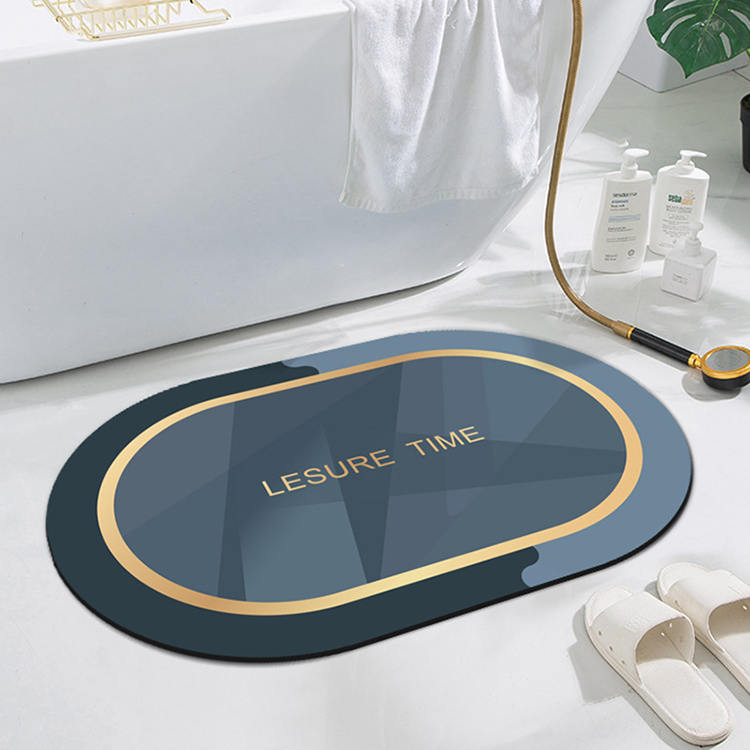
The Diatomite Non-Slip Bath Mat is a rectangular indoor mat intended for use in bathrooms and other areas where water may reach the floor. The surface is made from leathaire material described in the product specifications as leather-like polyester cloth. This surface layer provides a soft hand feel and a comfortable texture for bare feet. It also contributes to the product’s visual appeal by accepting modern patterns that can coordinate with contemporary interiors.
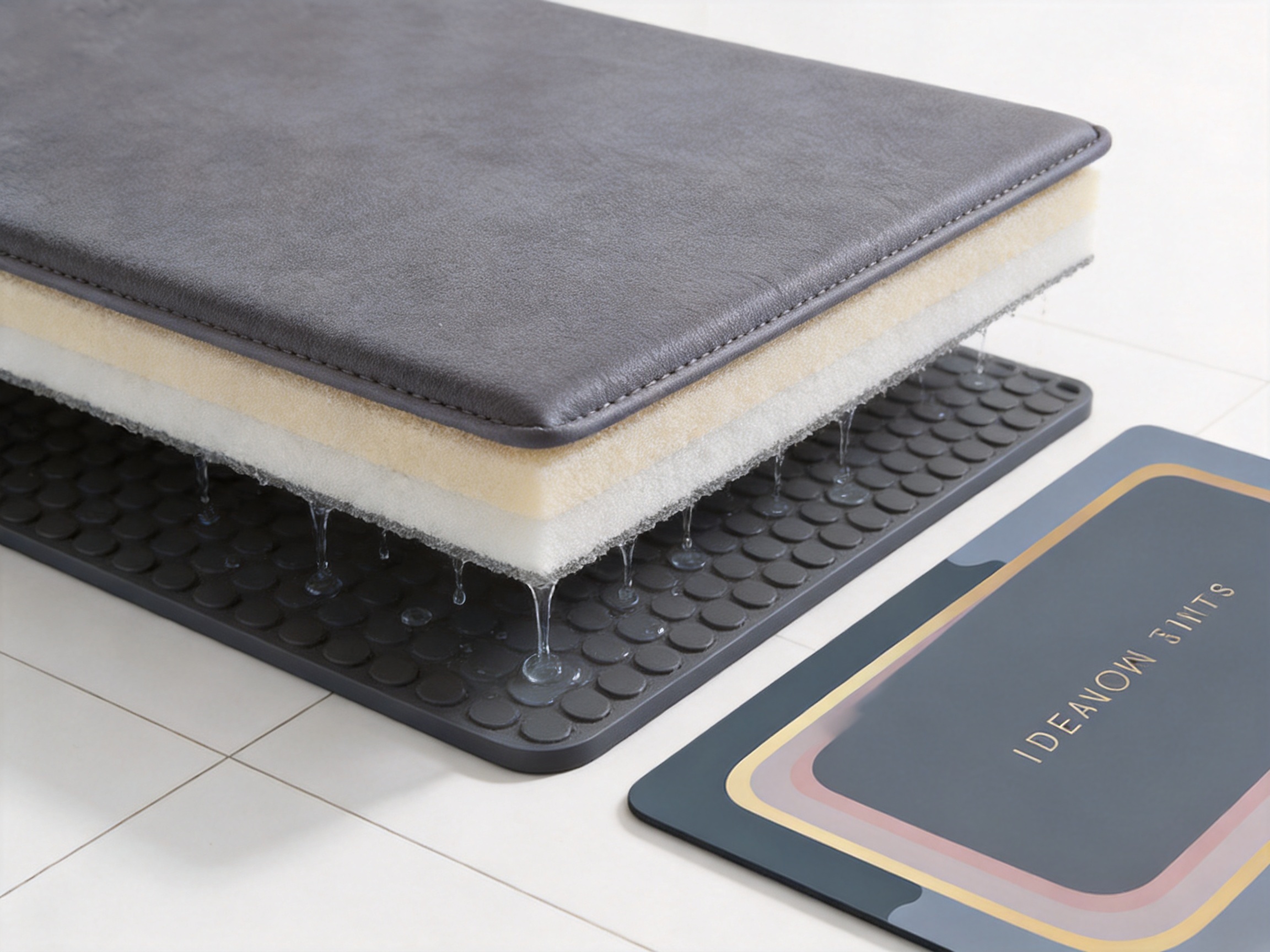
Under the surface is a foam layer designed to absorb moisture from wet feet. Instead of allowing water to remain pooled on the visible surface, the foam helps draw moisture away from the contact area. The backing is made from rubber, helping the mat resist shifting and skidding when placed on a smooth indoor floor. These layers are bonded together to create a unified construction with a slim, stable profile.
The term “diatomite” is commonly associated with absorbent mineral materials. In this product, the listed construction emphasizes a soft polyester leathaire surface, an absorbent foam middle layer, and a rubber backing. Buyers should therefore review the final technical specification, material declaration, and labeling requirements for their particular market before using mineral-content claims in packaging or advertising. This transparent approach helps ensure that product communication accurately reflects the actual construction supplied for each order.
| Product name | Diatomite Bath Mat |
| Product category | Bath mat |
| Available sizes | 40 × 60 cm, 50 × 80 cm, 60 × 90 cm, or custom dimensions |
| Surface material | Leathaire, described as polyester leather cloth |
| Weight | 1800 gsm |
| Thickness | 3 mm |
| Construction | Bonded multilayer construction |
| Back material | Rubber |
| Usage | Indoor |
| Shape | Rectangular |
| Pattern | Modern |
| Care | Water wash; natural drying recommended |
| Special features | Non-slip, soft, washable, water absorption |
| Recommended rooms | Bathroom, kitchen, children’s room, and other indoor areas |
The combination of a practical specification and a simple shape makes the mat easy to merchandise. Standard sizes can be used for general retail collections, while custom dimensions allow buyers to create products for specific bathroom layouts, hotel rooms, apartment projects, or promotional programs. The rectangular form also makes packing, stacking, displaying, and shipping more straightforward than irregular or highly sculpted designs.
Water management is one of the most important functions of a bath mat. After a shower or bath, a person may step onto the mat with a significant amount of water on the soles of the feet. If that moisture remains on the surface, the user may experience an uncomfortable wet feeling, and the floor may become more difficult to keep clean. If water spreads beyond the mat, it may also increase the possibility of slipping on smooth tiles or other hard flooring.
The absorbent foam layer in this product is intended to receive moisture from wet feet and help prevent water from remaining visibly on top of the mat. The surface layer supports this process while offering a soft contact point. This layered approach is more practical than relying only on a decorative top fabric, because the middle structure contributes directly to moisture handling.
Effective absorption also depends on how the mat is used and maintained. A bath mat should be positioned on a clean, dry, and level floor. It should be allowed to dry naturally after washing or after extended exposure to water. In humid environments, lifting the mat periodically can help air reach the underside and the floor below. These simple practices support better hygiene and help maintain the product’s performance.
Compared with a thin decorative floor cloth, an absorbent bonded mat can provide a more purposeful solution for wet areas. Compared with very thick pile products, the 3 mm profile can be easier to place beneath doors, bathroom furniture, and cabinets. The product therefore occupies a useful position between a lightweight decorative mat and a bulky high-pile rug.
A bath mat is frequently used in an environment where water and smooth flooring are present together. For this reason, stability is just as important as absorbency. The rubber backing helps the mat resist unwanted movement during normal use. When the user steps onto the mat, the backing is intended to create friction against the floor and reduce shifting or skidding.
The bonded construction also contributes to stability. By joining the surface, foam, and backing into a single structure, the mat is less likely to behave like a loose collection of separate layers. A unified construction can improve handling, simplify cleaning, and help maintain the intended shape. It also supports more consistent finishing around the edges and across the body of the product.
No bath mat should be considered completely slip-proof under every condition. Floor contamination, excessive water, dust, oil, uneven flooring, loose tiles, and improper placement can reduce traction. Consumers should place the mat flat, keep the floor beneath it clean, and replace it if the backing becomes damaged or loses its ability to remain stable. Clear care and safety instructions are valuable additions to any retail package.
Against ordinary fabric mats without a specialized backing, this product offers a clear functional advantage. The rubber underside is designed specifically to help prevent shifting and skidding, making the mat better suited to bathrooms and other areas where movement can be a concern. For retailers, this feature also provides a straightforward benefit that can be communicated easily on packaging and product listings.
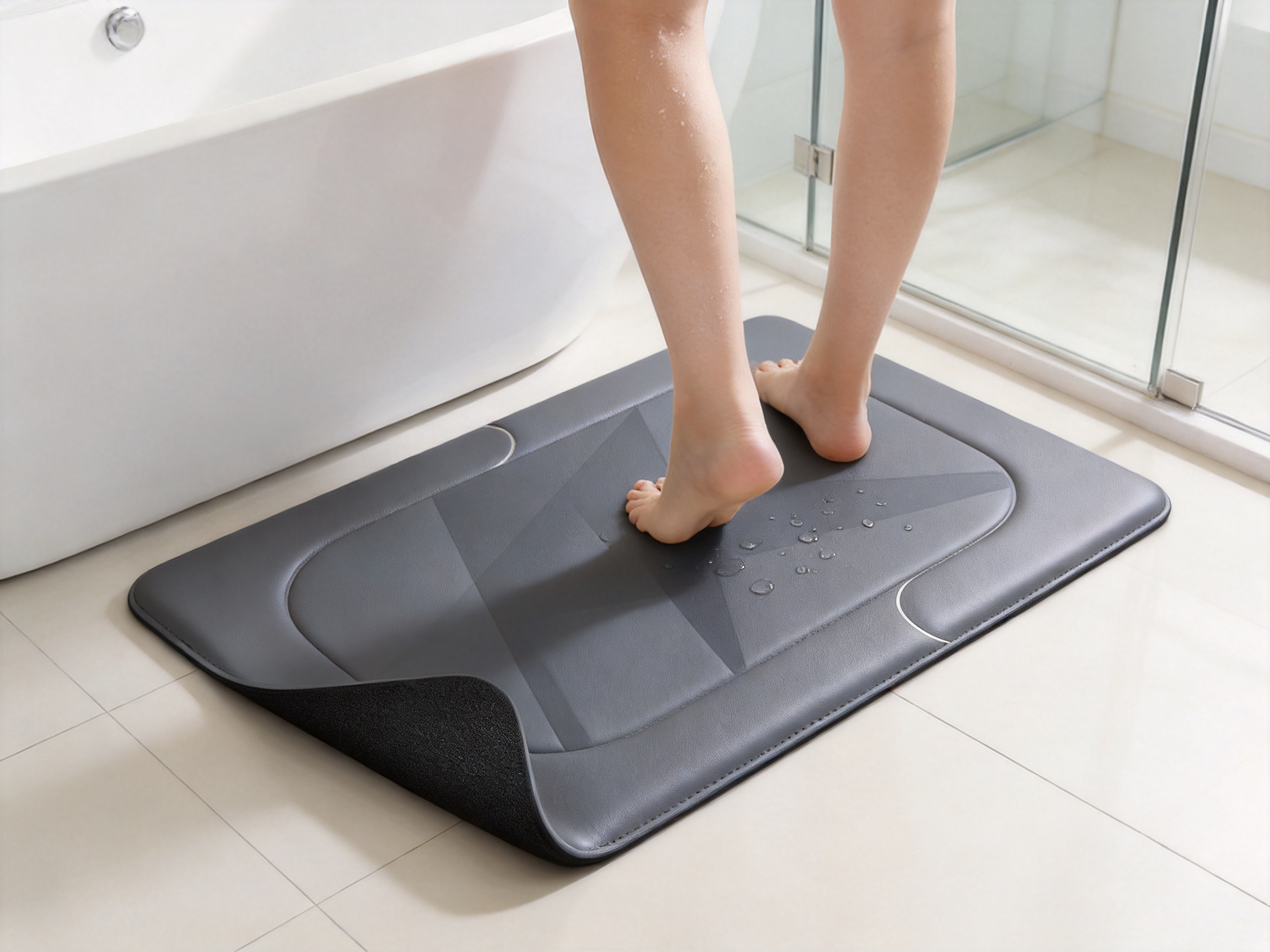
Comfort is often associated with thickness, but greater thickness is not always more convenient. A very thick mat may feel luxurious, yet it can create problems around doors, storage units, toilets, washing machines, or low-clearance furniture. The 3 mm thickness of this bath mat offers a slimmer alternative. It provides a soft and cushioned sensation underfoot while remaining relatively easy to position in compact rooms.
The leathaire surface layer is important to this experience. The product information describes the surface as soft and comfortable, with a leather-like polyester cloth construction intended to improve durability and resistance to fading. This creates a smoother and more refined touch than many rough utility mats. The surface is suitable for users who want a practical bath mat that still feels pleasant in daily use.
The 1800 gsm weight gives the product a substantial feel without requiring a deep pile. In practical terms, the mat can look more stable and substantial than a very lightweight floor cloth while remaining easier to handle than a thick, dense rug. This balance is useful for households that need to wash the mat regularly or move it during bathroom cleaning.
For children’s rooms, guest bathrooms, and family homes, tactile comfort can influence whether a mat is used consistently. A product that feels unpleasant or rough may be avoided, reducing its practical value. The soft surface and moderate cushioning of this mat are intended to encourage regular use after bathing, washing hands, or completing other water-related routines.
Although the bath mat is primarily designed for bathrooms, its modern pattern and neutral rectangular form allow it to serve in several indoor environments. It can be placed in front of a shower, beside a bathtub, near a vanity, outside a laundry area, or in another location where moisture and comfort are relevant. The same design language may also suit kitchens, children’s rooms, entry areas, and indoor utility spaces.
Modern patterns can support a broad range of décor styles. They can complement contemporary apartments, minimalist bathrooms, practical family homes, and hospitality interiors. A simple rectangular silhouette is easy to coordinate with vanities, cabinets, shower screens, and tiled walls. It also allows distributors to include the product in coordinated collections of area rugs, kitchen mats, door mats, carpet fabrics, and other soft floor coverings.
The surface can be developed in different colors or printed designs depending on the order specification. This makes the product suitable for buyers who want a consistent visual identity across several room categories. For example, a retailer may use related patterns for bath mats, kitchen mats, and door mats while changing the sizes and functional specifications for each use.
Design flexibility is especially important in private-label and project-based business. A buyer may need a small size for compact bathrooms, a wider format for double vanities, or a custom shape for a particular installation. The ability to discuss dimensions, surface patterns, and finishing details with an experienced manufacturer can reduce the need to compromise between appearance and practicality.
Bath mats are exposed to water, dust, soap residue, hair, skin particles, and other household contaminants. Easy maintenance is therefore essential. The product is designed for water washing, allowing users to rinse the mat with water or foam and then dry it naturally. This provides a simple cleaning method that does not require specialized equipment or chemical treatment.
Regular washing can help maintain freshness, but the care process should follow the final product instructions supplied with each order. Water temperature, detergent selection, washing method, drying conditions, and frequency may vary according to the surface print, backing formulation, and customer requirements. Buyers should request a formal care label and test the finished production before large-scale retail distribution.
Natural drying is recommended in the supplied product information. After washing, the mat should be placed in a clean, ventilated area and allowed to dry thoroughly before returning it to the floor. Avoiding prolonged dampness is particularly important in bathrooms, where high humidity can slow evaporation. The mat should not be folded or stored while wet.
The rubber backing should be inspected from time to time. If it develops cracks, peeling, severe deformation, or reduced traction, the mat should be replaced. The floor beneath the mat should also be cleaned regularly, since dirt trapped between the backing and the floor may affect stability. These maintenance practices are simple and can extend the useful life of the product.
The performance of a bonded bath mat depends on the interaction of its layers. The surface layer provides the visible design, tactile comfort, and initial contact with water. The middle foam layer contributes to cushioning and absorption. The rubber backing supports floor stability. Bonding brings these components together so that the finished mat can function as one coordinated product.
| Layer or component | Primary contribution |
| Leathaire surface | Soft touch, visual appearance, comfortable contact, and a surface suitable for modern patterns |
| Foam middle layer | Water absorption and moderate cushioning underfoot |
| Rubber backing | Resistance to shifting and skidding on suitable indoor floors |
| Bonded construction | Layer integration, structural consistency, and convenient handling |
| Polyester leather cloth specification | Durability and resistance to fading according to the supplied product description |
One advantage of this structure is that it avoids relying on one material to perform every function. A surface fabric alone may not provide adequate stability. A rubber sheet alone would not deliver a comfortable touch. A thick foam layer may improve cushioning but increase bulk. By assigning different roles to different layers, the manufacturer can achieve a balanced product with a slim profile.
Material selection also affects production consistency. Surface materials must be inspected for color, print quality, width, and defects. Foam must be checked for evenness and suitable recovery. Rubber backing must be evaluated for coverage, adhesion, and dimensional stability. Bonding conditions must be controlled so that the layers remain securely joined without excessive adhesive marks, curling, or uneven thickness.
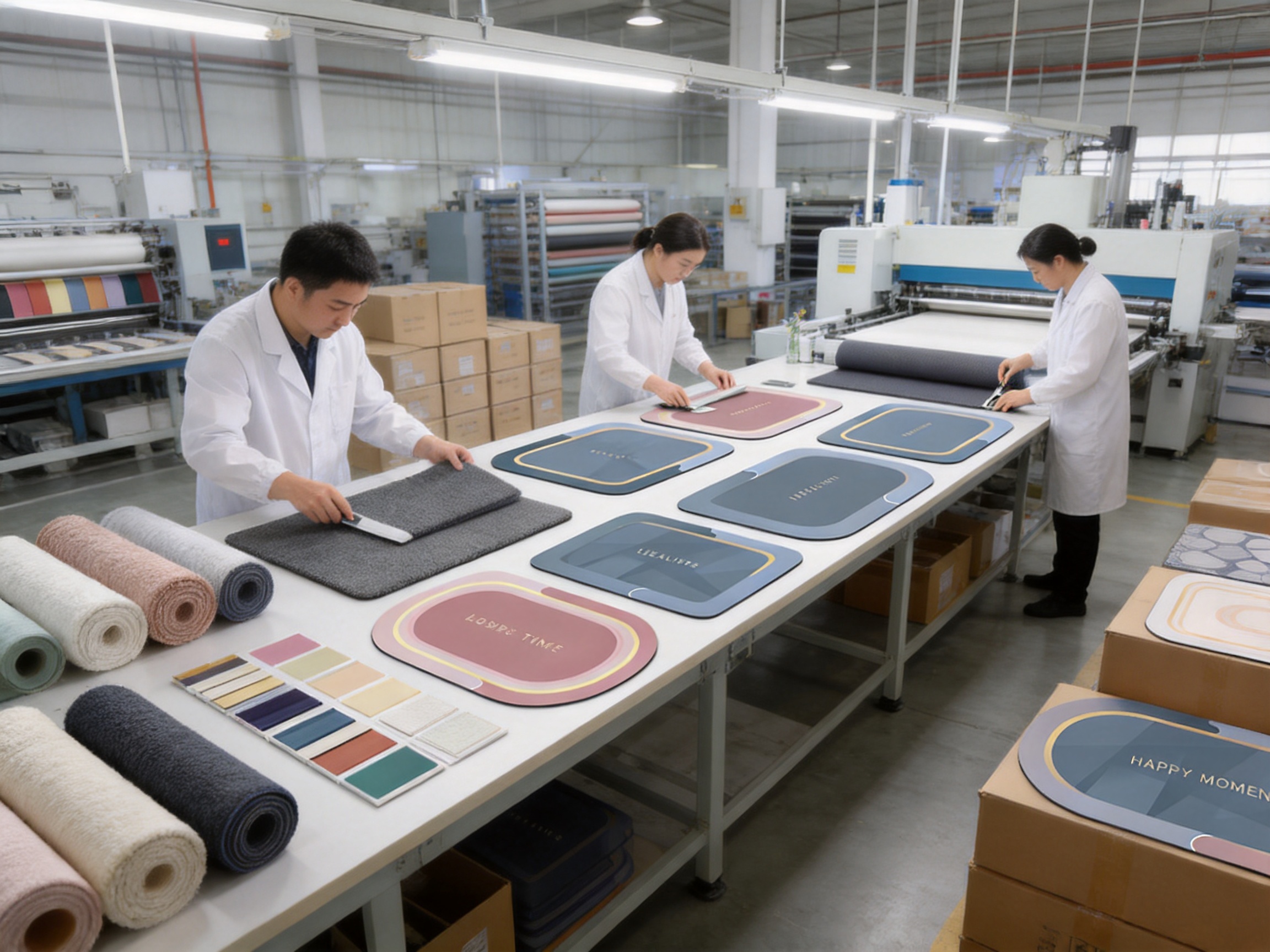
The manufacturer behind this product is based in Shaoxing, Zhejiang, a region widely recognized for its textile industry and extensive production resources. Its business covers carpet fabrics, rugs, mats, and finished textile products. This specialization provides a foundation for developing products that combine textile design, surface treatment, lamination, backing, cutting, and finishing.
A major strength is control across several stages of the production chain. The company operates weaving and dyeing or printing capabilities as well as finished carpet processing facilities. This integrated structure can simplify communication between departments and reduce dependence on unrelated outside suppliers. When a customer requests changes to color, pattern, material, size, or finishing, direct coordination between fabric development and finished-product teams can support a more efficient response.
Integrated production can also improve lead-time management. If surface fabric, printing, and finishing are handled through a coordinated manufacturing system, the company may be better positioned to plan production schedules, monitor work in progress, and identify delays. For wholesale buyers, predictable lead times are important because product availability affects promotions, seasonal launches, retail replenishment, and project completion.
Quality control benefits from the same structure. The manufacturer can review materials before processing, monitor bonding and cutting during production, and inspect finished mats before packing. This allows quality issues to be identified closer to their source. For example, a pattern alignment problem can be addressed during printing, while an edge or backing issue can be corrected during finishing and inspection.
The company also reports a team of more than 20 fabric engineers. A dedicated engineering group can support new product development, surface experimentation, material selection, construction testing, and customization. Since carpet and mat trends change regularly, ongoing development helps the manufacturer respond to preferences for new textures, patterns, colors, dimensions, and performance features.
Customization is an important advantage for wholesale customers. While the standard sizes of 40 × 60 cm, 50 × 80 cm, and 60 × 90 cm cover many common applications, different markets may require other dimensions. A hotel bathroom, a residential development, a modular apartment, or a specialty retail program may need a size that is not commonly available from stock suppliers.
Custom sizing can also improve the relationship between the product and its intended room. A compact washroom may benefit from a smaller mat that does not interfere with door movement. A larger bathroom may require an extended mat in front of a double sink. A project buyer may need several sizes for different room layouts while maintaining the same surface pattern and construction.
In addition to dimensions, buyers may discuss pattern direction, color, printing, packaging, labels, and collection coordination. A manufacturer with experience in both fabric development and finished mats can evaluate whether a requested design is suitable for the selected surface material and production method. This technical review helps avoid designs that are visually attractive but difficult to reproduce consistently.
Customization should be managed through a clear development process. The buyer should confirm the intended application, size range, surface material, backing, care requirements, color standards, packaging method, and target price. Samples should be evaluated for appearance, hand feel, absorption, dimensional accuracy, adhesion, and backing performance. Approval of a pre-production sample provides a reference for later bulk inspection.
For private-label buyers, packaging and product information should accurately describe the construction. If a product uses polyester leather cloth, foam, and rubber backing, these materials should be represented correctly in labels and sales documentation. If the product is marketed with a diatomite-related name, the buyer should confirm that the wording complies with local product regulations and does not imply a material composition that is not present in the final specification.
Environmental responsibility is increasingly relevant to textile buyers and consumers. The manufacturer describes a focus on ecological protection, consumer health, and more sustainable production methods. Its company information references the use of recycled polyester and water-saving dyeing techniques, as well as OEKO-TEX® and Global Recycled Standard certifications. Certification scope, validity, and product applicability should be confirmed for each specific order, but these stated capabilities indicate an awareness of current sustainability expectations.
Water-saving dyeing methods may help reduce the amount of water used in textile processing. Recycled polyester can provide an alternative material route for products where recycled content is technically and commercially appropriate. These approaches do not remove the need for responsible chemical management, energy efficiency, waste control, and accurate certification documentation, but they can form part of a broader improvement program.
For buyers, environmental claims should be supported by appropriate records. A purchaser may request certification copies, transaction certificates, material declarations, test reports, restricted-substance documentation, and production information. This is especially important when products are sold in markets with detailed sustainability labeling requirements. Transparent documentation protects both the manufacturer and the buyer from vague or unsupported claims.
The bonded construction can also support product efficiency by combining several functions into one relatively slim mat. A product that is durable, washable, and suitable for repeated household use may reduce the need for frequent replacement. Proper care remains essential, because a product’s environmental impact depends not only on the materials used during production but also on its service life, packaging, shipping, maintenance, and end-of-life handling.
The bath mat market includes cotton mats, microfiber mats, PVC-backed fabric mats, memory foam mats, natural fiber mats, and decorative floor cloths. Each category has its own strengths. The Diatomite Non-Slip Bath Mat competes by balancing several benefits rather than focusing on only one feature.
Compared with a basic flat fabric mat, this product offers a dedicated absorbent middle layer and rubber backing. Compared with a deep-pile mat, it offers a lower 3 mm profile that may be easier to place near doors and bathroom fixtures. Compared with a non-backed textile, it provides greater attention to floor stability. Compared with a purely utilitarian rubber mat, it provides a softer and more visually refined surface.
| Comparison point | Basic fabric mat | Diatomite Non-Slip Bath Mat |
| Surface comfort | Varies by fabric and weave | Soft leathaire surface designed for comfortable bare-foot use |
| Water management | May depend mainly on surface fibers | Absorbent foam layer helps draw moisture away from the visible surface |
| Floor stability | May shift without a suitable backing | Rubber backing helps resist shifting and skidding |
| Profile | Can be very thin or highly bulky | 3 mm construction offers a slim, cushioned format |
| Cleaning | Depends on the textile and backing | Designed for water washing and natural drying |
| Design flexibility | May be limited by fabric type | Modern surface patterns and custom dimensions are available by specification |
| Wholesale adaptability | Often supplied in fixed formats | Standard sizes plus custom dimensions and development support |
The most important competitive advantage is the product balance. Consumers do not experience absorption, comfort, safety, appearance, and maintenance as separate purchasing decisions. They expect these features to work together. A mat that performs well in one area but poorly in another may receive negative feedback. This product is designed to provide a more complete everyday solution.
The primary application is beside a shower, bathtub, vanity, or sink. The absorbent structure helps manage moisture, while the rubber backing supports stability on an appropriate indoor floor. The soft surface provides a comfortable place to stand after bathing or while completing personal care routines.
The rectangular mat can also be used in kitchens near sinks, dishwashing areas, or preparation zones. The washable construction and water-absorption feature are useful where occasional splashes occur. Users should remember that cooking oils, grease, and heavy food contamination may affect the backing or surface and should be cleaned promptly.
In a children’s room or family bathroom, a soft and washable mat can provide a more comfortable surface near handwashing or bathing areas. The mat should always be placed flat and checked regularly for wear. It should not be used as a substitute for supervision or other household safety measures.
The product may also be suitable for indoor utility rooms, laundry areas, entrances, or other spaces where a slim absorbent mat is required. Before using it at an entrance, the buyer should evaluate the level of outdoor dirt, grit, and heavy traffic expected. The product is specified for indoor use and is not intended to replace a heavy-duty outdoor entrance mat.
Custom sizing and coordinated pattern development may make the mat appropriate for hotels, serviced apartments, student accommodation, residential developments, and interior design projects. Project buyers can request samples to assess color consistency, washing requirements, placement, packaging, and compatibility with the intended flooring.
Wholesale buyers should establish clear quality criteria before production begins. Important checkpoints include material composition, surface color, pattern placement, size, thickness, weight, edge finishing, bonding, backing coverage, odor, packaging, and labeling. A documented inspection standard helps both parties understand what constitutes an acceptable finished product.
Dimensional inspection should verify length, width, squareness, and thickness. Since the product is bonded, excessive variation between layers may create curling or uneven edges. Weight checks can help confirm that the production remains close to the agreed 1800 gsm specification. Surface inspection should identify printing defects, stains, holes, streaks, color variation, or visible bonding marks.
Backing inspection should verify that the rubber layer covers the intended area and remains securely attached. The mat should lie flat on a suitable test surface without excessive curling. Buyers may also conduct simple movement checks under dry conditions and evaluate the product after washing and natural drying. More formal slip-resistance testing may be appropriate when required by the destination market or end-use environment.
Absorption testing should be performed using a consistent method. Variables may include the amount of water applied, contact time, surface condition, temperature, and measurement procedure. A controlled test is more useful than an informal demonstration because it allows production lots to be compared fairly.
Packaging is another quality consideration. The mat should be protected from dust, moisture, compression damage, and deformation during storage and transport. Packaging details may include individual polybags, paper bands, cartons, barcode labels, care instructions, and pallet arrangements. The best format depends on the buyer’s sales channel and sustainability policy.
A professional ordering process begins with a product brief. The brief should state the target market, intended application, standard or custom size, preferred colors, surface pattern, construction, backing, packaging, expected quantity, and required delivery schedule. Providing this information early allows the manufacturer to recommend a suitable production route.
The next stage is sample review. Samples should be evaluated not only for appearance but also for practical performance. Buyers should place the mat on the intended type of floor, step on it with dry and damp feet, inspect the edge finishing, wash it according to the proposed care instructions, and observe how it dries. These tests can reveal issues that are not obvious from photographs.
After sample approval, the buyer and manufacturer should confirm the technical specification in writing. The document should include tolerances, materials, colors, pattern references, size, thickness, weight, backing, care label, packaging, carton details, and inspection requirements. Any changes made after approval should be recorded and acknowledged by both parties.
During bulk production, the manufacturer can provide updates on material preparation, printing, bonding, cutting, finishing, inspection, and packing. Buyers with strict schedules may request a pre-shipment inspection or production photographs. Clear communication helps reduce the risk of misunderstandings and supports more predictable delivery.
After shipment, feedback from customers and end users can support future development. Information about preferred sizes, colors, washing behavior, packaging, and common complaints can be used to refine later orders. A manufacturer with fabric engineers and integrated facilities is often better positioned to respond to this feedback with practical design changes.
Place the mat on a clean, level, and dry indoor floor. Smooth the mat flat before use and ensure that the edges are not folded or curled. Do not place it over loose rugs, unstable flooring, or surfaces contaminated with oil or cleaning chemicals. Allow sufficient space around doors and bathroom fixtures so that the mat does not interfere with movement.
Rinse or wash the mat with water or a suitable mild cleaning solution according to the final care label. Avoid harsh chemicals unless they have been confirmed as compatible with the surface, print, foam, and rubber backing. After cleaning, allow the mat to dry naturally in a ventilated area. Do not store it while damp.
Shake or wipe away loose dirt regularly. Lift the mat occasionally to clean and dry the floor underneath. Inspect the surface, edges, and backing for signs of damage. If the rubber underside becomes cracked, detached, or significantly less stable, discontinue use and replace the mat.
Care instructions should be adapted for the final production batch. A buyer may request laboratory or internal testing to confirm colorfastness, dimensional stability, washing performance, and backing adhesion. The care label should be written clearly for the destination market and should not promise performance beyond the tested specification.
A bath mat may appear to be a simple product, but consistent quality depends on numerous technical steps. The surface must be attractive and comfortable. The foam must be even and properly integrated. The rubber backing must provide suitable friction without excessive odor or poor adhesion. The finished mat must be cut accurately, remain flat, and survive normal washing.
A manufacturer focused on textiles and finished floor coverings understands the relationship between these details. Experience with weaving, dyeing, printing, bonding, backing, and finishing enables a more complete evaluation of the product. This is particularly valuable when buyers request modifications, because changing one component may affect another. For example, a new surface material may require revised bonding conditions, while a heavier backing may change the final thickness and packing method.
The manufacturer’s location in a major textile center also provides access to a broad supply network and technical knowledge base. Combined with in-house or coordinated production facilities, this can support efficient sourcing and faster product development. The stated team of more than 20 fabric engineers further strengthens the company’s ability to develop new carpet and mat fabrics in response to market trends.
For international buyers, manufacturing capability is not limited to machinery. It also includes communication, documentation, quality management, sample development, production scheduling, packaging coordination, and after-sales support. A reliable supplier should be able to discuss both design and technical performance in a practical and transparent manner.
The standard sizes are 40 × 60 cm, 50 × 80 cm, and 60 × 90 cm. Custom dimensions can be discussed for wholesale, project, and private-label orders.
The product is specified for indoor use. It is intended for bathrooms, kitchens, children’s rooms, indoor utility areas, and similar locations. Outdoor exposure, direct weather, and heavy outdoor contamination are not the stated applications.
The rubber backing is designed to help prevent shifting and skidding on suitable indoor floors. The floor should be clean, dry, level, and free of oil or other contaminants. No mat can guarantee complete slip prevention under every condition.
The specified thickness is 3 mm. This slim profile provides moderate cushioning while helping the mat fit in areas where a thick pile could interfere with doors or furniture.
The product information describes a leathaire surface, also identified as polyester leather cloth, an absorbent foam middle layer, and a rubber backing. Buyers should confirm the final material declaration for each order.
Yes. Water absorption is listed as a special feature, and the foam layer is designed to absorb moisture from wet feet so that water does not remain on the visible surface for an extended period.
Yes. The stated care instruction is water washing. The mat can be rinsed with water or foam and should be dried naturally. The final care label should be followed because washing requirements may vary according to the approved production specification.
The leathaire surface is designed to provide a soft and comfortable feeling underfoot. The foam layer also contributes moderate cushioning within the 3 mm construction.
Custom development can be discussed according to the buyer’s requirements. Pattern, color, dimensions, labels, packaging, and other details should be confirmed through sampling and a written technical specification.
The product is marketed as a diatomite bath mat, while the supplied specifications emphasize polyester leather cloth, foam, and rubber. Buyers should verify the exact composition and ensure that product names and marketing claims comply with the requirements of their destination market.
Yes, it may be suitable for hospitality and residential projects when the size, performance, care, packaging, and compliance requirements are confirmed. Custom dimensions and coordinated designs can be considered for project orders.
The manufacturer operates textile and finished-product facilities and reports a team of more than 20 fabric engineers. These capabilities support pattern development, material selection, construction adjustments, sample preparation, and customized carpet or mat programs.
The buyer should check the approved sample, material declaration, dimensions, weight, thickness, surface quality, backing adhesion, absorption, washing behavior, colorfastness, packaging, labeling, production lead time, and inspection standard. Written confirmation of these details is recommended.
The Diatomite Non-Slip Bath Mat is designed as a balanced solution for modern indoor living. Its soft leathaire surface provides a comfortable touch, while the foam middle layer supports water absorption. The rubber backing helps improve stability, and the bonded construction brings the layers together in a slim 3 mm format. The 1800 gsm weight gives the mat a substantial feel without the bulk of a deep-pile product.
Its advantages over ordinary bath mats include the combination of moisture management, comfort, washable construction, modern appearance, and non-slip support. Standard sizes make it easy to introduce into retail collections, while custom dimensions and product development services support project and private-label requirements. The rectangular design and contemporary pattern also allow the mat to coordinate with other carpet and rug products across the home.
Manufacturing strength is an equally important part of the offering. Textile production knowledge, weaving, dyeing or printing, finished carpet processing, engineering support, and supply-chain coordination provide a foundation for consistent development and wholesale service. Environmental initiatives such as recycled polyester, water-saving dyeing methods, and stated certification capabilities may further support buyers seeking more responsible sourcing options, subject to order-specific verification.
For consumers, the product offers a comfortable and practical surface for everyday bathroom use. For distributors, retailers, hospitality buyers, and project purchasers, it provides a flexible platform for customized sizes, designs, packaging, and coordinated floor-covering collections. With appropriate care, accurate labeling, and clear quality control, it can serve as a dependable addition to the bath mat category.
1. Product technical information supplied for the Diatomite Bath Mat, including dimensions, weight, thickness, construction, materials, care instructions, features, and recommended room types.
2. Manufacturer-provided company information concerning textile production, carpet fabric development, finished-product processing, customization, engineering resources, and supply-chain coordination.
3. General textile product development principles relating to bonded multilayer constructions, foam absorption, rubber backing, surface comfort, and dimensional control.
4. General indoor floor-covering care principles concerning water washing, natural drying, floor cleanliness, backing inspection, and safe placement.
5. General sustainability guidance relating to recycled polyester, water-saving dyeing, textile certification documentation, and responsible product claims.

ADD: No.75 Zhenyuan Road, Yuecheng District, Shaoxing City, Zhejiang Province, China 312000

Tel : +86-189 6750 9795

FAX : +86-0575-8803 2773

Email : fisher@benetextile.com

Copyright © Zhejiang Benyi Textile Technology Co., Ltd. All Rights Reserved. Carpets and Rugs Manufacturer

 English
 Français
 Deutsch
 عربى
عربى