

Tang Meilin — Customer Success and Product Support Specialist
 Home / Author / Tang Meilin — Customer Success and Product Support Specialist / Flat Faux Rabbit Fur Carpet: A Soft, Durable, and Customizable Solution for Modern Interiors
  2026.08.01
 Tang Meilin — Customer Success and Product Support Specialist
Choosing the right carpet is about more than selecting an attractive color or a pleasant texture. A successful carpet must combine comfort, durability, safety, easy maintenance, reliable production, and commercial flexibility. For retailers, interior brands, hospitality suppliers, and home textile distributors, the ideal product must also be consistent from one order to the next and adaptable to different market requirements.
The Flat Faux Rabbit Fur Carpet is designed to meet these expectations. Made from 100% polyester microfiber, this rectangular indoor area rug provides a soft rabbit-fur-like touch while maintaining a practical flat profile. Its 1500gsm weight, 15–20mm pile height, bonded construction, and non-woven backing with anti-slip dots make it suitable for bedrooms, living rooms, nurseries, children’s rooms, and other indoor spaces.
Unlike many decorative rugs that focus only on appearance, this product has been developed as a balanced textile solution. The surface delivers a thick and fluffy feel, the interlayer adds cushioning, and the backing helps reduce movement on smooth floors. At the same time, the washable and fade-resistant construction supports everyday use and straightforward care.
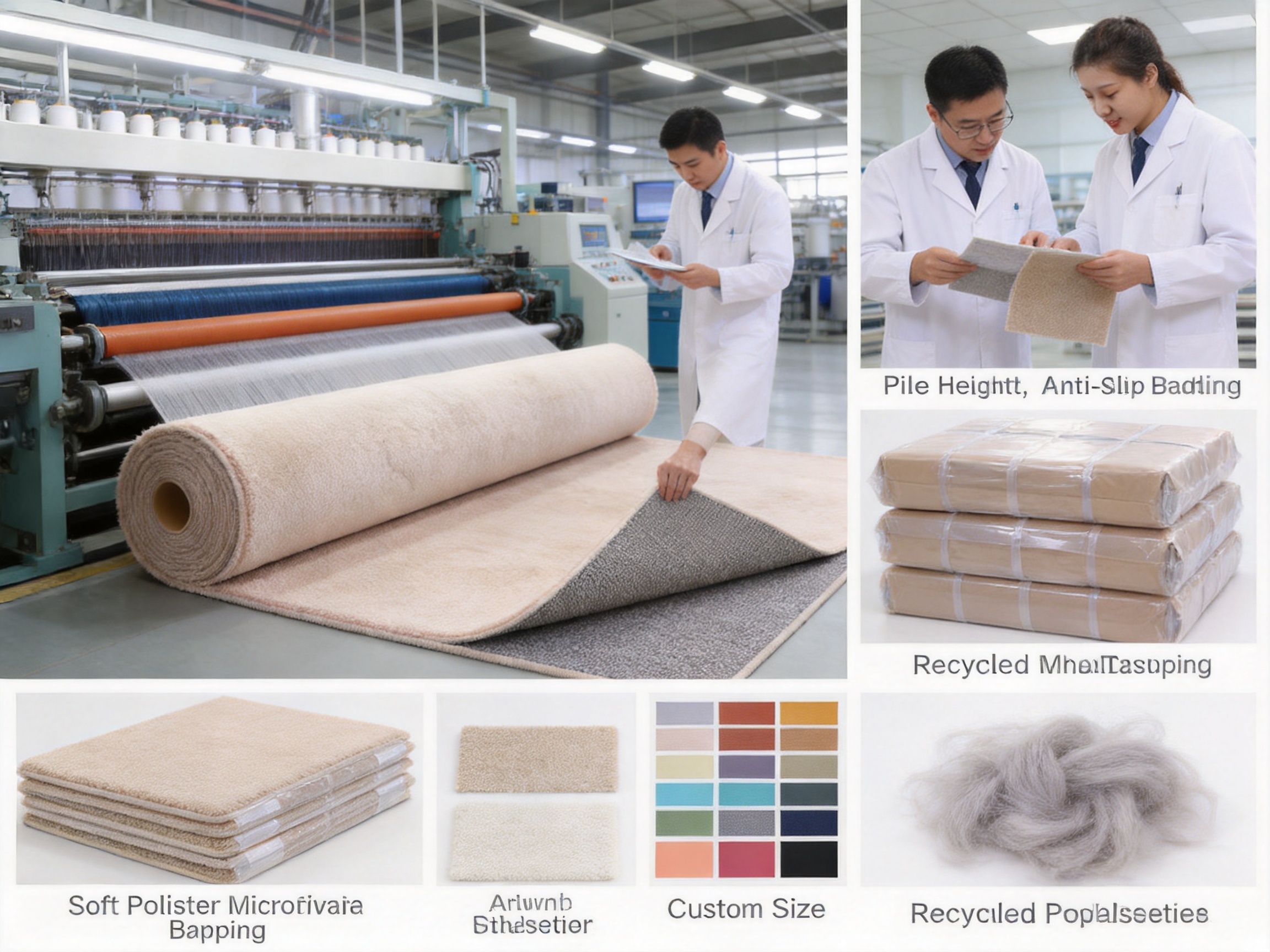
Behind the finished product is a vertically coordinated textile manufacturing system. Zhejiang Benyi Textile Technology Co., Ltd. operates across fabric development, weaving, dyeing and printing, and finished carpet processing. This production structure allows the company to control more stages of manufacturing, improve lead-time management, respond to customization requests, and maintain consistent quality for wholesale buyers.
This article examines the product’s materials, construction, applications, production advantages, customization potential, care requirements, and commercial value. It also explains why a flat faux rabbit fur carpet can be a competitive choice for brands looking to expand their range of soft, practical, and visually versatile home textiles.
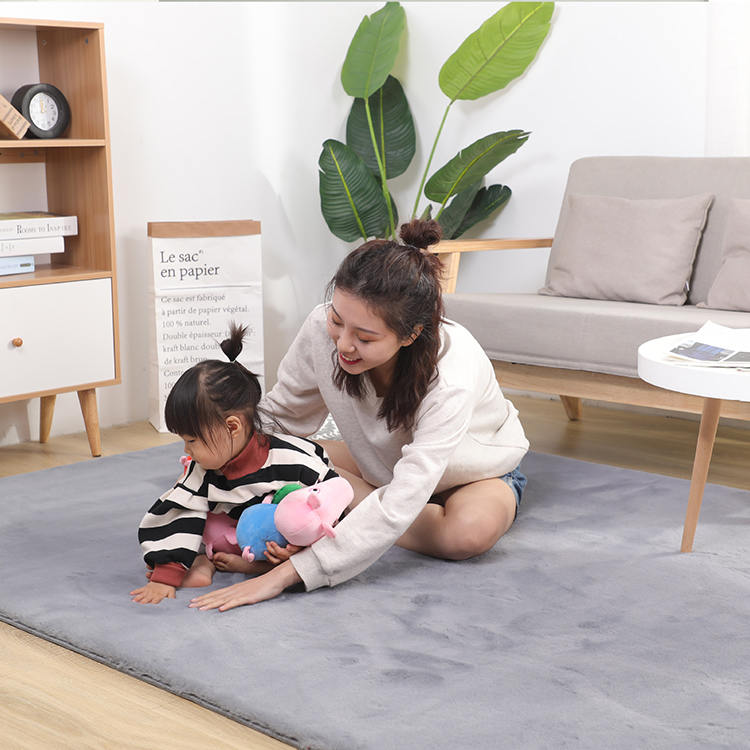
Flat Faux Rabbit Fur Carpet
Content
The Flat Faux Rabbit Fur Carpet is an indoor area rug with a solid-color design and rectangular shape. It is produced from premium polyester microfiber, a synthetic fiber known for its durability, dimensional stability, color flexibility, and soft hand feel. The material is engineered to imitate the smooth and comforting touch associated with rabbit fur while providing the practical benefits expected from a modern household textile.
The rug is available in multiple standard dimensions, including 2' x 3', 2' x 6', 3' x 5', 4' x 6', 5' x 7', 6' x 9', and 8' x 10'. Custom sizing is also available. This range allows the same basic product concept to serve several retail and interior applications, from compact bedside rugs to larger living-room floor coverings.
With a weight of approximately 1500gsm and a pile height of 15–20mm, the carpet offers a noticeable sense of thickness without becoming excessively bulky. The pile is high enough to create a soft contact surface, yet moderate enough to support regular vacuuming and practical use. Its flat faux-fur appearance gives the rug a clean, contemporary look that can be coordinated with minimalist, Scandinavian, modern, casual, or children’s interior styles.
The construction is bonded, which helps combine the surface, interlayer, and backing into a stable floor-covering structure. The back uses non-woven fabric with anti-slip dots. This combination contributes to improved floor contact and helps limit sliding during normal indoor use. For many applications, an additional rug pad may not be necessary, although the final suitability depends on floor type, room conditions, and installation requirements.
The product’s main characteristics can be summarized as follows:
| Product Attribute | Specification | Commercial Benefit |
|---|---|---|
| Product type | Flat faux rabbit fur area rug | Combines decorative appeal with everyday functionality |
| Primary material | 100% polyester microfiber | Soft, durable, color-flexible, and suitable for scalable production |
| Weight | 1500gsm | Provides a substantial and comfortable floor feel |
| Pile height | 15–20mm | Balances softness, visual fullness, and maintenance practicality |
| Construction | Bonded | Supports structural stability and shape retention |
| Backing | Non-woven fabric with anti-slip dots | Helps improve grip and reduce movement on indoor floors |
| Pattern | Solid colors | Easy to coordinate with different interiors and product collections |
| Shape | Rectangular | Suitable for bedrooms, seating areas, children’s rooms, and hallways |
| Sizes | Standard sizes from 2' x 3' to 8' x 10', plus custom sizes | Supports retail, project, and private-label requirements |
| Care | Vacuum cleaning and water washing | Provides practical maintenance for household use |
| Recommended environment | Indoor | Appropriate for residential and selected commercial interiors |
The defining feature of this carpet is its surface texture. The thick and fluffy contact layer is designed to create a rabbit-fur-like sensation under the hand and feet. This tactile quality is important because consumers often judge a rug through both visual and physical interaction. A surface that looks soft but feels coarse may disappoint; this product is intended to align appearance with touch.
Polyester microfiber contributes to the smoothness of the surface. The fine fibers can be arranged to create a dense, comfortable feel while maintaining a stable textile structure. Compared with some natural-fiber floor coverings, polyester also offers greater flexibility in color development and easier integration into large-scale manufacturing programs.
The 1500gsm construction gives the product a fuller appearance than lightweight decorative mats. It provides visual substance when placed beside a bed, beneath a coffee table, or in a children’s room. A heavier surface can also help the rug feel more settled on the floor, particularly when combined with a suitable backing.
The 15–20mm pile height is another important balance point. Extremely low-pile rugs may be easy to clean but can feel thin and less inviting. Very high-pile rugs may offer exceptional softness but can be more difficult to vacuum, more likely to trap debris, and less convenient beneath furniture or doors. This product occupies a middle range that supports comfort without making daily care unnecessarily complicated.
The thick non-woven felt interlayer adds another level of comfort. It helps separate the feet from hard or cold flooring and can make the rug feel more cushioned in use. In households with children or pets, this extra softness may improve the comfort of floor-level activities. It can also help create a warmer and more welcoming atmosphere in rooms where people frequently sit, play, or relax.
Because the rug is intended for indoor use, it can be used as part of a coordinated interior scheme rather than as a seasonal outdoor accessory. It is especially suitable for spaces where softness and visual calm are important. Solid colors allow the texture to become the main design feature, avoiding the visual complexity of large patterns and making the rug easier to match with furniture, bedding, curtains, and wall finishes.
The market includes many low-cost decorative rugs, but products in this category do not always provide the same combination of surface quality, thickness, backing performance, and production flexibility. The Flat Faux Rabbit Fur Carpet is positioned as a more complete textile product rather than a thin surface covering intended only for temporary decoration.
A 1500gsm weight and 15–20mm pile height give the carpet a substantial appearance and feel. Compared with lightweight rugs, the product can create a stronger sense of comfort and quality when presented in a retail environment. A fuller construction is also valuable for brands that want to offer customers a more premium-looking home textile without moving to a highly specialized or expensive natural-fiber product.
Some plush surfaces are soft but fragile, while some durable synthetic rugs sacrifice comfort. Polyester microfiber allows the product to address both requirements. The surface is designed to be pleasant underfoot, while the synthetic construction supports repeated household use and helps resist premature fading when the rug is maintained correctly.
Backing is often overlooked when comparing rugs, yet it has a direct effect on user experience. A rug that moves easily can become inconvenient and potentially unsafe. The non-woven backing with anti-slip dots helps improve contact with the floor and reduce unwanted movement. This feature is particularly relevant for bedrooms, children’s rooms, entrances, and other areas where people frequently walk across the rug.
The ability to clean a carpet with water adds practical value. Consumers want soft furnishings that can remain attractive despite dust, everyday marks, and household activity. The product can be vacuumed for routine maintenance and washed with water as needed, subject to appropriate handling and drying. This makes it more suitable for homes seeking a comfortable rug that does not require highly specialized care.
Solid colors are commercially useful because they appeal to a broad customer base. They can support neutral collections, seasonal color launches, children’s ranges, bedroom assortments, and coordinated furniture programs. Retailers can offer different colors without changing the fundamental product structure, while interior brands can match the rug to a wider variety of design concepts.
Standard sizes are convenient for stock programs, but custom sizing is essential for project orders, private-label collections, hospitality interiors, and regional market preferences. The availability of custom sizes helps buyers avoid being limited to a single retail format. It also allows the product to be adapted to specific room dimensions, display concepts, or packaging plans.
The product is designed for indoor settings and can be used in multiple areas of the home. Its soft surface, rectangular shape, solid colors, and range of dimensions allow it to perform both as a functional floor covering and as a decorative element.
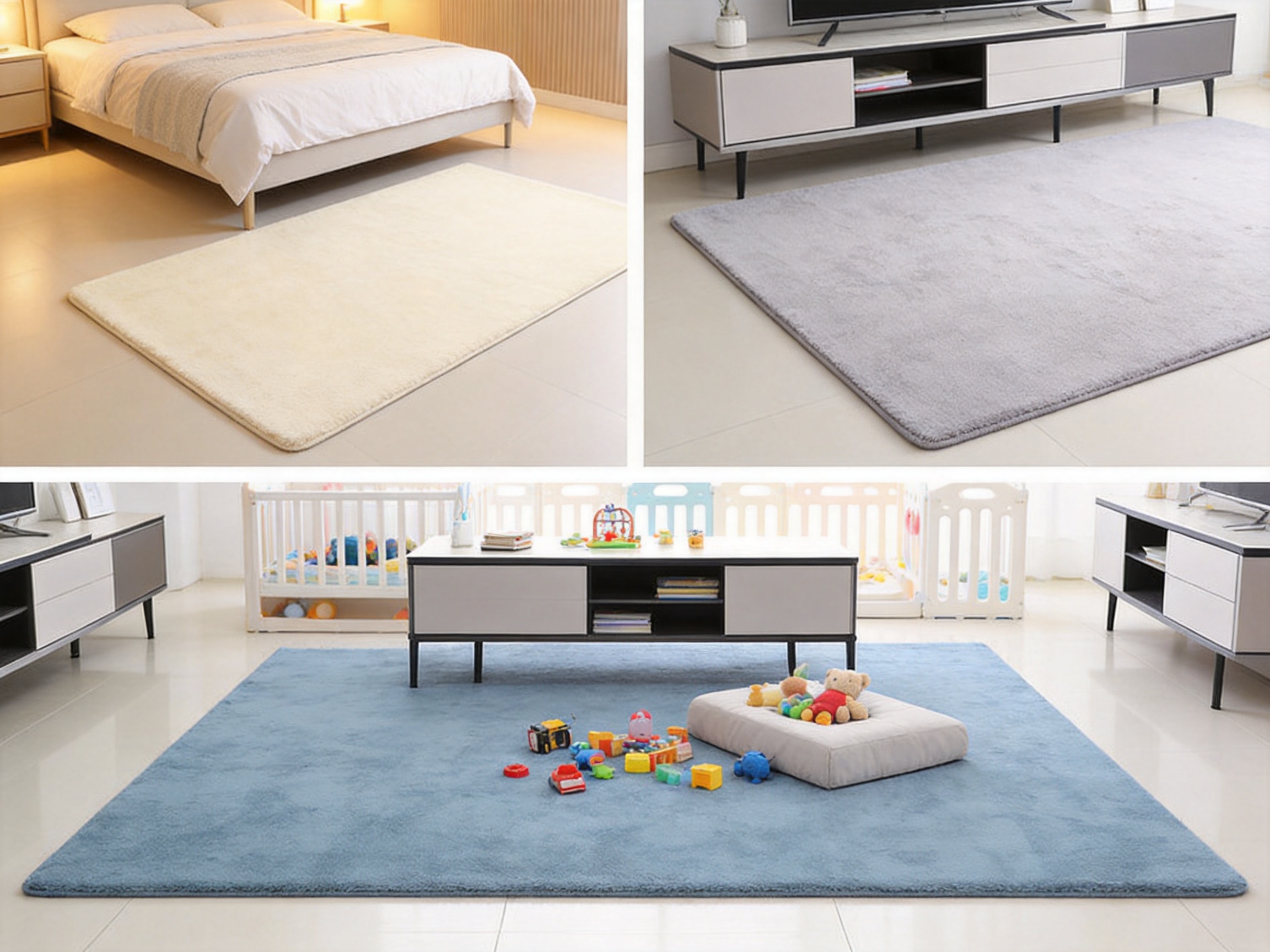
A bedroom is one of the most natural applications for a faux rabbit fur carpet. A smaller size can be placed beside or at the foot of a bed, providing a soft surface for the first step in the morning. Larger sizes can define the area beneath a bed or extend into the surrounding floor space. The solid-color design supports calm bedroom schemes, while the plush texture introduces warmth without requiring a strong pattern.
In a living room, a larger carpet can be positioned beneath a coffee table, in front of a sofa, or within a conversation area. The 6' x 9' and 8' x 10' options are particularly useful for larger seating arrangements, while the 4' x 6' and 5' x 7' sizes can serve smaller apartments or compact lounges. The rug’s softness can make a seating area feel more inviting and visually complete.
The cushioned surface and soft touch are valuable in children’s environments. A rug can create a comfortable area for reading, playing, or floor-based activities. The anti-slip backing helps support a more stable surface, while the washable construction offers practical benefits for families. When used in a nursery or children’s room, buyers should select suitable colors and follow all applicable product-care and indoor-air-quality requirements.
Compact dimensions such as 2' x 3' or 2' x 6' can work well in dressing areas, wardrobe spaces, and beside storage furniture. The carpet can add softness and visual cohesion to areas that might otherwise contain only hard flooring. Because solid colors are easy to coordinate, the same collection can be offered in multiple sizes for a complete bedroom assortment.
Urban homes often require textiles that are comfortable but easy to maintain. A washable synthetic area rug can meet this need more conveniently than a highly delicate specialty textile. Different sizes can be used to define zones within an open-plan apartment, including a reading corner, dining-adjacent lounge, or sleeping area.
Although intended for indoor use, the product may also be considered for selected commercial interiors where a soft decorative rug is appropriate. Boutique accommodation, serviced apartments, show homes, and retail display areas may benefit from its clean appearance and broad size range. Commercial buyers should assess traffic levels, cleaning schedules, fire requirements, and other project-specific standards before selecting the product for a particular installation.
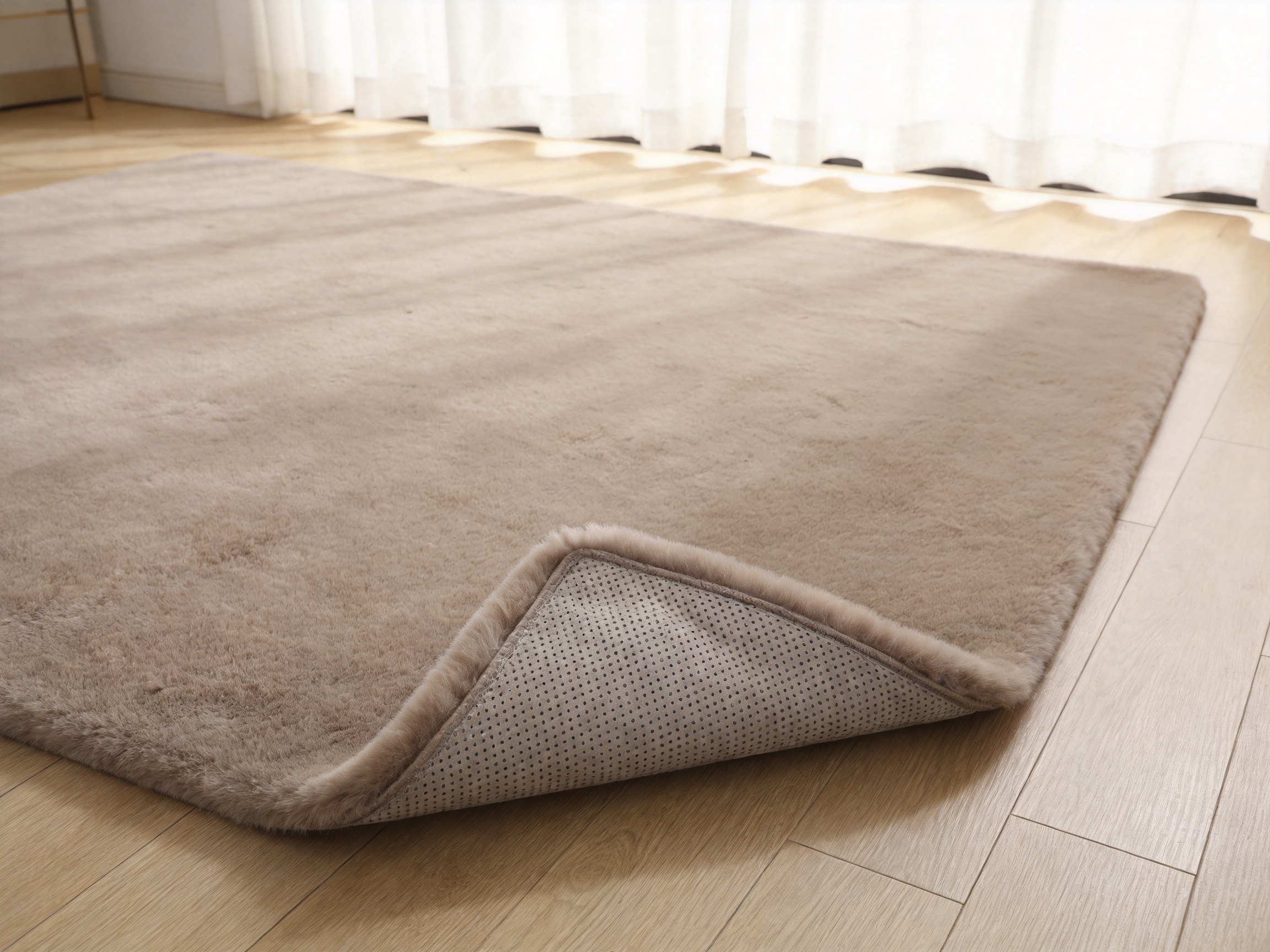
The surface is made from 100% polyester microfiber. Polyester is widely used in home textiles because it offers dependable performance, broad color possibilities, and compatibility with efficient production methods. Microfiber construction can create a smooth, dense, and comfortable contact layer. It also supports the consistent appearance required for wholesale and private-label programs.
The material is selected not only for softness but also for durability and fade resistance. In normal indoor conditions, a properly maintained polyester rug can retain its color and surface character over an extended period. Exposure to strong direct sunlight should still be managed, as all dyed textiles may be affected by prolonged ultraviolet exposure.
Bonded construction helps connect the different layers of the carpet into a unified product. This is important for maintaining shape and supporting the relationship between the surface, felt-like interlayer, and backing. A stable structure helps the rug remain presentable during handling, packaging, transportation, placement, and everyday use.
For wholesale buyers, construction consistency is especially important. Variations in bonding, surface density, or backing application can affect the final product’s appearance and performance. A controlled manufacturing process helps reduce these variations and makes it easier for brands to maintain consistent specifications across repeated orders.
The thick non-woven felt interlayer provides additional cushioning. It supports the soft underfoot sensation and helps create a barrier between the user and hard flooring. This layer also contributes to the carpet’s overall body, helping it feel more substantial than a single-layer decorative mat.
The backing consists of non-woven fabric with plastic anti-slip dots. These dots create areas of increased friction between the rug and the floor. While no textile backing can eliminate movement in every situation, this construction helps reduce sliding under normal indoor conditions. Buyers should ensure that the floor is clean, dry, and suitable before placing the rug.
The backing also provides a practical foundation for packaging and handling. A defined backing layer helps protect the surface during transportation and supports more consistent placement when the rug is unpacked and arranged in the room.
A product’s final quality is strongly influenced by the manufacturing system behind it. Zhejiang Benyi Textile Technology Co., Ltd. is located in Shaoxing, Zhejiang Province, a region widely recognized for its textile expertise and supply-chain resources. This location provides access to textile development capabilities, skilled production personnel, material resources, and related processing services.
The company specializes in carpets, rug fabrics, and finished textile products. Its production model combines the surface and backing rather than relying solely on traditional, fragmented carpet-processing methods. This approach is intended to simplify production, reduce unnecessary steps, improve efficiency, and support stronger control over the final construction.
The company has its own weaving, dyeing and printing factories, and finished carpet processing factories. This vertically coordinated structure is a significant advantage for buyers that require dependable quality and lead-time control. When several critical stages are managed within the same production system, communication can be more direct and production decisions can be coordinated more efficiently.
Integrated manufacturing also supports better problem resolution. If a buyer identifies an issue related to color, surface feel, bonding, or backing, the relevant production teams can work together instead of relying entirely on separate external suppliers. This can shorten feedback cycles and improve the consistency of corrective actions.
More than 20 fabric engineers contribute to product development. Their role includes studying market trends, evaluating surface effects, developing new structures, and adapting materials to customer specifications. The company develops new carpet fabrics each quarter, giving buyers access to a continuing flow of textile concepts rather than a static product catalog.
For brands, this development capacity can be useful when building seasonal collections or responding to changing consumer preferences. A buyer may require a particular weight, pile height, color family, backing treatment, or size format. A team with dedicated fabric-development experience is better positioned to evaluate those requests and translate them into manufacturable specifications.
Control over multiple production stages can support more predictable quality and lead times. This is especially valuable for wholesale customers that plan retail launches, promotional campaigns, container shipments, or coordinated home textile collections. Consistent production planning helps reduce the risk that one delayed external process will disrupt the entire order.
Quality management should cover raw material selection, surface density, color consistency, pile height, bonding strength, backing coverage, dimensional accuracy, packaging, and final inspection. A professional buyer can request product specifications, sample approval, inspection criteria, and testing documentation according to the intended sales market.
The company provides customized services according to customer requirements. Customization can include size, color, packaging, labeling, surface development, and collection coordination, subject to technical evaluation and minimum order requirements. This flexibility helps retailers and private-label brands distinguish their offerings from generic stock products.
Modern carpet buyers increasingly evaluate environmental performance alongside appearance and price. Zhejiang Benyi Textile Technology Co., Ltd. describes its development direction as focused on ecological protection, consumer health experiences, and more sustainable textile production.
The company invests in sustainable materials and production methods, including recycled polyester and water-saving dyeing techniques. Recycled polyester can help reduce dependence on newly produced petroleum-based raw materials when the appropriate recycled feedstock and verification systems are used. Water-saving dyeing methods can reduce water consumption and contribute to more efficient resource management.
The company has also passed OEKO-TEX® and GRS certifications, according to the supplied company information. Buyers should confirm the current scope, validity, product coverage, and documentation for any specific order or market requirement. Certification claims should always be matched with the relevant certificate and applicable production site.
Environmental responsibility is not limited to the fiber itself. It can involve material efficiency, production waste control, dyeing chemistry, energy use, packaging selection, transportation planning, and product lifespan. A durable and washable carpet may provide better practical value over time than a short-lived decorative item that must be replaced frequently.
For brands, sustainability communication should remain accurate and specific. It is preferable to explain the material composition, production practices, certifications, and care instructions clearly rather than make broad environmental claims that cannot be verified. Transparent information helps consumers make better purchasing decisions and supports long-term trust between manufacturers, brands, and end users.
The product’s basic construction can serve as a platform for different market programs. Standard sizes are appropriate for general retail, while custom specifications can support more focused commercial strategies.
Solid colors make the carpet suitable for coordinated color collections. Buyers may select neutral shades for year-round home furnishing programs, soft pastels for nurseries, deeper tones for contemporary interiors, or seasonal colors for limited collections. Color matching should be evaluated through physical samples because screen displays and printed references cannot reproduce textile color perfectly.
Offering several dimensions allows a brand to create good, better, and best assortment levels or to serve different room types. Smaller sizes are easier to ship and may appeal to first-time buyers, renters, and customers furnishing compact rooms. Medium and large sizes can support complete living-room and bedroom layouts.
Custom dimensions may be useful for furniture retailers, interior designers, hospitality projects, and online brands that want exclusive formats. Size planning should account for cutting, finishing, packaging, shipping volume, and the relationship between rug dimensions and common furniture layouts.
Wholesale buyers may request packaging that reflects their brand identity. Options can include custom labels, printed inserts, product stickers, barcode systems, color cards, care instructions, and carton markings. Packaging should protect the soft surface from moisture, dust, compression damage, and handling during transportation.
The same manufacturing capability can be used to develop related carpets, rug fabrics, cushions, blankets, bath mats, kitchen mats, and other home textile products. Coordinated colors and textures can help a brand build a more complete interior collection. A customer who discovers a soft faux-fur rug may also be interested in matching bedroom or living-room accessories.
The Flat Faux Rabbit Fur Carpet can be positioned between a basic floor mat and a highly specialized luxury rug. Its strongest commercial message is the combination of tactile comfort, decorative simplicity, practical care, and scalable production.
For online retailers, texture-focused product photography and clear specification tables can communicate the product’s appeal. Customers should be shown the surface close-up, the backing, the available sizes, and examples of room placement. Since softness cannot be fully experienced online, detailed descriptions of pile height, weight, microfiber composition, and interlayer construction are particularly important.
For physical stores, the product benefits from touch-based merchandising. A sample corner or display piece can allow customers to feel the surface and compare the thickness with lighter rugs. Color grouping can emphasize the solid-color collection and help shoppers imagine the carpet in different rooms.
For private-label brands, the product offers a foundation for building a consistent house style. The brand can choose its own color palette, packaging direction, size assortment, and marketing language while relying on established manufacturing capabilities. This reduces the need to develop an entirely new product structure from the beginning.
For distributors, a broad size program can simplify product planning. Multiple dimensions under one product family may reduce the complexity of supplier management while giving downstream customers more choice. The same construction can be presented to bedroom furniture retailers, children’s product stores, home décor shops, and general household goods distributors.
Regular care helps preserve the carpet’s softness, color, and appearance. Vacuum cleaning can remove loose dust, hair, and surface particles. A vacuum should be used at an appropriate setting for the pile height, and aggressive brushing or excessive suction should be avoided if it pulls at the fibers or affects the surface direction.
The carpet can be washed with water as needed. Before washing, users should check the product label and confirm that their washing method is suitable for the rug’s size and equipment. Small rugs may be easier to clean than large formats. Water temperature, detergent selection, drying conditions, and handling should be controlled to help protect the bonding and backing layers.
The rug should be dried thoroughly before being returned to the floor. Residual moisture can contribute to odors or affect some flooring surfaces. Direct, intense heat should be avoided unless specifically permitted by the care instructions. The carpet should be stored in a clean and dry location if it is not in use.
For stain treatment, prompt action is generally preferable. Liquid spills should be absorbed rather than aggressively rubbed. A mild cleaning solution may be tested first in an inconspicuous area. Strong chemicals, bleaching products, and abrasive tools may alter the color or surface texture and should not be used unless approved by the manufacturer.
To support long-term appearance, the rug can be rotated periodically so that walking and furniture pressure are distributed more evenly. Furniture with sharp or extremely heavy contact points should be positioned carefully. Although the product is fade-resistant, placing it away from prolonged direct sunlight can help preserve the original color.
Professional buyers should evaluate samples before placing a large order. The first review should confirm the surface touch, color, pile height, weight, dimensions, edge finishing, backing coverage, and overall appearance. The rug should be placed on a representative floor surface to assess grip and movement.
Buyers may also examine the product after folding, rolling, or packaging to determine whether the surface recovers effectively. The backing and bonding should be checked for visible separation, uneven application, or excessive odor. If the product is intended for a regulated market, relevant testing should be discussed before production begins.
Sample approval is useful because it creates a clear reference for future orders. The approved sample can establish expectations for color, softness, construction, size tolerance, backing, label placement, and packaging. Buyers should also confirm whether custom colors or sizes affect minimum order quantities and production lead times.
For repeat programs, quality control should be documented. Inspection points may include raw material verification, production-line checks, finished-product inspection, carton quantity, and shipment condition. Clear specifications help both the manufacturer and buyer identify acceptable tolerances and reduce misunderstandings.
Shaoxing is known as an important textile center, and its industrial environment provides access to a broad range of textile knowledge and supporting resources. A manufacturer located in this region can benefit from proximity to fiber suppliers, fabric specialists, dyeing facilities, machinery services, packaging providers, and logistics networks.
However, location alone does not guarantee product quality. The more important factors are technical capability, production control, communication, product development, and the ability to meet customer specifications. In this case, the company’s focus on carpet fabrics and finished products provides a specialized foundation for developing products such as the Flat Faux Rabbit Fur Carpet.
The combination of dedicated fabric engineers and in-house production stages supports a development process that can move from concept to sample and then to scaled production. This is valuable for buyers who want more than a standard catalog item. It creates opportunities to test new colors, adjust thickness, revise backing options, and develop product families based on market feedback.
Experienced textile manufacturing also helps address practical details that are easy to underestimate. These include how the pile behaves after bonding, how the backing responds to washing, how the product is folded or rolled for shipping, how colors remain consistent across lots, and how custom sizes affect cutting efficiency. Technical attention to these details can make a significant difference to the final customer experience.
The Flat Faux Rabbit Fur Carpet should be compared with alternative materials according to the intended application rather than through a single measure of quality. Natural wool, cotton, polypropylene, acrylic, and other synthetic constructions each have different characteristics.
Cotton rugs may offer a natural hand feel and can be appropriate for certain casual interiors. However, lightweight cotton constructions may not provide the same level of plushness or cushioning as a 1500gsm microfiber carpet with a 15–20mm pile. The faux rabbit fur surface is more strongly focused on softness and visual fullness.
Wool is valued for its natural fiber characteristics, warmth, and traditional appearance. It can also require a higher purchase budget and more specialized care. Polyester microfiber offers a different value proposition: a soft decorative surface, flexible color development, washable care potential, and efficient large-scale production.
Thin printed mats can be economical and convenient, but they may feel less cushioned and provide a less luxurious tactile experience. The Flat Faux Rabbit Fur Carpet adds thickness, a fluffy contact surface, and a felt-like interlayer. This makes it better suited to customers who prioritize comfort and decorative softness.
High-pile shag rugs can be very soft but may be harder to vacuum and more difficult to place beneath doors or furniture. The 15–20mm pile height offers a moderate alternative. It creates a plush feel while maintaining a comparatively manageable profile for routine household use.
These comparisons do not mean that one material is universally superior. Instead, they show how this carpet is differentiated: it is designed for buyers seeking a soft, visually clean, practical, and customizable indoor rug with a controlled manufacturing process.
Effective product communication should focus on verifiable features and customer benefits. Marketing teams can describe the carpet as a soft microfiber area rug with a rabbit-fur-like feel, a 15–20mm pile, 1500gsm weight, bonded construction, and anti-slip dot backing.
The product story can be organized around four themes: comfort, protection, practicality, and flexibility. Comfort comes from the fluffy microfiber surface and cushioned interlayer. Protection relates to the soft barrier between users and hard floors. Practicality includes vacuum cleaning, water washing, fade resistance, and anti-slip backing. Flexibility comes from the solid-color design, multiple sizes, and custom manufacturing options.
Marketing materials should avoid suggesting that the rug is made from real rabbit fur. The product is made from polyester microfiber and is designed to imitate the feel of rabbit fur. Clear wording protects consumer understanding and emphasizes the value of a synthetic, animal-free surface.
Product pages should also explain that the rug is intended for indoor use. Customers should be given clear information about the recommended rooms, available sizes, care method, and backing design. Good specifications reduce returns and help shoppers choose an appropriate format for their space.
The carpet is made from 100% polyester microfiber. This material is selected for its soft feel, durability, color flexibility, and suitability for efficient textile production. The surface is designed to provide a rabbit-fur-like tactile experience without using real animal fur.
The pile height is approximately 15–20mm, and the total product weight is approximately 1500gsm. The construction also includes a thick non-woven felt interlayer that contributes additional cushioning.
Yes. The backing uses non-woven fabric with anti-slip dots. This helps increase friction with the floor and reduce movement during normal indoor use. The floor should be clean and dry, and the product should be used according to the applicable care and safety instructions.
Yes. The stated care method is water washing, and the carpet can also be maintained with a vacuum cleaner. The specific washing process should be selected according to the product label, rug size, available equipment, and drying conditions.
Standard sizes include 2' x 3', 2' x 6', 3' x 5', 4' x 6', 5' x 7', 6' x 9', and 8' x 10'. Custom sizes can also be discussed for suitable wholesale, private-label, and project orders.
The carpet is designed for indoor use and is suitable for bedrooms, living rooms, children’s rooms, nurseries, dressing areas, and similar interior spaces. It may also be considered for selected commercial display or accommodation projects after reviewing the specific usage requirements.
The described product uses solid colors. This simple design makes it easy to coordinate with furniture, bedding, curtains, and other home textiles. Buyers seeking customized colors or coordinated collections can discuss their requirements with the manufacturer.
The product combines a 1500gsm weight, 15–20mm pile, fluffy microfiber surface, non-woven cushioning interlayer, bonded construction, and anti-slip dot backing. Together, these features provide a fuller and more comfortable experience than many lightweight decorative mats.
Customized services are available according to customer requirements. Buyers can discuss packaging, labeling, colors, sizes, and collection development with the manufacturer. Minimum order quantities, technical feasibility, and lead times should be confirmed for each project.
The product is manufactured by Zhejiang Benyi Textile Technology Co., Ltd., located in Shaoxing, Zhejiang Province, China. The company specializes in carpets, rug fabrics, and finished textile products and operates multiple stages of its textile production chain.
The company invests in sustainable materials and production methods, including recycled polyester and water-saving dyeing techniques. It also reports having passed OEKO-TEX® and GRS certifications. Buyers should request current documentation and confirm certification coverage for the relevant product and production site.
The anti-slip dot backing is designed to help reduce movement, and the product information states that an additional rug pad may not be needed. Nevertheless, the decision depends on the floor surface, rug size, room activity, and local safety requirements. Buyers should evaluate the carpet under actual installation conditions.
Before placing an order, buyers should provide the intended market, target customer, required dimensions, color references, packaging expectations, estimated quantity, and delivery schedule. Early communication allows the manufacturer to evaluate material availability, production capacity, sampling requirements, and technical details.
A typical development process may include reviewing the product specification, confirming the desired color and size, producing a sample, approving the sample, confirming packaging, arranging production, inspecting finished goods, and coordinating shipment. The exact process can vary according to the order and level of customization.
Buyers should also confirm the commercial terms for custom products. These may include minimum order quantity, sample charges, tooling or development costs if applicable, payment conditions, production lead time, inspection arrangements, carton dimensions, and shipping documentation.
Clear communication is especially important for color and texture. A digital image cannot fully represent the softness, density, or shade of a textile surface. Physical sample approval is therefore recommended for important programs and repeat orders.
The Flat Faux Rabbit Fur Carpet offers a well-balanced combination of softness, thickness, visual simplicity, and practical performance. Its polyester microfiber surface provides a comfortable rabbit-fur-like feel, while the 1500gsm weight and 15–20mm pile create a fuller floor experience. The bonded construction, non-woven interlayer, and anti-slip dot backing add structural and functional value.
Its advantages are particularly relevant for brands and wholesalers. The carpet is available in several standard sizes, can be customized, uses a commercially flexible solid-color design, and is supported by a manufacturer with fabric engineering and integrated production capabilities. These factors help buyers develop consistent retail and private-label programs rather than relying only on generic ready-made products.
The manufacturer’s strengths extend beyond this single rug. Its presence in Shaoxing’s textile manufacturing environment, in-house weaving and dyeing resources, finished carpet processing, team of more than 20 fabric engineers, and focus on ecological production create a foundation for ongoing product development. This is important for customers who want to adapt products to market trends and build a broader home textile assortment.
For consumers, the main appeal is straightforward: a soft, attractive indoor rug that feels comfortable, helps create a warmer room atmosphere, and can be maintained with ordinary household care. For commercial buyers, the value lies in the combination of product performance and manufacturing flexibility.
The Flat Faux Rabbit Fur Carpet is a versatile indoor area rug developed for modern homes and adaptable textile collections. Made from 100% polyester microfiber, it delivers a soft and fluffy surface while maintaining the durability and production flexibility associated with synthetic fibers. Its 1500gsm weight, 15–20mm pile height, bonded construction, cushioned non-woven interlayer, and anti-slip dot backing provide a practical foundation for everyday use.
The solid-color rectangular format allows the rug to fit naturally into bedrooms, living rooms, children’s rooms, nurseries, dressing areas, and other indoor environments. Water-wash care and vacuum-cleaning compatibility make it easier to maintain, while fade resistance supports long-term visual appeal when the product is used and cared for appropriately.
From a sourcing perspective, the carpet is supported by a textile manufacturer with integrated production resources, dedicated fabric engineers, customization capabilities, and a stated commitment to environmental protection. Buyers seeking carpets and rugs for wholesale, private-label, retail, or project applications can use the product as a reliable foundation for soft and practical interior collections.
By combining tactile comfort with production control, customization potential, and responsible textile development, this carpet represents a strong option for brands that want to offer more than a basic decorative floor covering. It is a product designed to make indoor spaces feel softer, warmer, and more welcoming while giving professional buyers the flexibility needed in a competitive home textile market.
1. Product specification sheet for the Flat Faux Rabbit Fur Carpet, including material, weight, pile height, construction, backing, sizes, care instructions, and recommended room types.
2. Zhejiang Benyi Textile Technology Co., Ltd. company profile and manufacturing information, including textile development, weaving, dyeing, printing, finished carpet processing, and customization services.
3. General textile engineering principles relating to polyester microfiber, bonded carpet construction, non-woven interlayers, anti-slip backing systems, and pile-height performance.
4. OEKO-TEX® textile safety and product-certification guidance.
5. Global Recycled Standard, or GRS, principles for recycled materials and responsible production-chain verification.
6. General home textile care guidance for vacuum maintenance, water washing, drying, stain treatment, and protection of synthetic pile surfaces.

ADD: No.75 Zhenyuan Road, Yuecheng District, Shaoxing City, Zhejiang Province, China 312000

Tel : +86-189 6750 9795

FAX : +86-0575-8803 2773

Email : fisher@benetextile.com

Copyright © Zhejiang Benyi Textile Technology Co., Ltd. All Rights Reserved. Carpets and Rugs Manufacturer

 English
 Français
 Deutsch
 عربى
عربى